
Classroom Jeopardy Rules: How to Play in Class
Classroom Jeopardy is a fun way to learn in school. It’s like the TV show “Jeopardy,” but for classroom lessons. This game helps students review what they’ve learned and makes learning exciting. Here’s how to set it up and play, explained simply for teachers with students who are learning English.
The main goal of Classroom Jeopardy is to review what students have learned in a fun way. It’s not just about winning points. The game helps everyone remember their lessons better. It also teaches students to work together and think fast. In the end, the team with the most points wins, but all students learn more by playing. The game makes learning fun and helps students feel good about what they know.
Time Allocation
Allocate 30-45 minutes for the game, including setup and scoring. Most classroom jeopardy sessions fall within the 5- to 45-minute games range, giving you flexibility to match your schedule.
For standard class sizes (20-30 students): Plan for 35-40 minutes total. This includes 5 minutes for setup and rules explanation, 25-30 minutes of gameplay, and 5 minutes for final scoring and wrap-up.
For smaller groups (10-15 students): You can complete the game in 20-25 minutes, since fewer teams mean faster turns and less wait time between questions.
For larger classes (30+ students): Budget the full 45 minutes or slightly more. With more teams competing, each round takes longer, and you’ll want extra time to manage buzz-in procedures and keep everyone engaged.
The actual duration shifts based on question difficulty too. If you’re using higher-point questions that require more thought, add 5-10 minutes. Quick recall questions move faster. You can also adjust the game board itself: a full 5×5 grid (25 questions) takes longer than a streamlined 4×4 version (16 questions) that still covers your content effectively.
Don’t forget that your first session will run longer as students learn the format. By the second or third game, you’ll shave off several minutes once the routine becomes familiar.
Materials Needed
- Jeopardy Board: Create a Jeopardy board with categories and points (e.g., 100 to 500).
- Questions and Answers: Prepare questions and answers for each category.
- Buzzer System: Use bells or other noise-makers for students to “buzz in.”
- Scoreboard: Keep track of team scores.
- Timer: Use a stopwatch or phone timer to limit response time.
First, you need a few things to play the game. Make a Jeopardy board on a whiteboard or chalkboard. Write down different subjects at the top and points below them. You also need questions and answers for each subject. For buzzing in, use bells or just let students raise their hands. Keep score on a piece of paper or another board. Use a clock or phone to time the answers.
Preparation
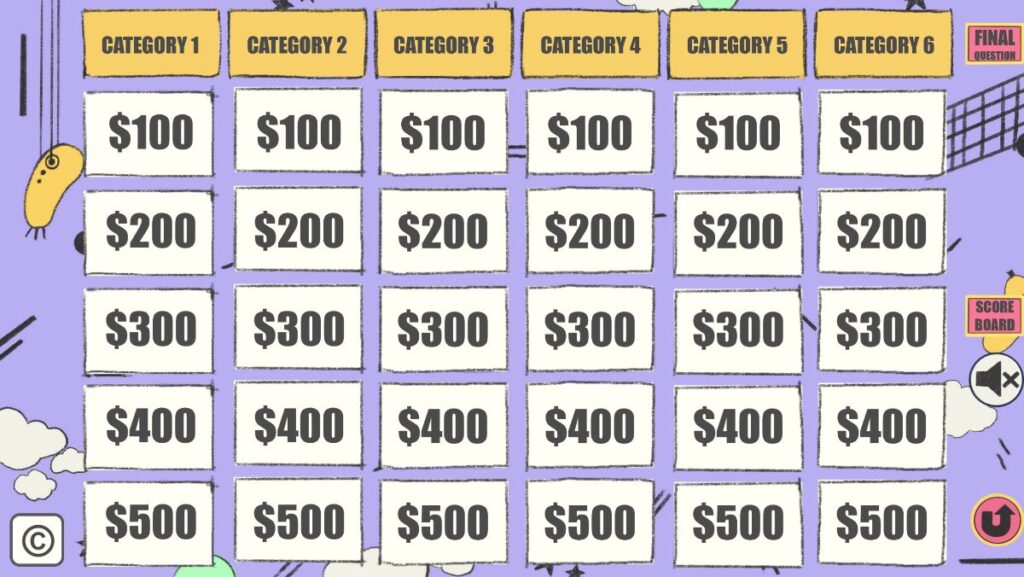
- Set Up the Board: Write categories at the top of the board and points below each.
- Divide Students: Form teams (2-4 students per team is good).
- Review Rules: Explain how to play, buzz in, and how points are awarded or deducted.
Get the game ready before starting. Put the board up with subjects and points. Make teams of students. Each team should have 2 to 4 students. Tell the students how to play. Explain how to buzz in and how points work.
How to Play the Game
To start playing Classroom Jeopardy, choose a team to go first. This team picks a subject and a point number from the board.
The host then reads the clue aloud to all teams. In traditional Jeopardy format, clues are presented as answers, and students must respond in the form of a question. For example, if the clue reads “The largest planet in our solar system,” the correct response would be “What is Jupiter?” However, many classroom versions simplify this rule, especially for younger students, and allow direct answers instead.
Once the clue is read, teams buzz in when they know the answer. The first team to buzz in gets to answer. It’s important that students wait until they are called on after buzzing in before they give their response. This prevents chaos and ensures fair play.
If their answer is correct, they earn the points shown on that square. If it’s wrong, they lose those points, and other teams get a chance to buzz in and answer the same question. Some teachers prefer to skip the penalty for wrong answers to keep the game more encouraging.
After a question is completed, the team that answered correctly chooses the next clue. If no team answered correctly, the original team selects again. Keep playing like this until all questions are answered or time runs out.
Understanding how to play Jeopardy in a classroom setting gives you flexibility to adapt the rules. You can adjust point values, time limits, or buzzer systems to fit your class size and available technology.
Rules of the Game
- Taking Turns: Teams take turns choosing a category and point value.
- Answering Questions: When a question is asked, the first team to buzz in gets to answer.
- Correct Answers: If correct, the team earns the points. If wrong, points are deducted, and other teams can buzz in.
- Final Jeopardy: End with a “Final Jeopardy” where teams wager points on a final question.
- Winning: The team with the most points at the end wins.
The rules are simple. Teams take turns choosing a subject and a point number. When you ask a question, the first team to buzz in can answer. If they’re right, they get points. If they’re wrong, they lose points. Other teams can try if the first team is wrong. The game ends with a “Final Jeopardy” question. The team with the most points at the end wins.
Extra Tips for Success
- Clarity: Use simple language for questions and answers to ensure understanding.
- Engagement: Encourage all team members to participate by rotating who chooses the category and who answers.
- Feedback: Provide correct answers and explanations for educational value.
- Variation: Adapt categories and questions to fit the lesson or subject area.
- Inclusivity: Ensure questions cater to various skill levels to keep all students engaged.
Make sure to use easy words for questions and answers. This helps everyone understand. Let different students pick subjects and answer questions so everyone plays. If someone answers wrong, tell them the right answer. This helps them learn. Change the game to make it work for your class. Some questions can be easy, and some can be hard. Make sure everyone feels happy and included.
Classroom Jeopardy is a great way to make learning fun. Follow these simple steps, and you’ll have a game that helps students review and enjoy their lessons.
If you are building the board yourself, follow this step-by-step guide on how to make your own Jeopardy game in PowerPoint.
Want more ideas? See our full list of the 20 best review games for the classroom.