
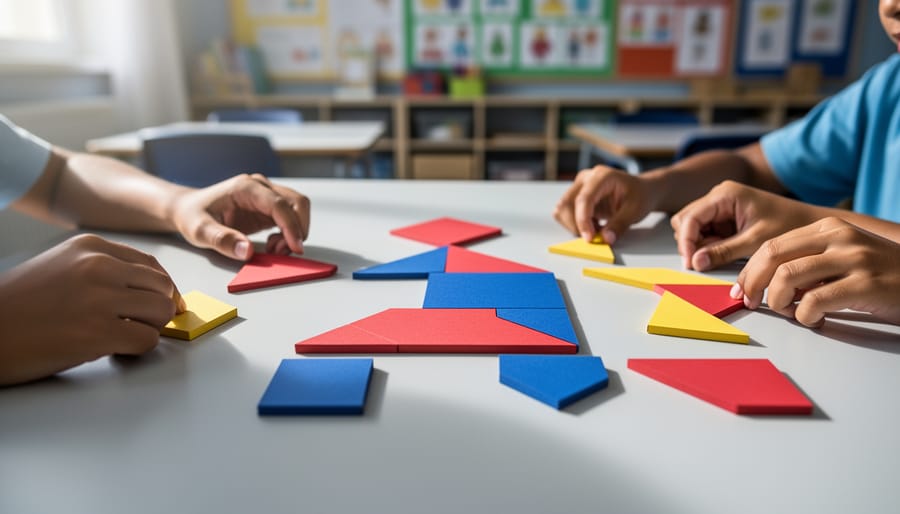
8 Tangram Challenges for Offline Classroom Fun and Problem-Solving
The best tangram challenges are the ones you can launch in five minutes with nothing but paper, scissors, and a little imagination. Think silhouette matching, silent builds, team relays, and review games where students earn their pieces by answering questions. Each one works for almost any grade, and each one bends easily to fit your subject, from geometry and fractions to vocabulary and storytelling.
Why do tangrams work so well in a classroom? Seven simple shapes turn into hundreds of puzzles, and kids get hooked on that “wait, I can almost see it” feeling. They’re low-prep, low-cost, and a great fit when you need some no-wifi game ideas in your back pocket.
Below, you’ll find eight challenges you can run right away, plus easy ways to customize each one for your students.
How We Picked These Tangram Challenges for Your Classroom
Choosing a tangram challenge should feel easy, so I curated this list with a busy teacher’s week in mind. Think of it as a set of ideas to try, not a lab report: I haven’t hands-on tested each one in a classroom, but every pick was chosen to be practical, flexible, and fun. If you already love offline review games these will fit right into your routine.
Here’s what each challenge had to deliver:
- Low prep: you can set it up in minutes, with printed or hand-cut tangram sets.
- Grade-flexible: easy to make simpler or trickier for any age.
- Team-friendly: built for pairs, small groups, or the whole class.
- Easy to customize: swap in your own subject, vocabulary, or math facts.
- Quick to explain: you can describe the rules in under a minute.
The research backs up the effort, too. Tangrams boost visuospatial skills so even a short challenge pays off.
Here’s what you’ll need to get started:
- Printed or hand-cut tangram sets (one per student or team)
- Paper and pencils for tracing silhouettes
- Scissors, if you’re cutting sets yourself
- Small baggies to keep pieces together
- A timer, plus optional prizes or a scoreboard
8 Tangram Challenges to Try Offline
1. Classic Silhouette Showdown, Match the Shape
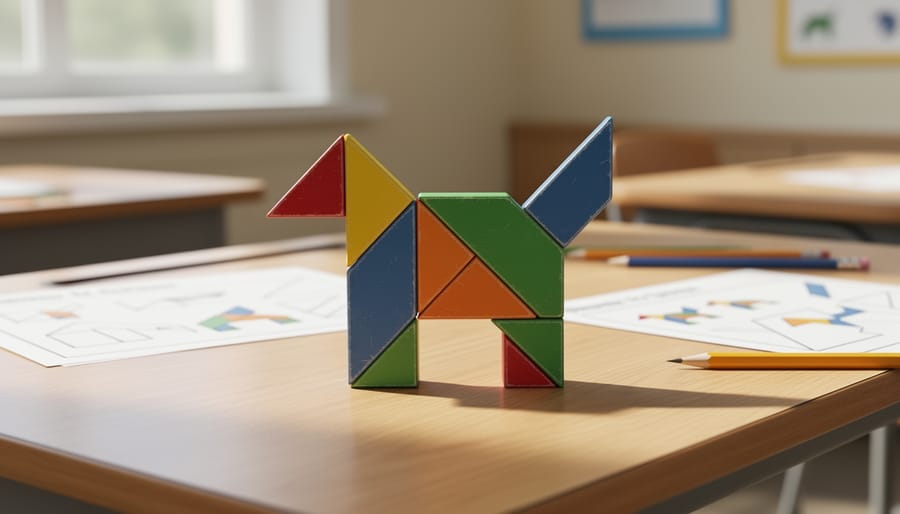
Hand each team a tangram set and a printed silhouette face down. When you say go, they flip the page and race to rebuild the shape using all seven pieces. The cat, the house, and the rocket are all good starters because their outlines are easy to recognize.
For timing, try a three-minute countdown for a quick warm-up, or skip the clock and award a point to the first team that finishes with every piece flat and touching. Either way, ask finishers to raise a hand quietly so nobody gets distracted.
To scale difficulty, start with outlined silhouettes where the interior lines show how the pieces fit. That’s perfect for younger students or first-timers. When they’re ready for more, switch to solid black shapes with no internal clues. Students have to rotate, flip, and test pieces themselves.
Customize it by theme: ocean animals for science, landmarks for social studies, or letters and numbers for early learners.
2. Team Relay Tangram, One Piece at a Time

Set up one workstation per team at the front of the room, each with a tangram set and a target silhouette taped nearby. Teams line up single file at their station. On “go,” the first student places one piece, tags the next teammate, and heads to the back of the line. The next student adds a piece, and so on until the puzzle is complete.
Keep the rules simple:
– Only one piece per turn
– Pieces must lie flat and inside the outline
– Students can move a teammate’s piece, but only on their own turn
For scoring, give 3 points for the first finished puzzle, 2 for second, and 1 for third. Add a bonus point for a perfect fit with no gaps.
Grade tip: Younger students do well with 3 to 4 piece puzzles, while older students can tackle all seven pieces.
Customization twist: Add a “pass” card that lets a team skip one tricky placement per round.
3. Silent Tangram Challenge, Build Without Talking

Here’s a challenge that doubles as a lesson in patience: no talking allowed. Give each small group a tangram set and a silhouette card, then announce that they must solve the puzzle using only gestures, nods, and facial expressions. Pointing at pieces is fine, and so is sliding a piece toward a teammate. Words, whispers, and sound effects are out.
Start with a short practice round so students get the feel of it. Then set a timer for five to eight minutes and let the silent teamwork begin. You’ll see some wonderful moments, like a student tapping the table to say “try that one again.”
Tip for noisy classes: choose a silent signal, like a raised hand or a flicked light switch, to pause the action. Quiet challenges often settle a lively room faster than any reminder will.
Grade-level twist: for younger students, use outlined silhouettes. For older ones, try solid shapes.
4. Jigsaw-Style Expert Groups, Split the Puzzle, Share the Solution
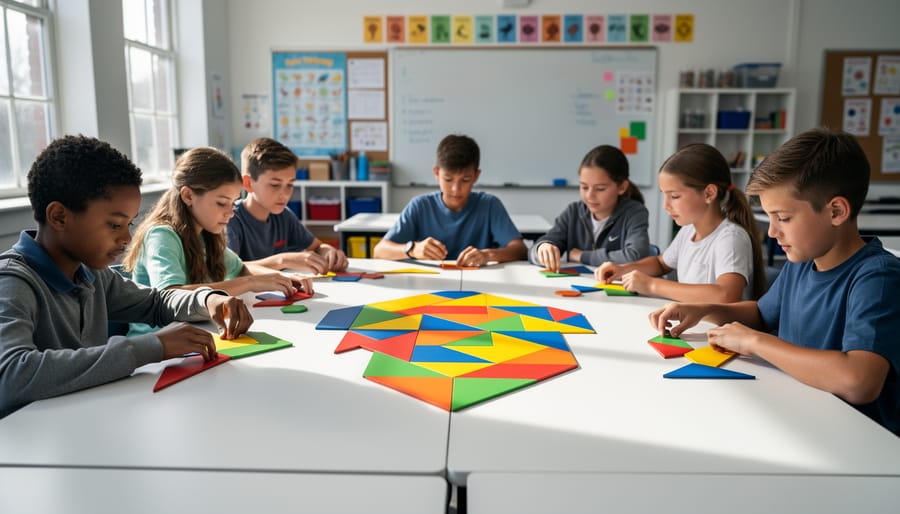
Here’s a twist that borrows from the classic jigsaw cooperative-learning method. Pick a larger tangram picture, like a bird in flight or a sailboat, and divide its silhouette into three or four sections. Give each group member one section to master.
Start with “expert” teams. Everyone with the same section meets up, studies it, and figures out which pieces and angles make it work. Give them a few minutes to practice and agree on the trickiest moves.
Then students return to their home groups. Each expert teaches their section to teammates, and together they fit the parts into the full design. Because every student holds a piece of the solution, nobody can sit back and coast.
Grade-level tip: younger students do well with two sections and a labeled outline. Older students can tackle four sections with no guide.
Customize it: choose a picture that connects to your unit, like a tangram animal for a habitat lesson or a landmark for social studies.
5. Review Question Tangram, Earn Your Pieces
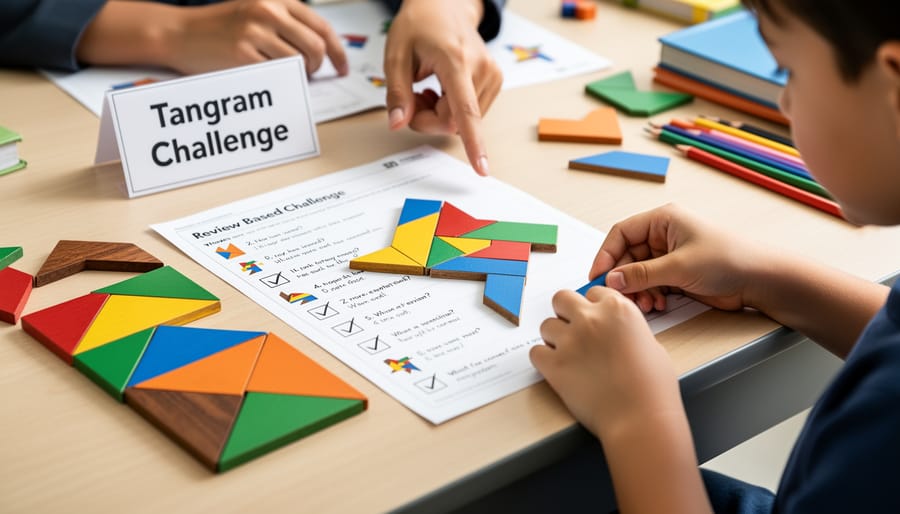
Here’s a challenge that turns review time into a game. Prep a stack of review cards for whatever you’re studying, and keep one set of tangram pieces per team in an envelope at the front of the room.
To play, teams send a runner up for each question. Answer correctly, and the team earns one tangram piece. Miss it, and they try again with a new question. Once a team collects all seven pieces, they build the mystery shape you’ve displayed on the board or hidden under a cover.
The best part is how easily you can customize it. Swap in multiplication facts for third graders, vocabulary words for an ELA unit, or cell parts for a science review. Mixing easy and tough questions lets every student contribute.
For extra fun, hand out pieces randomly rather than in order. Teams have to figure out the shape from whatever they’ve earned, which adds a nice layer of strategy.
6. Create-Your-Own Tangram Puzzle, Student Designers
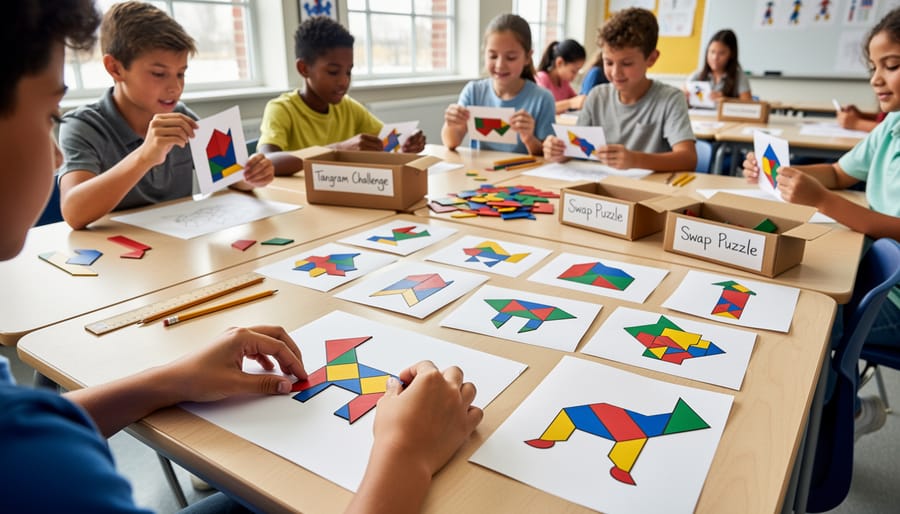
Here’s a challenge where your students become the puzzle makers. Give each child a set of tangram pieces and a blank sheet of paper, then let them arrange all seven pieces into a shape of their own invention. It can be an animal, a vehicle, a letter, or something totally abstract. Once they’re happy with the design, they carefully trace around the outside edge and remove the pieces, leaving a solid silhouette.
Now comes the fun part. Students swap silhouettes with a partner and race to solve each other’s puzzles. Remind them to keep the pieces touching so the shape stays solvable, and have designers keep a secret solution on the back of their paper.
For a class puzzle gallery, tape the best silhouettes to a bulletin board or hallway wall and invite visitors to solve them at lunch or during free time. Younger students can theme their shapes around a unit, like ocean animals or community helpers, while older students can add a short riddle clue.
7. Story Tangram Challenge, Build the Scene
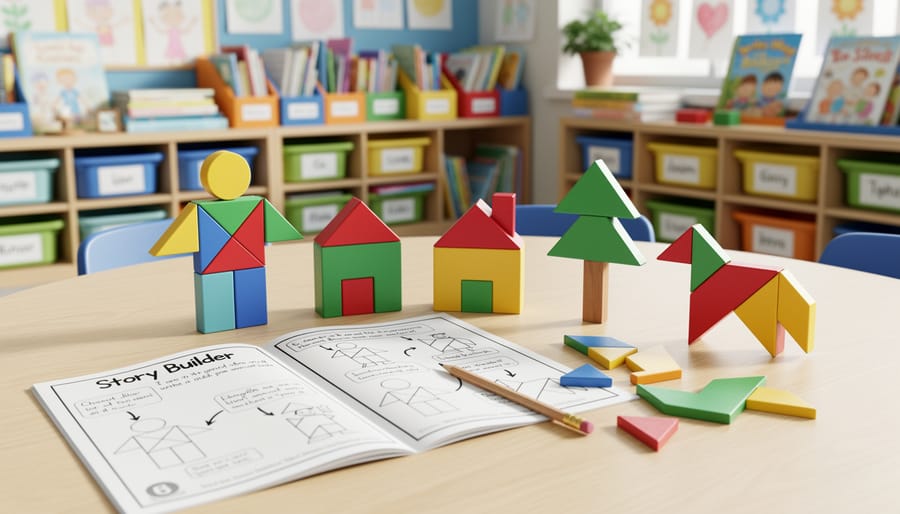
Pick a story your class already knows, or read a short one aloud. Then give each team a tangram set and a scene to build: a character, a setting, or a key moment from the plot. Students build their picture, then take turns telling that part of the story using their shapes as the visual.
For a bigger project, have teams build a sequence of scenes (beginning, middle, end) and line them up like a storyboard on their desks. Quick photos or sketches can be taped into a class book.
Grade tip: younger students can build one character from a picture book, while older students can illustrate a turning point in a historical event or a scene from a novel.
Customization twist: assign each team a different chapter, then have the whole class “read” the story by walking past each scene in order.
8. Mystery Piece Challenge, Solve It With Missing Pieces
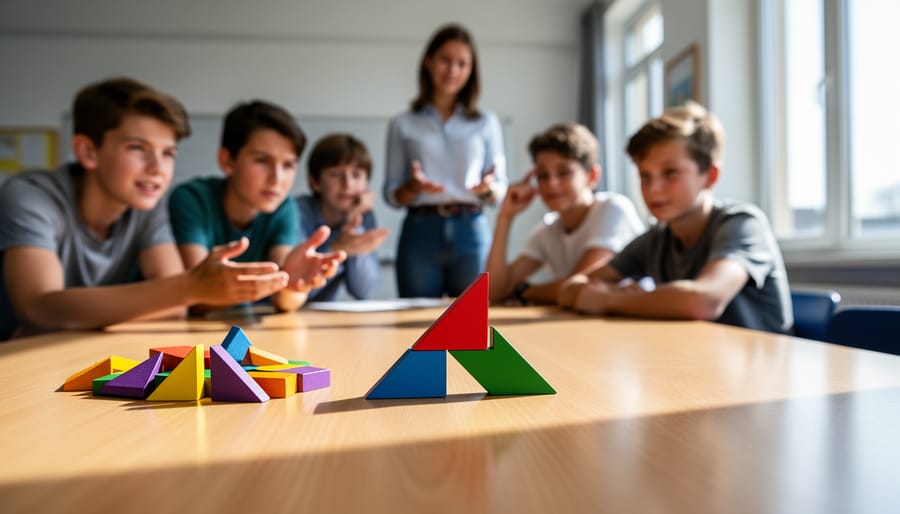
Here’s a twist that keeps fast finishers on their toes. Hand each team a silhouette puzzle, but quietly remove one or two pieces from their set before they start. The challenge is to build the shape as closely as they can with what’s left, or to figure out which pieces are missing and sketch what they would look like.
Start with one missing piece, like a small triangle, so teams can see how much the other shapes can stand in for each other. Then take away two for older students. Ask groups to explain their reasoning out loud: why does this piece fit here, and what would the missing one have done?
To customize, let teams “buy back” a missing piece by answering a review question correctly. Keep it playful and low-pressure, since there’s often more than one clever solution.
Tips for Running Tangram Challenges Smoothly
Running tangram challenges doesn’t take much, but a few small habits keep things calm and fun. Give each group a baggie with its seven pieces so nothing wanders off, and count them back in at the end. A simple visible timer helps too, since a five-minute countdown adds energy without pressure.
Mix up your teams every round so students work with different classmates, especially during the team relay or the jigsaw-style expert groups. For stuck groups, keep a few hint cards handy, like a photo of where the biggest triangle goes, so they can keep moving without feeling stuck. If you’re tying a challenge into some printable puzzle time you can run both stations side by side.
Remember, every challenge here can be tweaked for your students. Change the timer, swap the subject, or let kids choose their own twist. The goal is a low-pressure, giggle-friendly classroom.
Tangram Challenge FAQs
Quick answers to the questions teachers ask most. Every challenge above can be tweaked to fit your class.
What grade levels do tangrams work for?
Tangrams suit kindergarten through middle school, and many older students enjoy the tougher versions. Younger kids do well with outlined silhouettes, while older kids can tackle solid shapes or the Mystery Piece Challenge.
How do I make a set from scratch?
Cut a paper or cardstock square into seven pieces: two large triangles, one medium triangle, two small triangles, one square, and one parallelogram. Printing a template and cutting along the lines is the quickest route.
How long does a challenge take?
Most run 10 to 20 minutes, including setup and a quick explanation. Relay-style games like Team Relay Tangram can finish even faster.
How can I support students who need extra help?
Offer hint cards, outlined silhouettes with the piece lines showing, or a partner to work with. Letting them start with the Classic Silhouette Showdown at an easier level builds confidence.
For scorekeeping, a simple tally on the board works great. You can award a point per solved puzzle or per correct answer in Review Question Tangram, then add bonus points for teamwork.
Final Takeaway: Pick One Challenge and Start Playing
Tangrams might be the easiest way to get your class thinking, talking, and laughing together, and all it takes is paper, scissors, and a little imagination. You don’t need to try all eight ideas at once. Pick the one that fits your students best, run it this week, and tweak it as you go.
Whether you begin with a quick Classic Silhouette Showdown or a Review Question Tangram, your students will be problem-solving before they realize it. Happy puzzling!