
10 Whole Class Math Games Your Students Will Ask to Play Again
Whole class math games turn review time into the best part of the school day. Instead of handing out another worksheet, you put one game on the projector or one set of cards in play, and every student in the room is practicing math at the same time. Here are ten whole class math games that need almost no prep, plus tips to keep every kid involved.
What makes a whole class math game work?
- Everyone plays at once. Teams or the whole room, never one student at a time while 25 others watch.
- Low prep. If it takes longer to set up than to play, it will not happen twice.
- Every skill fits. The best formats let you swap in whatever you are teaching this week.
1. Math Game Show (the class favorite)
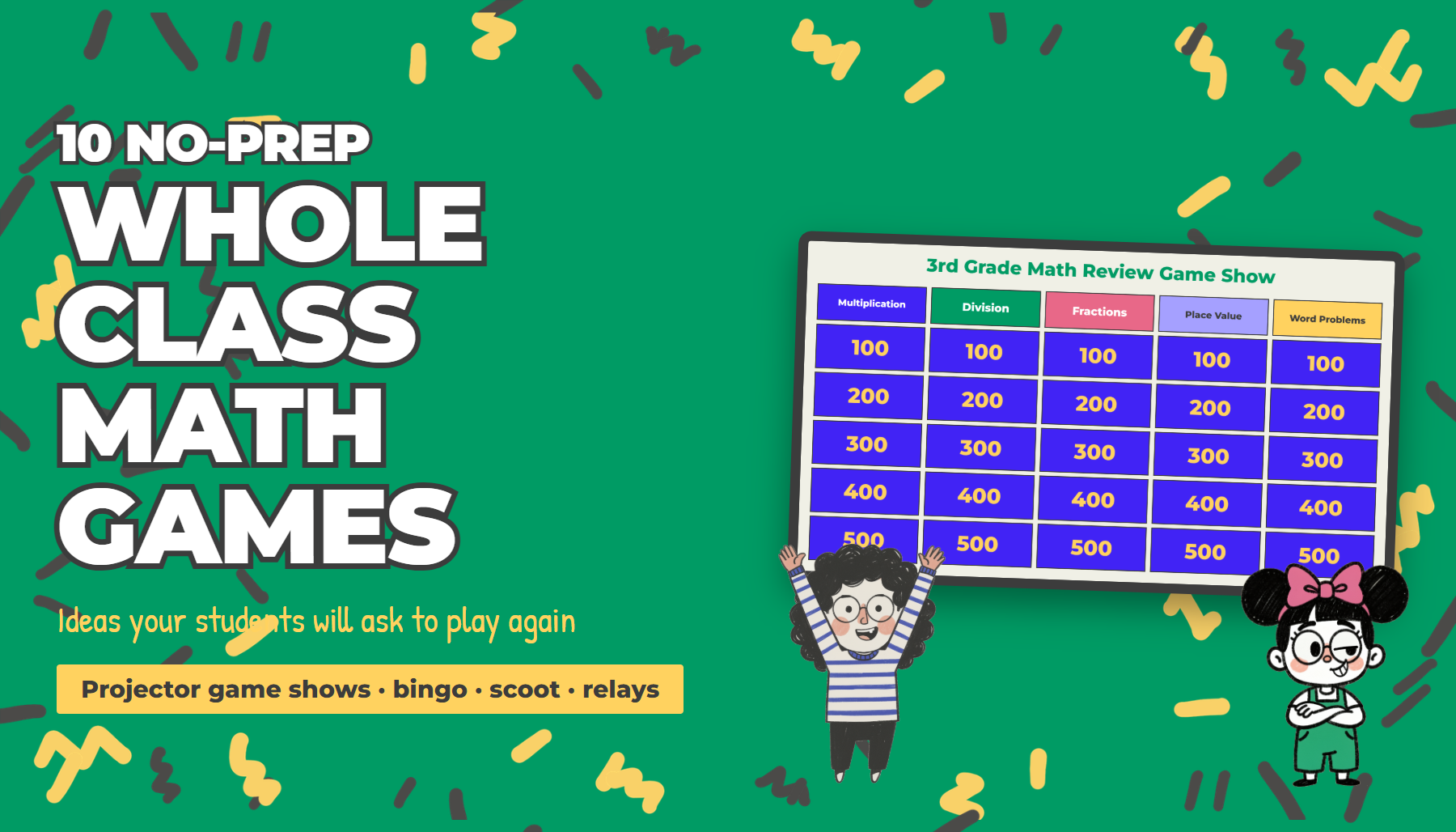
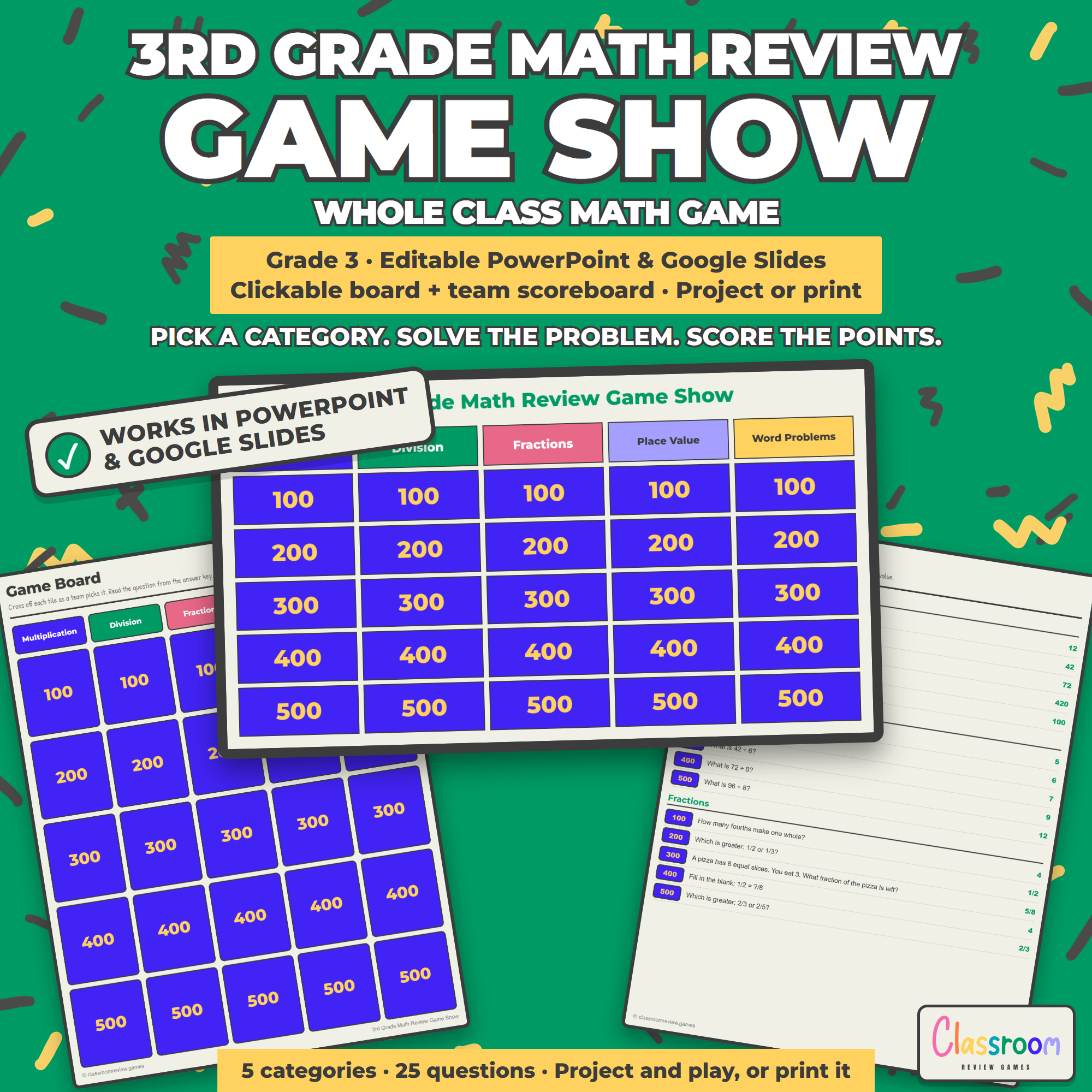
A jeopardy style board on the projector: teams pick a category and a point value, solve the problem, and score the points. It feels like a real game show, and because the questions live on editable slides, it works for any unit.
I built a ready-to-play version for 3rd grade: 3rd Grade Math Review Game Show. It has a clickable board with 25 editable questions across multiplication, division, fractions, place value, and word problems, plus a team scoreboard, in PowerPoint and Google Slides. There is also a printable board, answer key, and score sheets for a no-screen version.
2. Math Trashketball
Answer a question correctly, earn a shot at the trash can with a paper ball. One point for the right answer, bonus points for the basket. It gets the wiggles out and even reluctant mathematicians want a turn.
3. Math Bingo
Call out problems, students solve them and mark the answer on their board. Addition facts, multiplication facts, fractions, or vocabulary all work. Boards with different layouts keep everyone honest.
4. Around the World
One student stands behind a classmate’s desk. Show a fact card; whoever says the answer first moves on. The goal is to travel all the way around the room. Great for fact fluency in short bursts.
5. I Have, Who Has
Deal out a chain of cards. One student reads “I have 12. Who has 6 times 7?” and the student holding 42 answers next. The whole class has to listen to every card, and the chain either works or it does not.
6. Scoot
Put a task card on every desk. Students solve their card, then “scoot” one desk over on your signal. In one round, every student solves every problem, and moving keeps the energy up.
7. Math Relay Races
Teams line up, and each runner solves one step of a problem before tagging the next teammate. Perfect for multi-step problems: one student writes the equation, the next solves it, the next checks it.
8. Guess My Number
Pick a secret number. Students ask yes or no questions using math language: Is it even? Is it greater than 50? Is it a multiple of 3? Sneaky practice for place value, comparison, and number sense.
9. Last Team Standing
Every team starts standing. Show a problem, teams write their answer on a whiteboard, and any team that gets it wrong sits for one round. Rotate rounds fast so nobody sits long.
10. Exit Ticket Showdown
Turn the last five minutes into a lightning round. Two or three quick problems from today’s lesson, teams answer on whiteboards, and the day’s champion team gets bragging rights on the board tomorrow.
Tips for running whole class math games
- Random team picks keep everyone in. Draw name sticks so the fastest hand does not answer everything.
- Require whole-team answers. A team only scores if anyone on the team can explain the answer.
- Keep rounds short. Fifteen focused minutes beats a forty minute marathon.