
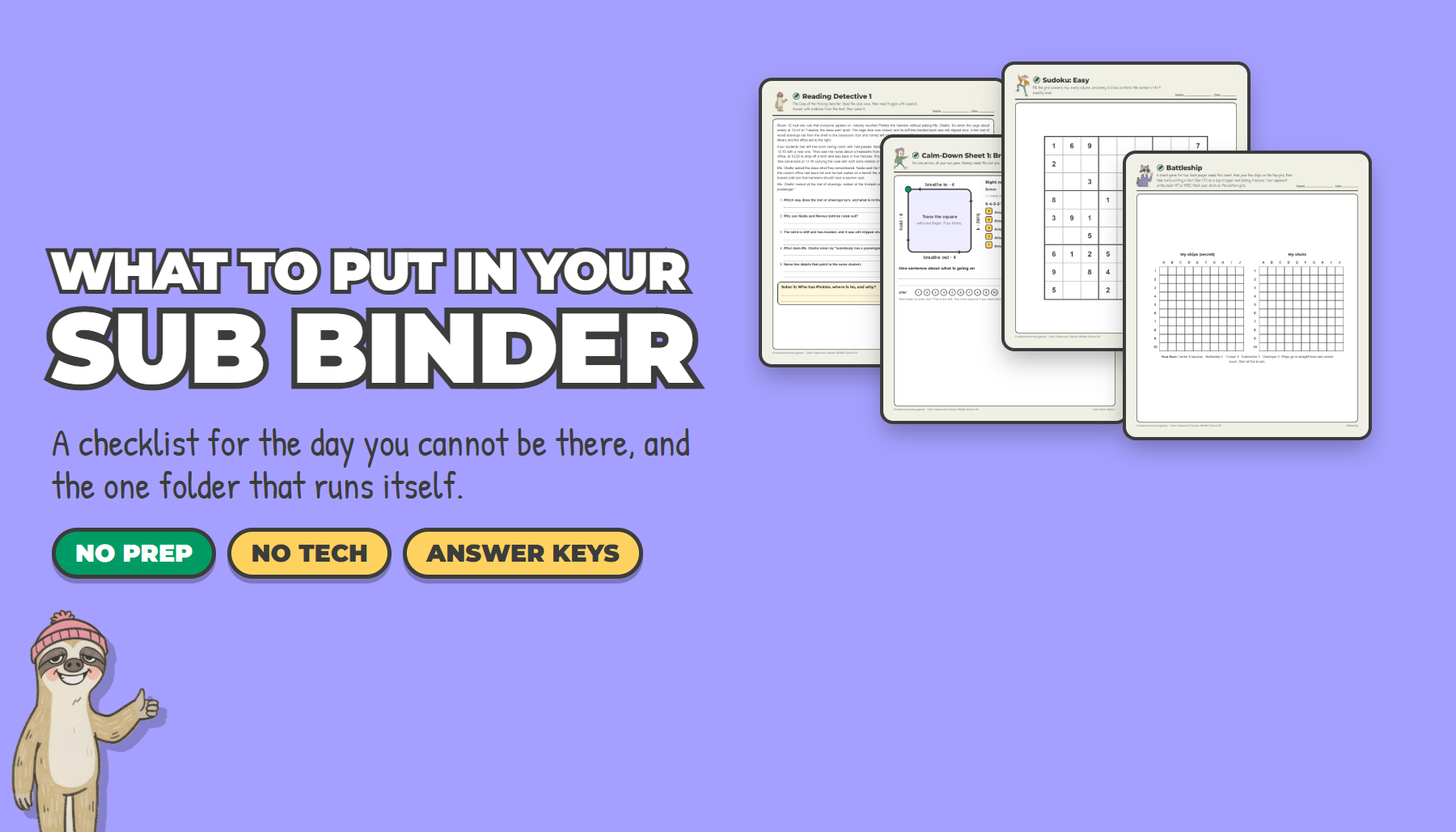
What to Put in a Sub Binder: The Checklist for the Day You Cannot Be There
Every teacher has had the 6 a.m. moment: the fever, the sick child, the car that will not start. You are not going in, and a stranger is about to run your room. What you leave behind decides whether that day is calm or chaos. This is what goes in my sub binder, the one I keep by my desk, and the part of it that runs itself.
What a sub binder is (and what it is not)
A sub binder is a printed folder a substitute can open cold and teach from for a full day. Some teachers call it a sub kit, a sub folder or a sub tub. Kept ready for a sudden absence, it is also your emergency sub binder. It is not your lesson plans. Lesson plans assume subject knowledge and your routines. A sub binder assumes neither. Everything in it should work for a stranger with no login, no projector, and no idea what page you were on. For the lesson plans themselves, use my sub plan template.
I build mine in two halves: the information a sub needs about the class, and the work students can do without me.
What to put in a sub binder, part one: the information pages
- A cover page. The words “Sub Binder,” your name and your room number in big letters, so the office and the teacher next door can find it in seconds.
- A note to the sub. Half a page. Where things are, how attendance works, who to call, and one sentence about the tone you want: “This class is chatty but kind. Quiet work is fine.”
- The schedule of the day. Times, periods, breaks, and which activity goes where. Subs do not know what “block 3” means.
- Seating charts. One per class. A sub who can use names has a much easier day.
- A class list with dismissal notes. Bus numbers, pickups, allergies, and the two students who are genuinely helpful.
- Emergency procedures. Fire, lockdown, medical. Copy the school page. Do not make a sub go looking for it.
- A “how it went” slip. One page the sub fills in at the end. You will want to know what happened, and subs appreciate being asked.
If you want these pages already laid out, my Middle School Sub Plans binder has a binder cover, a note to the sub, a schedule of the day, a class list and dismissal sheet and a “how it went” sheet ready to fill in, plus a lesson plan already filled in for its nine no-prep activities. There are versions for elementary, high school, and preschool too, and you will find all of my sub binders and sub plans in the Sub Plans and Emergency Activities category.
Part two: work that runs itself
This is where most sub folders fall apart. A worksheet that needs explaining is not sub work. A game that needs a projector is not sub work. What survives a sub day is quiet, self-contained, and self-checking. Here is the mix I aim for.
1. Quiet solo puzzles
Word searches, sudoku, secret codes, logic grids, mazes. Students know the rules already, so nothing has to be taught, and the room goes quiet in about a minute. Print more than you think you need. Early finishers eat through these.
2. A calm-down sheet or two
Sub days are wobbly days. Some students act up, some shut down. A calm-down sheet (box breathing, 5-4-3-2-1 grounding, a brain dump) gives one student a way out of a spiral without the sub having to manage it. Keep three or four printed in the front pocket and tell the sub they are there.
3. Whisper partner games
Battleship on paper, dots and boxes, connect four in a grid. Two students, two pencils, no talking. These are the ones students remember, and the noise level stays low because silence is part of the game.
4. One or two review tasks with a key
A reading passage with questions, a page of math word problems, a short science or writing task. Not new content, just practice a sub can hand out and, this is the important part, check against a key. Better still, hand the key to students when they finish so they check their own work.
5. Whole-class calm games on a card
For the last ten minutes, or when the room needs a reset: silent ball, silent line-up, count to twenty as a class. Write the rules on one card so the sub does not have to invent anything.
How to organize a sub binder
A sub reads the binder from the front, usually in a hurry. Put the pages in the order they will be needed:
- Cover page
- Note to the sub and today’s plan
- Schedule and seating charts
- Class list with dismissal and medical notes
- Emergency procedures
- The activities, in the order the day runs, with the answer keys in the back pocket
- The “how it went” slip
A binder with a front and a back pocket works best: calm-down sheets and early finisher puzzles go in the pocket where the sub sees them first. Pages that never change can go in sheet protectors. Check it after every sub day and at the start of each semester. For the day’s lesson pages, my sub plan template shows what to write.
The folder that runs itself
I got tired of rebuilding part two every time, so I made it once. My Calm Classroom Games and Activities Kit is 43 pages for grades 6 to 8: 20 quiet games and 4 review activities, every puzzle checked by computer, five answer-key pages, color and ink-saver black and white, US Letter and A4. It is built so a sub can hand out any page cold. Nothing needs subject knowledge and nothing needs a screen.
Inside: word searches, sudoku, secret codes, word ladders, letter mix, logic grids, mazes, categories, zen patterns, two calm-down sheets, six whisper partner games, four whole-class calm games on teacher cards, and quiet review pages for reading, math, science and engineering, and writing.
If you teach younger students, the Quiet Classroom Games Kit does the same job for grades 2 to 5, and the Conflict Resolution Scenario Games are a good add for a class that needs to talk something through.
The sub binder checklist
- Cover page with your name and room
- Note to the sub, half a page
- Schedule of the day with the activity for each slot
- Seating charts for every class
- Class list with dismissal and medical notes
- Emergency procedures
- Quiet solo puzzles, more than one class set
- Three or four calm-down sheets in the front pocket
- Two or three whisper partner games
- One or two review tasks with their answer keys
- A card of whole-class calm games
- A “how it went” slip
Sub binder questions
What is the difference between a sub binder and sub plans?
The sub binder holds what rarely changes: the cover, the note, the schedule, seating charts, class lists, emergency procedures and a set of work that fits any day. Sub plans are the lessons for one particular day. Many teachers keep both in the same binder, with the day’s plan right after the note.
Where should I keep my sub binder?
In the same place every time, somewhere a stranger can find it: on top of the desk, in a labeled tray, or in the top drawer. Tell the office and the teacher next door where it is, so it can be found even when you cannot be reached.
Build it once in September, top up the puzzle pages after each sub day, and the 6 a.m. moment becomes a five-minute email instead of a scramble. And if you are the one covering the class, the other half of this story is the sub bag you never arrive without, plus my substitute teacher tips for the day itself.