
Sub Plan Template: What to Include, a Filled-In Example, and Emergency Sub Plans
A good sub plan template is the page you fill in on a calm afternoon so that a sick morning does not turn into a panic. Write it once, keep it in the same place, and any substitute teacher can walk into your room and run the day.
Below you will find the eight parts every sub plan needs, a template you can copy into a document, a filled-in example for one class, what to leave on your desk, and how to keep a set of emergency sub plans ready for the mornings when you cannot plan anything at all.
The short version
- Write for a stranger. Your sub may not know your school, your subject or a single student’s name.
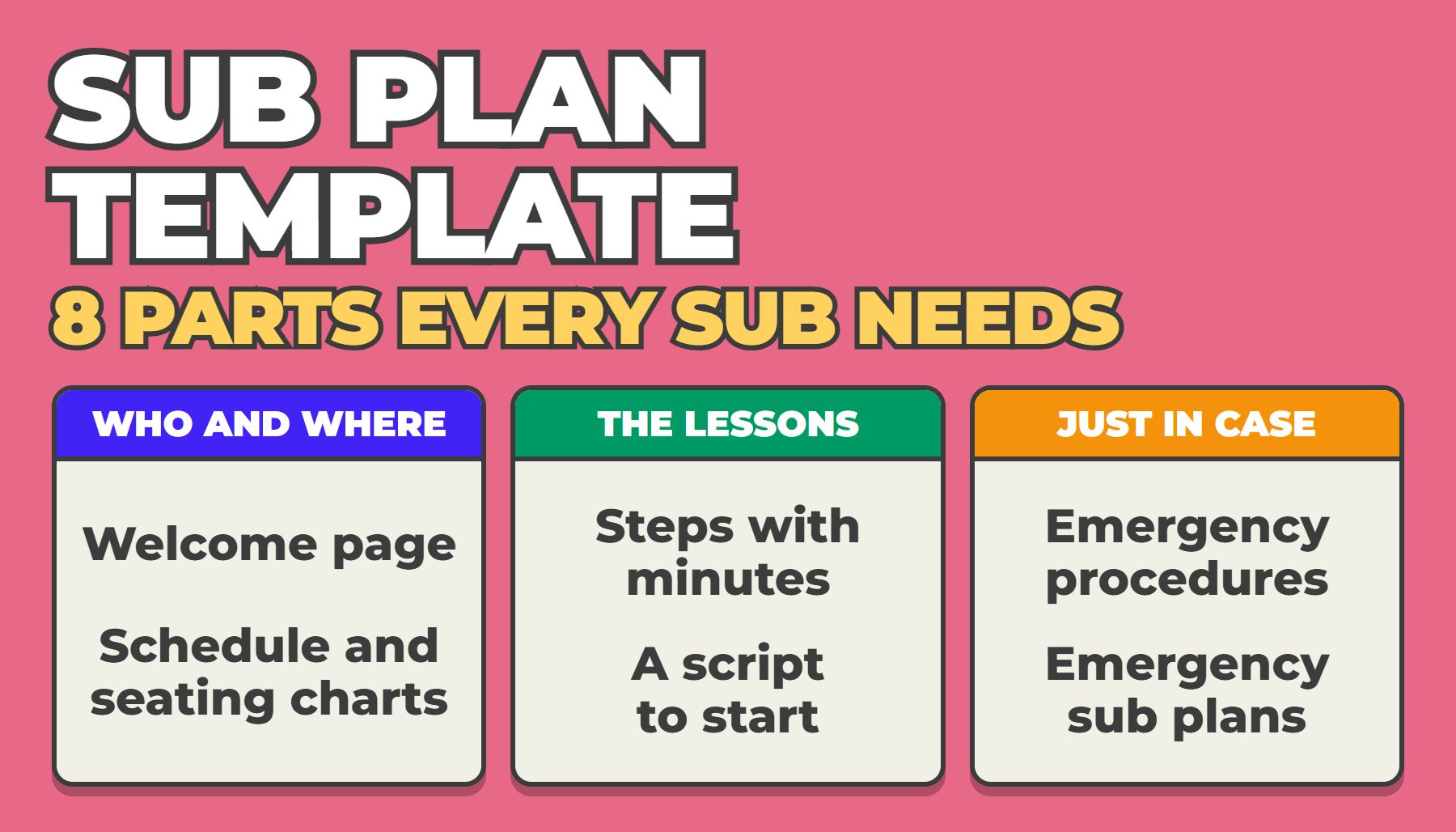
- Keep the parts that never change on their own pages: welcome page, schedule, seating charts, routines, emergency procedures.
- Write each lesson as numbered steps with minutes, the exact words to start it, and where the materials are.
- Review, do not introduce. Practice of what students already know goes much better than a new topic.
- Keep emergency sub plans printed and ready, separate from your regular plans, for the days you cannot write anything.
The eight parts of a good sub plan
Every school runs a little differently, but the sub plans that substitutes thank you for all answer the same questions. Here they are in the order a sub needs them.
1. A welcome page
Your name, your grade or subject, the room number and the date. Then who to ask for help: the teacher next door, a team lead and the front office extension. Add where to find the key, the bathroom pass and anything the sub will need in the first ten minutes. One page is enough.
2. The schedule
Bell times for every period or block, lunch, recess and specials, plus any duty you were supposed to cover. Mark the students who leave for services and when they go and come back. If today runs on a special schedule, such as an assembly or an early release, say so at the very top.
3. Class lists and seating charts
One seating chart per class. A sub who can call students by name has far fewer problems than one who points and says “you”. Add how attendance works at your school: a paper sheet, an online system, or a list sent to the office.
4. Student notes
Allergies, medical plans and where medication is kept. Students who use a break card, need extra time or sit in a certain place for a reason. Two or three reliable helpers per class. Keep these notes short and factual, and keep private details in a folder rather than on top of the desk where anyone can read them.
5. Routines
How class starts, the bathroom rule, phones and devices, what early finishers do, and how class ends. If you use an attention signal, describe it. Students will tell a sub “we never do that”, and a written routine settles it.
6. The lesson plan for each class
One block per period or subject: what students are practicing in one sentence, the materials and exactly where they are, numbered steps with minutes, what to collect and where to put it, and what to do with ten spare minutes.
7. Emergency procedures
Fire, lockdown and shelter: where to go, which exit, and where the emergency folder and class list are kept. Most schools have a standard sheet. Put a copy right behind the welcome page.
8. The end of the day
Where to leave collected work, a short note form for the sub (who was absent, who helped, what was finished, anything that went wrong), and how to leave the room: lights, windows, door, and the key back to the office.
The sub plan template
Copy this into a Google Doc or a Word document. Fill in the first part once and keep it. For each absence you only update the date and the lesson blocks.
SUB PLANS
Teacher: ________ Room: ____ Grade or subject: ________ Date: ________
If you need help: teacher next door ________ (room ____), team lead ________, office extension ____
Where things are: key ________, bathroom pass ________, emergency folder ________, extra pencils and paper ________
Today’s schedule:
Time ______ Class or subject ______ Students out or in ______
Time ______ Class or subject ______ Students out or in ______
Time ______ Class or subject ______ Students out or in ______
Lunch ______ Recess or duty ______ Dismissal ______
Routines: start of class ________, bathroom ________, phones ________, early finishers ________, attention signal ________
Student notes (see the folder for details): medical ________, helpers ________, please know ________
Lesson block (one per class):
Class and time: ________
Students are practicing: ________
Materials and where they are: ________
Steps with minutes: 1. ____ 2. ____ 3. ____ 4. ____
Say this to start: “________”
Collect and leave: ________
If there is time left: ________
If something goes wrong: ________
End of the day: leave work ________, fill in the note form, lights and windows, return the key to ________
Thank you! Please leave a note on how the day went.
A filled-in example
This is what one lesson block looks like when it is written for a sub. The class and the lesson are made up, but the format is the one I recommend: short lines, numbers, minutes, and nothing the sub has to guess.
Period 3, 7th grade ELA, 10:15 to 11:05
Students are practicing: finding the main idea of a short article and two details that support it.
Materials: the reading passage stack in the blue tray on my desk (32 copies), answer key in the folder underneath, word search for early finishers in the green folder.
Steps:
- 5 min. Stand at the door. Students take the warm-up from the front table and start in silence. Take attendance with the seating chart.
- 5 min. Read the script below out loud, then hand out the passage.
- 20 min. Students read and answer questions 1 to 4 on their own.
- 10 min. Partners compare answers and agree on one main idea sentence.
- 5 min. Collect everything, warm-up on top, into the “Period 3” folder on my desk.
- 5 min spare. Word search from the green folder.
Say this to start: “Today you will read a short article and find its main idea. Work on your own first. In twenty minutes you will check with a partner.”
Helpers: the two students starred on the seating chart can hand out and collect papers.
If something goes wrong: if the copies are missing, use the reading set in the red emergency binder in my left desk drawer.
How to write sub plans a substitute can actually follow
- Write for someone who has never been in your room. “Do the usual warm-up” means nothing to a sub. Say which sheet, where it is, and how long it takes.
- Number the steps and give minutes. A sub can glance at “step 4, 10 minutes” in the middle of a lesson. A paragraph is hard to follow while thirty students are watching.
- Give the exact words to start each activity. Two or three sentences the sub can read out loud. They get the sub through the most nervous minutes of the lesson.
- Stack the materials in the order they are used, labeled by class or period.
- Plan for no technology. The sub may have no login, and the projector may not work. If the lesson needs a screen, leave a paper version too.
- Choose review, not new content. A new topic taught by a sub usually has to be taught again. Practice of what students already learned is a better use of the day.
- Leave the answer keys. A sub who can check work on the spot keeps students working.
- Leave more work than time. Ten spare minutes with nothing planned are the minutes when things go wrong.
- Mix individual and partner work. A whole period of silent worksheets is hard for any class. One partner or team task in the middle helps everyone.
Emergency sub plans: the version you write once
Your regular sub plan template covers absences you know about: a conference, an appointment, a training day. Emergency sub plans cover the morning you wake up with a fever and cannot write anything. They are different in three ways.
- They are not tied to your current unit. Choose review and skill practice that fit any week of the school year.
- They are printed and waiting. Copies made, in a labeled binder or sub tub, and the office knows where it is.
- They cover more than one day. An illness often lasts more than one day. Plan at least one full day, and ideally three.
Good emergency activities need nothing but paper: review activities, a reading with questions, writing prompts, logic puzzles, partner tasks and a review game. Leave out anything that needs a video, a lab, a login or a lesson that has to be taught first. Check the binder twice a year, because class lists, schedules and phone extensions change.
What to leave on your desk
- The sub plan, on top of everything else
- Seating charts and class lists for every class
- Materials stacked in the order they are used, labeled by class
- Emergency procedures and the evacuation map
- A note form for the sub to fill in at the end of the day
- A note saying where the emergency binder is, in case today’s plan falls apart
I go through the full list, including the information pages that live in a sub binder, in What Is in Your Sub Kit?
Common sub plan mistakes
- Plans that only make sense to you. Ask yourself if a stranger could run the lesson from the page alone.
- A video or online lesson with no backup. If the sub cannot log in, the lesson is gone.
- Too little work. Students who finish in twenty minutes have thirty minutes to fill on their own.
- A forgotten schedule change. An assembly or a duty you did not mention leaves the sub in the wrong place.
- Plans that only exist on your laptop. Keep a printed copy in the room, or a shared document the office can open and print.
Ready-made sub plans if you would rather not write them
Writing a full set of emergency sub plans takes hours, which is exactly why I make them. In my Sub Plans and Emergency Activities category you will find plans that follow the format above. Most come with a plan already filled in on page 4 and answer keys, and the emergency binders and long term kits add a script the sub reads out loud for each activity.
- Emergency sub binders: one full no-prep day with nine activities, each with a script for the sub. There are binders for elementary, grades 2 to 5, middle school, high school and preschool, plus subject binders such as middle school math and high school English.
- Week long sub plans: five days for every grade from kindergarten to 5th grade, and for middle and high school subjects. I explain how I plan a full week in Week Long Sub Plans.
- Longer absences: two-week plans, four-week long term sub plans and six-week maternity leave plans.
- Calm classroom games for middle school and high school, for the moments the room needs to settle.
Every product has a Preview button, so you can see the real pages before you buy.
Questions teachers ask about sub plans
How detailed should sub plans be?
Detailed enough that someone who has never met your class can run the day without asking anyone. In practice that means numbered steps with minutes, where every material is, a short script to start each activity, and the answer keys.
How many days of emergency sub plans should I have?
At least one full day, ideally three. A sudden illness often lasts longer than a day, and the second morning is no easier to plan than the first.
Should my sub plan template be a Google Doc or on paper?
Both. Keep the template as a document so it is quick to update, and keep a printed copy in the room. Many subs have no login to your school’s systems.
Is a sub binder the same as sub plans?
Not quite. The sub binder holds the information that rarely changes: the welcome page, schedule, seating charts, routines and emergency procedures. The sub plans are the lessons for the day. Many teachers keep both in one binder.
What if I will be out for longer than a week?
Then the sub needs a plan for every day, a clear order of topics, and a way to keep work organized until you are back. My sub plans category has two-week, four-week and six-week kits that are planned day by day.
Fill in the template once, put your emergency plans in a binder, and the next sick day will be a quiet one. And if you are the substitute reading this, my substitute teacher tips are written for you.