
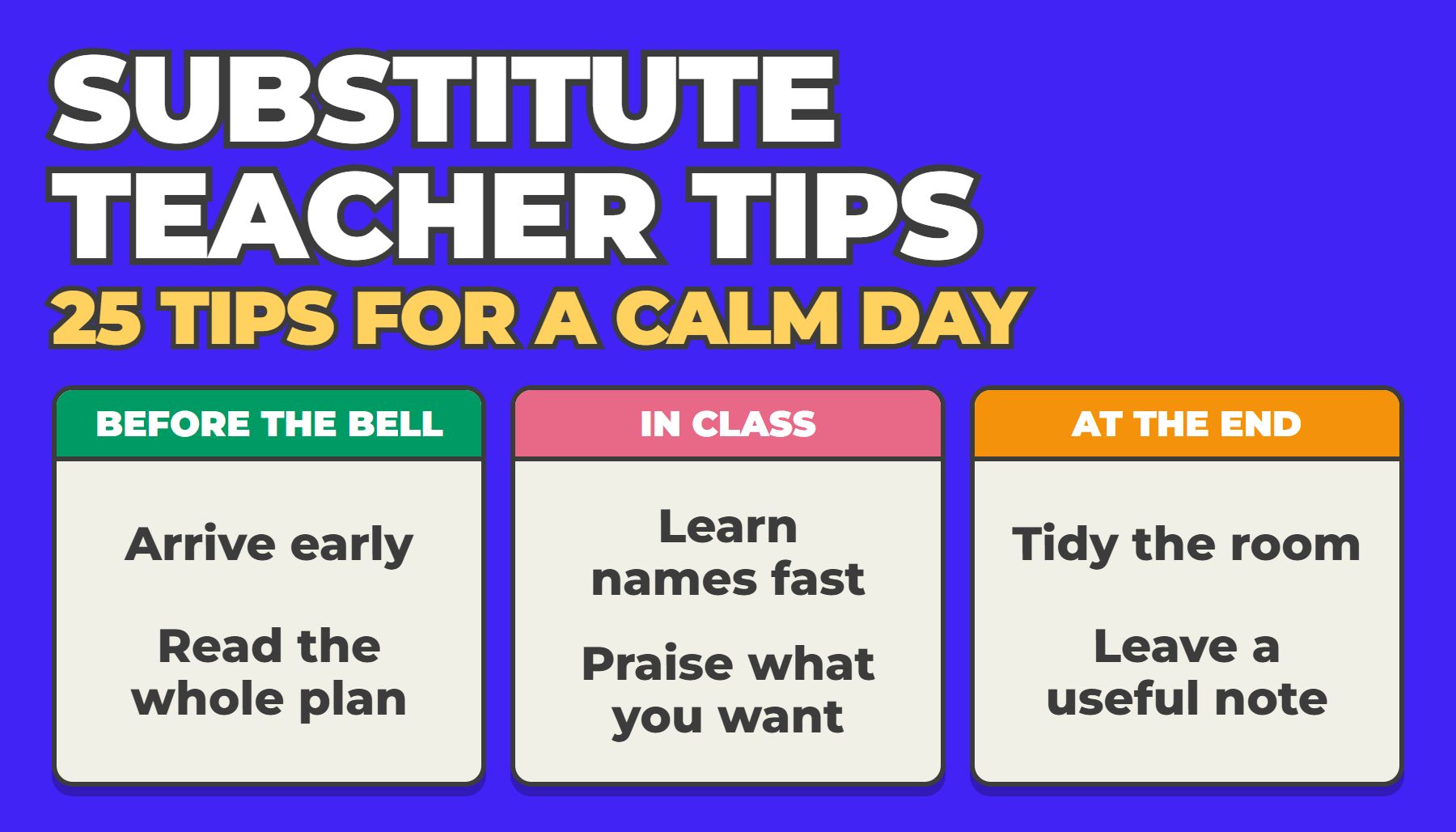
Substitute Teacher Tips: 25 Classroom Management Tips for a Calm Day in Any Grade
These substitute teacher tips are about the part of the job nobody can plan for you: walking into a room full of students you have never met and keeping the day calm. They work in any grade, and most of them cost nothing but a few minutes of attention.
I am a teacher, and I design the sub plans in my shop, so I think a lot about what the classroom teacher hopes will happen while they are away. The short answer: the students work, nobody gets hurt, and there is a note on the desk that says how it went. Here is how to get there.
The short version
- Arrive early and read the whole plan before the first student walks in.
- Greet students at the door and have a task waiting on their desks.
- Learn names fast with the seating chart. Names do more for behavior than any rule.
- Stay calm, quiet and specific. Correct privately and praise the behavior you want to see.
- Carry a no-prep backup for the day the plans are missing, and leave a short, useful note at the end.
Before the bell
1. Arrive early
Twenty to thirty minutes is ideal. You need time to find the room, read the plans, find the materials and walk the route to the nearest exit. A sub who arrives with the students starts the day already behind.
2. Read the whole plan before you start
Read it once from start to finish, then look at the schedule again. Check for anything unusual: an assembly, a duty, a student who leaves early, a class that goes to another room. Find every material the plan mentions now, not in the middle of the lesson.
3. Find the emergency information and the nearest help
Locate the emergency procedures, the class lists and the evacuation route. Introduce yourself to the teacher next door. Write down the office extension. If something goes wrong later, you will know exactly who to call.
4. Write your name and the plan on the board
Your name, the date and a short list of what the class will do today. Students settle faster when they can see the day has a shape. It also answers the first five questions before anyone asks them.
The first five minutes
5. Greet students at the door
Stand at the door, say hello, and point to the first task. It shows from the first minute that you are in charge of the room, and it gives you a quick look at every student before class begins.
6. Have a task waiting
Something students can start without instructions: the warm-up from the plan, a short puzzle, or a question on the board. A class that starts working in the first minute is much easier to keep working.
7. Introduce yourself in under a minute
Your name, what today looks like, and two or three expectations. For example: “I’m Ms. Rivera. Today you’ll finish the reading from yesterday and play a short review game at the end. I need you in your own seats, working, and asking me when you’re stuck.” Then start. Long speeches about rules invite students to test them.
8. Use names from the start
Take attendance with the seating chart and use it all day. “Jordan, eyes on your page, please” works far better than “hey, you in the back”. If there is no seating chart, ask students to make a name tent from folded paper as their first task.
9. Keep the teacher’s routines
Use the attention signal, bathroom rule and end-of-class routine the teacher left. Students do best with what they know. When a student says “we’re allowed to”, check the plan or the teacher next door rather than arguing.
Keeping the class on track
10. Give instructions in three steps, then write them down
Short and in order: “Read pages 4 and 5. Answer questions 1 to 6. Put your sheet in the tray when you finish.” Write the three steps on the board so nobody has to ask again.
11. Speak calmly, and a little more quietly than you want to
A raised voice tells students the room is getting away from you. A calm, steady voice makes them lean in. If the room is loud, wait for quiet rather than talking over it.
12. Walk the room
Move between the desks while students work. You see who is stuck, who is off task and who has finished, and most problems never start when an adult is standing nearby.
13. Try a look or a step before words
A look, a step toward a chatty pair or a quiet tap on a desk solves most small problems without stopping the class. Save words for when that does not work.
14. Praise the behavior you want, specifically
“Table 3 is already on question 2, thank you” works better than “good job, everyone”. Specific praise tells the rest of the class exactly what you are looking for.
15. Correct privately
Go to the student and speak quietly. A correction in front of the whole class gives the student an audience, and with an audience it can easily turn into a contest. A private word lets them change course without losing face.
16. Pick two helpers
Check the plan for named helpers, or ask the class who usually hands out papers. Helpers save you time and often know where things are. Choosing a student who seems restless can work well too.
17. Only say what you will follow through on
If you say a name goes on the note to the teacher, it goes on the note. Empty warnings teach a class that your words do not count. A small consequence you keep is better than a big one you do not.
18. Do not take it personally
Students test new adults. That is normal and it is not about you. Stay friendly and stay consistent. Most classes settle once they see that you are.
19. Never leave the class alone, and know when to call for help
Do not step out, even for a minute, and avoid being alone with one student behind a closed door. Never step between students who are fighting. If a student is unsafe, a fight starts or a student will not follow instructions after a private word, call the office or the teacher next door. That is what they are there for, and the classroom teacher would rather you called.
What changes from elementary to high school
20. Elementary: keep routines and keep them moving
Young children rely on routine, so follow the teacher’s schedule closely. Plan short tasks, build in a stretch or a movement break between them, and keep an eye on the clock for recess, lunch and dismissal. Know who goes home by bus, car or after-school care before the last bell.
21. Middle school: hold the seating chart
Middle schoolers will try to swap seats and names. Take attendance by the chart, keep students in their seats, and break work into short pieces. Partner work helps, as long as you choose the partners.
22. High school: explain the why and treat them as young adults
Older students respond to respect and to reasons. Tell them what the work is for and that the teacher will see it. Follow the school’s phone policy as written, calmly and the same way for everyone, rather than inventing your own.
When there are no plans
23. Carry a no-prep backup in your bag
Sooner or later you will arrive and find no plans. Ask the office and the teacher next door for the emergency sub folder first, because many teachers keep one. If there is nothing, you need work that fits any class: a review game on what students learned this week, logic puzzles, a writing prompt, a reading with questions, or a calm partner game.
That is the kind of material I put in my Sub Plans and Emergency Activities category. The middle school and high school emergency sub binders work in any subject, with nine one-period activities and a script to read out loud for each. The calm classroom games for middle school and high school are quiet puzzles and partner games that run from the printout alone. For more ideas on what belongs in your bag, see What to Bring as a Substitute Teacher.
At the end of the day
24. Leave the room the way you found it
Ask students to tidy up in the last five minutes. Desks straight, floor clear, materials back where they came from, and collected work stacked by class.
25. Write a short, useful note
The teacher reads this note first. Include who was absent, what each class finished and what they did not, who was helpful by name, and any problems described in plain facts. Add your name and how to reach you. A clear note is the single best way to be asked back.
How to get asked back
Teachers ask for the sub who followed the plan, kept the students working, left the room tidy and wrote a note they could act on. Being strict or being fun matters much less than being reliable. If you want more days at one school, tell the office you enjoyed it and leave your contact details with the note.
If you are just starting out, my guide on how to become a substitute teacher covers the requirements and the application process.
For classroom teachers: make the sub’s day easy
Most of these tips work better when the plan helps. A plan with numbered steps, minutes, a short script to start each activity and the answer keys gives any sub a calm day. My sub plan template shows how to write one, and the sub plans category has ready-made emergency binders, week long kits and long term plans from preschool to high school.
Questions substitutes ask
What should a substitute teacher do first thing in the morning?
Arrive early, read the whole plan, find the emergency information and the teacher next door, write your name and the plan on the board, and greet students at the door with a task ready. Then follow the plan as closely as you can.
How do I handle a class that will not listen?
Stop talking and wait for quiet instead of raising your voice. Give one short instruction and write it on the board. Move toward the loudest part of the room, use names, and speak to individual students privately. If a student will not cooperate after that, call the office.
What do I do if there are no sub plans?
Ask the office and the teacher next door for the emergency folder. If there is none, use your own backup: a review game, puzzles, a writing prompt or a reading with questions. In your note to the teacher, say there were no plans and what you did instead.
What should I write in the note for the teacher?
Everything from tip 25, on one page: absences, what each class finished, helpful students and any problems in plain facts.