The TpT AI Ban: What We Know, What Is Still Unclear, and What I Think About It
In October, Teachers Pay Teachers told its sellers that it wants to become an AI-free marketplace. Resources made by artificial intelligence are to be banned and removed. The announcement came at the same Town Hall as the new Exclusive Seller membership, and for many teachers it was the bigger surprise of the two.
A month later, sellers are still waiting for the actual rule. This article sorts out what TpT has confirmed, what sellers were told, what nobody knows yet, and what it means for you whether you buy or sell. At the end I say what I think about it.
The short version
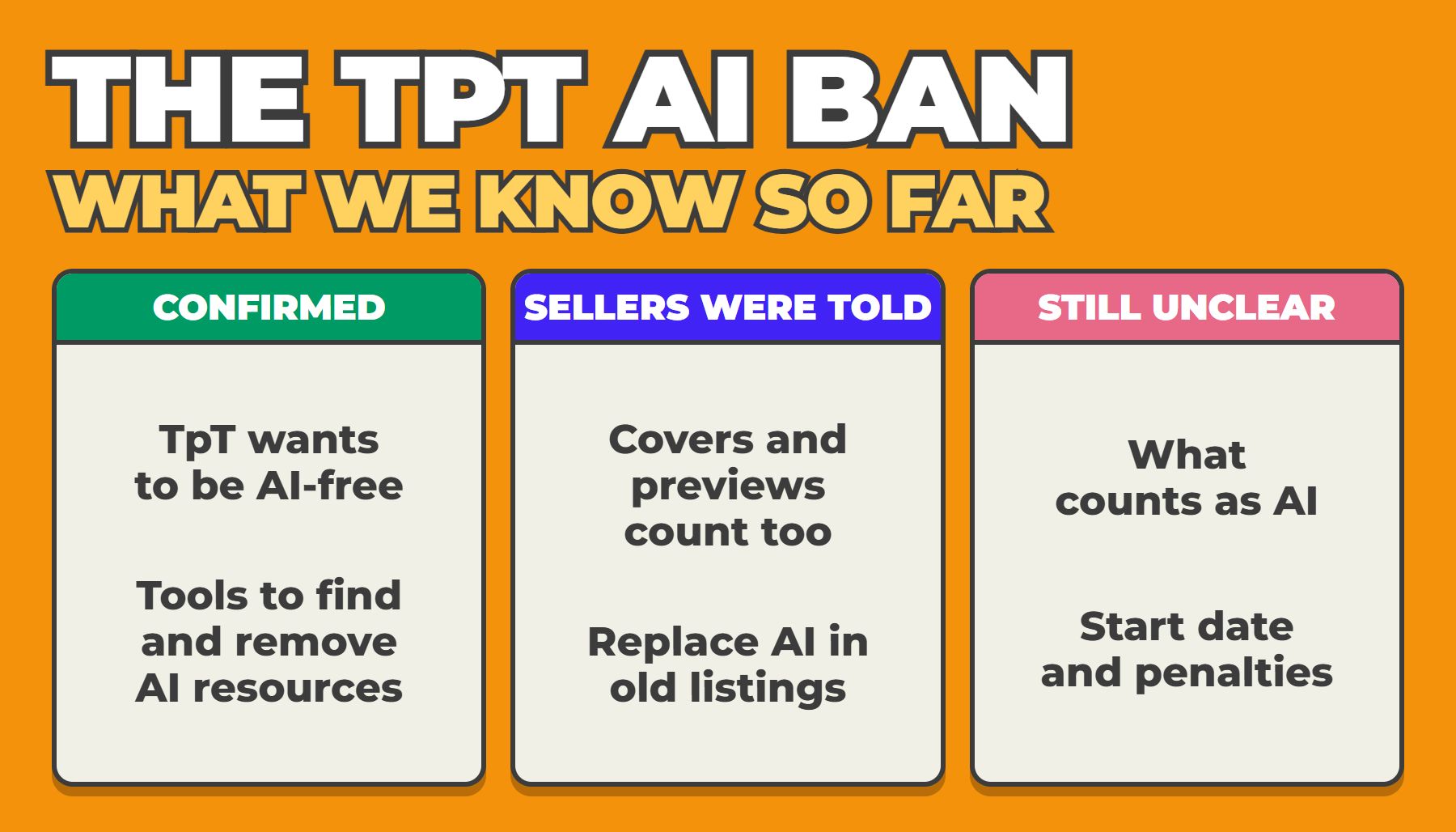
- TpT has said it will ban AI-generated resources and is building tools to find and remove them.
- There is no written policy yet. No definition of “AI-generated”, no start date, no penalties. I checked TpT’s help pages on November 10, 2026.
- Sellers were told it covers more than the resource file: covers, thumbnails and previews too, and to start replacing AI content in listings that are already published.
- Nothing changes for buyers right now. Nothing has been said about resources you already bought.
- It applies to every seller, Basic and Exclusive alike.
How we got here
In August, the education news site Chalkbeat reported on low-quality AI content for sale on TpT. The examples were hard to defend: an alphabet coloring sheet with a letter missing, a poster about the inventor of the potato chip illustrated with a firefighter and a stoplight, and a poster that still had part of the instruction to the image generator printed on it. Teachers told the reporter they were seeing more of this, and that it bothered them to see sellers charge for work they had not really made.
At that time TpT’s parent company, IXL Learning, answered that AI-made products were a tiny share of sales and that it already used tools to push stores with low-quality AI content down in search.
Two months later, at the Seller Town Hall on October 8, TpT went much further and announced the ban. Chalkbeat reported it on October 15.
What is known, what was reported, and what is unclear
This is the important part, because the three get mixed up a lot.
| Confirmed by TpT | Reported by sellers who attended the Town Hall | Not known yet |
|---|---|---|
| A TpT spokeswoman told Chalkbeat that what sellers offer should be “unique, expertly crafted, and AI-free”. | The ban covers AI-made text and images in resource files, covers, thumbnails and previews, and product descriptions as well. | What exactly counts as “AI-generated”. |
| TpT is building tools to find and remove AI-generated resources faster. | Sellers should start replacing AI content in existing listings now. No deadline was given. | Whether AI as a helper is allowed: spell-checking, translating, brainstorming, or the AI features built into design programs. |
| TpT says the aim is to keep teachers’ expertise at the center of the marketplace. | A way for users to report suspected AI resources is planned. | How TpT will tell AI work from human work, and what a seller can do if she is flagged by mistake. |
| TpT promises not to use sellers’ resources to train AI that makes competing teaching materials without the seller’s permission. | More guidance was promised for the following weeks. | The start date, the penalties, and what happens to clip art or images a seller bought from someone else. |
The middle column comes mostly from seller Mike Lane’s detailed write-up of the Town Hall. It matches what other sellers have described, but it is not on TpT’s own pages. When I looked on November 10, TpT’s Content Guidelines did not mention AI at all. The only AI article in the help center was the short promise about training, added at the end of October.
What it means if you buy on TpT
For now, nothing changes. Nothing has been said about taking away resources you already own, and I would not expect that.
In the long run this could be good for buyers. Teachers are short on time. Most of us do not check every line of a worksheet before we print it, and we should not have to. If the ban removes resources that nobody ever read through, that helps.
Until then, three quick checks protect you, with or without AI:
- Open the preview. If a seller shows only a cover and no real pages, be careful.
- Look for the small mistakes. Pictures that do not match their labels, odd spelling, an answer key that does not fit the questions.
- Read the newest reviews, not only the star rating.
What it means if you sell on TpT
My advice is to stay calm and get organized, in this order.
- Do not delete anything in a panic. There is no deadline and no written rule. Changes you cannot undo should wait for the real policy.
- Make a list. Go through your store and note where AI was involved: in the resource itself, on the cover, in the thumbnails, in the preview, in the description.
- Start with what buyers see first. Covers and thumbnails are the most visible, and usually the quickest to replace.
- Keep your working files. Drafts, design files, licenses for clip art. If a tool or another user flags you by mistake, these show how the resource was made.
- Do not guess about the gray areas. Nobody knows yet whether a spell-checker or a translation tool counts. Watch for TpT’s written guidance, and ask TpT support in writing if a product of yours is unclear.
What teachers are saying
This time teachers are honestly divided, and I think both sides have a point.
Many teachers who buy are relieved. They have seen the careless products, and they want to be able to trust what they download again.
Many sellers are worried. In the seller groups, people describe stores being marked down because they look like AI. Mike Lane argues that TpT should judge whether a resource is accurate and good, not only whether AI touched it, and he warns that detection tools and user reports will also hit honest sellers. There is a petition asking TpT to rethink the policy. And some sellers, like the teacher behind Lit & More, feel the AI news pulled attention away from the membership change announced on the same evening.
One researcher quoted by Chalkbeat made a point that stayed with me: teachers sharing their materials is a good idea, but a marketplace can push sellers to produce more and more pages, and quality suffers. That was true before AI. AI only made it faster.
My honest opinion
The goal is right. Resources that nobody read before they were uploaded should not be for sale to teachers. If a seller puts up hundreds of pages she never looked at, that is not a teacher sharing her work, and it damages the trust all of us depend on. I am glad TpT is taking that seriously.
But I think “AI-free” is the wrong test. The question that matters to a teacher on Sunday evening is not which tools were used. It is whether a teacher stands behind the resource: whether it is correct, whether someone checked every page, whether it works in a real classroom. A careless worksheet made by hand is still careless. And a careful teacher who lets a program check her spelling or tidy up a picture has not stopped being a teacher.
AI as a helper can only benefit everyone. Humans make mistakes. I do, and so does every teacher I know. When AI reads over a resource and catches a wrong answer or a typo, that resource gets better for the teacher who buys it and for the students who use it. I do not see who is helped by banning that. And I will go one step further: using AI to help create an activity is not a bad thing either, as long as a teacher reads it, tries it out, and takes responsibility for it.
Mistakes are not the real problem. They happen, whether they come from a person or from a program, and they can always be corrected. A seller who fixes an error as soon as a buyer points it out is doing her job well. The real problem is a resource nobody looked at before it was sold, and a seller who does not care when it turns out to be wrong.
The line is also much harder to draw than it sounds. AI is now built into the programs most of us use every day, from spell-checkers to design tools. Without a clear definition, every seller has to guess, and the people who guess most anxiously are usually the honest ones.
And I worry about false alarms. Tools that claim to recognize AI are known to get it wrong. If a store can be marked down or lose products because software or a competitor says so, there has to be a clear and fair way to answer.
I should be open about my own stake here. I use AI tools in parts of my own work, for example for artwork, and I check what goes into my shop before it goes live. So this policy matters to my store too, and I am waiting for the written rules like everyone else.
What I would wish for is simple. A definition in plain words. A clear difference between a resource that AI produced and a resource a teacher made with some help. An honest label instead of a guessing game. A date. And a fair way to appeal.
Where I think this is heading
I may be wrong about this, so please read it as a thought and not as a fact.
Any teacher can now ask an AI tool for a simple worksheet and have it a minute later, for free. Sooner or later most teachers will do exactly that, and they will spend less money on single worksheets. That will be felt on TpT, and in small shops like mine too.
TpT knows this better than anyone. Seen that way, the two big changes of this fall fit together. The Exclusive membership ties sellers’ work to TpT, and the AI ban sets TpT apart from what a teacher can generate herself. Some teachers put it more harshly and say it is simply about profit, as one of them told Chalkbeat. I cannot see inside the company, so I will not claim to know its reasons. What I see is a business trying to stay valuable while the ground moves under it.
My hope is that TpT does that by becoming more useful to teachers, and not only by holding on more tightly to the sellers it has. Because what will still be worth paying for, I believe, is what AI does not hand you in a minute: something complete, checked, and tried in a real classroom, from a person who answers when something is wrong.
The reason behind the ban is a good one: teachers should be able to trust what they buy. I hope the rule, when it comes, is written with as much care as TpT is asking of its sellers.
I will update this article when TpT publishes the policy. If you want my wider view on where TpT is heading, it is here: my honest opinion on selling on TpT.