Inference Games: 15 Classroom Games That Teach Students to Read Between the Lines (and How They Compare With Review Games)
Ask a class who won the battle and hands go up. Ask them why the general waited three days before attacking, when the textbook never says, and the room goes quiet. That silence is the gap between remembering and inferring, and it is the gap inference games are built to close. This guide explains what an inference game really is, gives you 15 of them sorted by type and grade, and then does something most lists skip: it compares inference games with review games, because they train different things and belong at different points in a unit.
The short version
- An inference game is any game where the answer is not stated anywhere. Players combine clues with what they already know and commit to a conclusion they can defend.
- A review game asks students to pull back something they were already taught. The answer exists in their notes.
- Review games build memory. Inference games build reasoning. You need both, and the best classroom games mix them on purpose.
- The fastest way to get more inference practice is not a new game. It is rewriting the questions in a game you already own. There is a step by step method for that further down.
What counts as an inference game?
An inference is a conclusion reached from evidence plus background knowledge. The reader sees a character shake out an umbrella in the doorway and concludes it is raining, although the word rain never appears. In reading research this is usually split into two kinds. Text-connecting inferences link two pieces of information inside the passage. Gap-filling inferences bring in knowledge from outside it. Good readers make both constantly and without noticing. Struggling readers often can decode every word and still miss them.
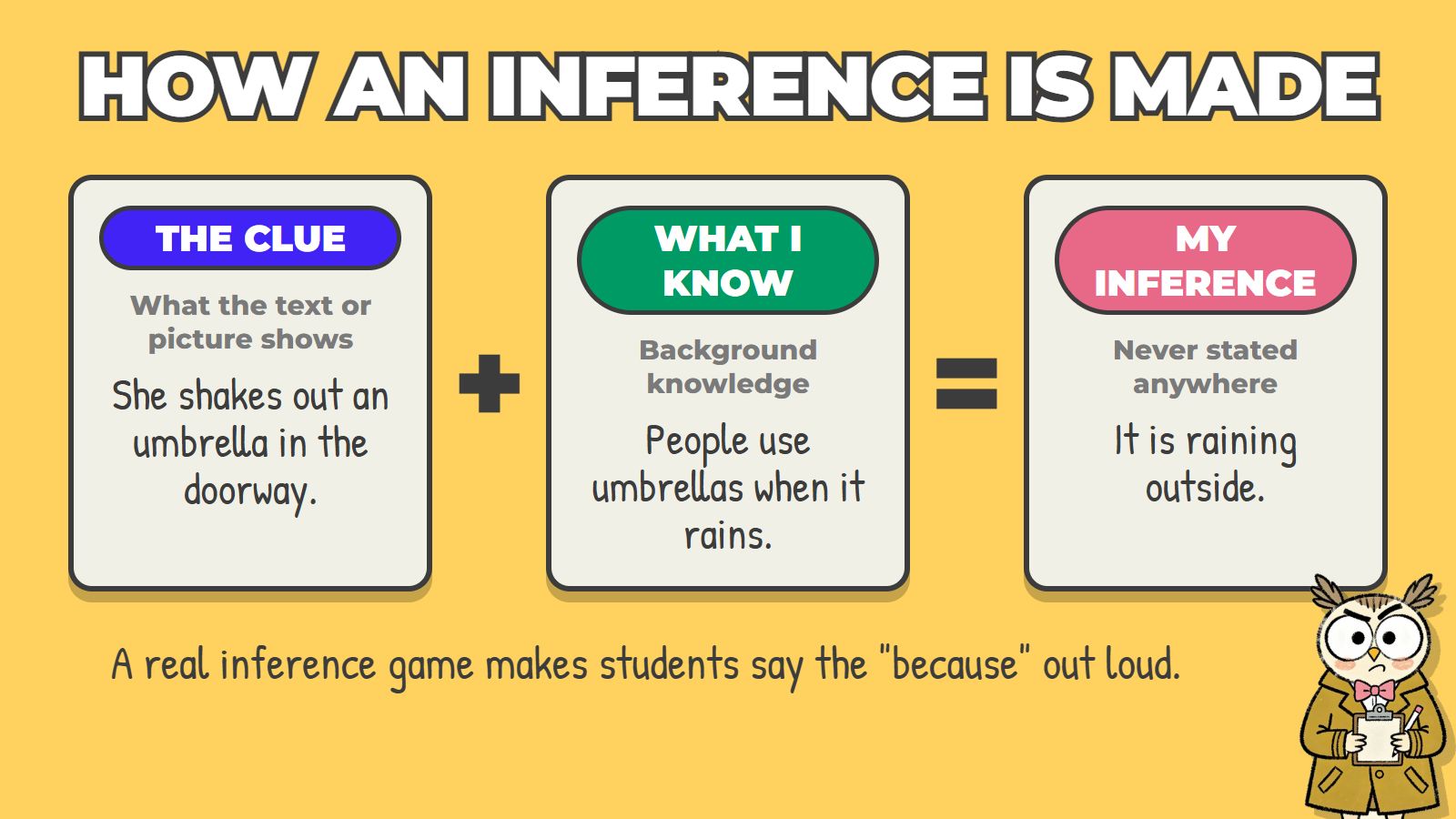
So a game only earns the name if it passes three tests:
- The answer is hidden. If a student can find the answer by scanning the text or their notes, it is a recall game wearing a detective hat.
- There are clues, and they are limited. Inference lives in the space between too little information and everything. One-word hints, a cropped photo, three objects in a bag.
- Players have to justify. “Because it says” or “because I know that” is the actual skill. A game that accepts a bare guess trains guessing.
That third test is the one most online inference games fail, and I will come back to it.
Why teach inference through games at all?
Three reasons, and only the last one is about fun.
Inference improves with practice and feedback, and games supply a lot of both. A widely cited literature review for the UK’s National Foundation for Educational Research, Effective Teaching of Inference Skills for Reading, concluded that inference can be taught, that it should be practised from the earliest grades rather than saved for fluent readers, and that teacher modelling and questioning are the main tools. A later meta-analysis by Amy Elleman (2017, Journal of Educational Psychology) found that inference instruction produced solid gains in both general and inferential comprehension, with less skilled readers gaining on literal comprehension as well. A fifteen minute game can put twenty inference questions in front of a class, each with immediate feedback. A worksheet gives you six and the feedback arrives on Thursday.
Games make thinking audible. Inference is invisible when it happens inside one head. In a team game students have to argue their way to an answer, which means weaker readers get to hear how stronger readers connect a clue to a conclusion. That overheard reasoning is the modelling the research asks for, delivered by peers.
A wrong inference costs less in a game. Inferring means committing to something the text does not confirm. Many students will not take that risk on paper. They will take it for a point.
Inference games vs review games
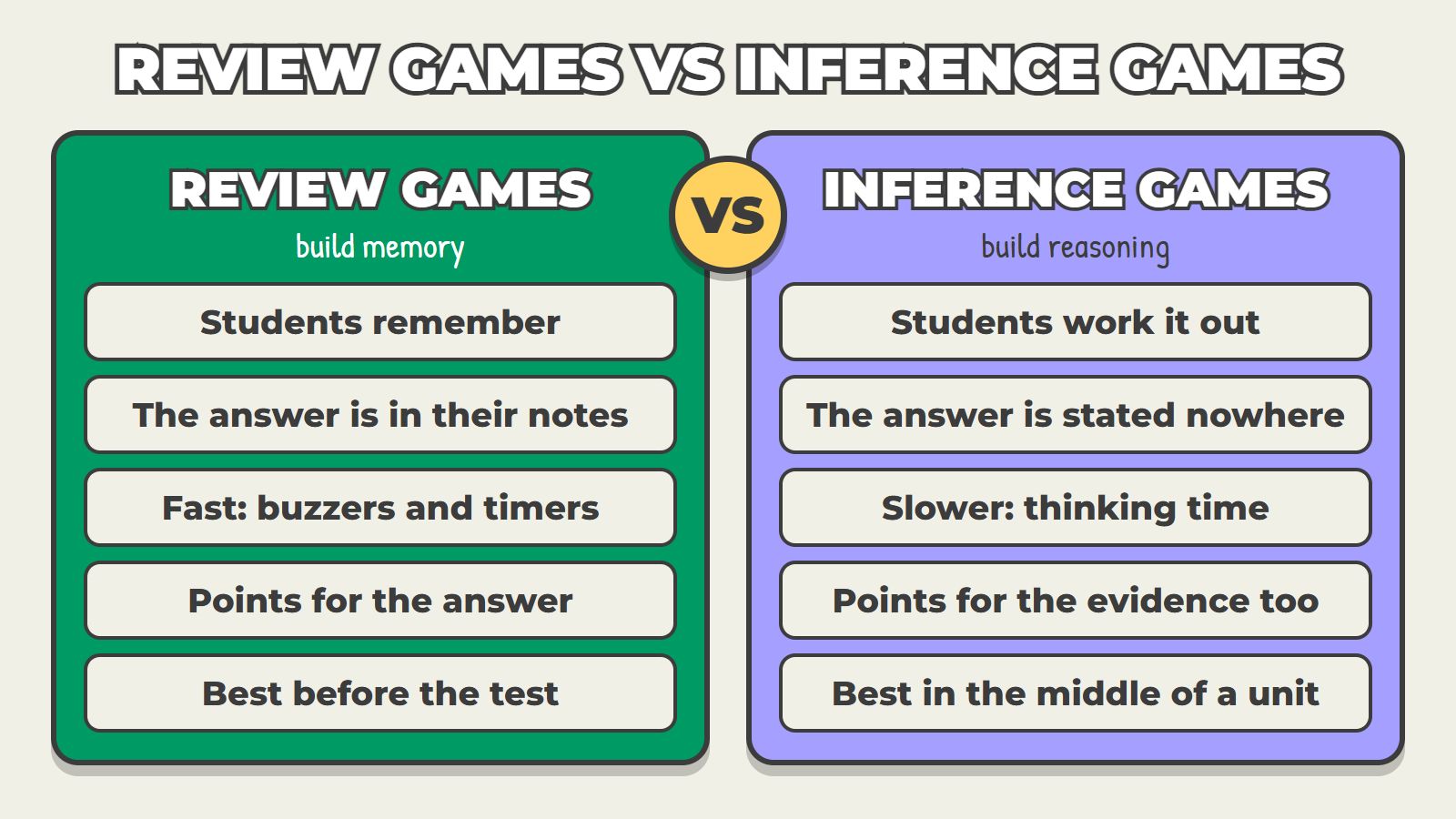
I make review games for a living, so I have a stake in this comparison. Here it is as plainly as I can put it.
| Review games | Inference games | |
|---|---|---|
| What the student does | Retrieves something already taught | Builds a conclusion nobody has told them |
| Where the answer lives | In notes, slides, the textbook | Nowhere. It has to be constructed from clues plus knowledge |
| Thinking level | Mostly recall and basic application (DOK 1 to 2) | Analysis and strategic thinking (DOK 2 to 3) |
| What it strengthens | Long term memory, through retrieval practice | Comprehension and reasoning, through guided practice with feedback |
| Right answers | Usually one, quick to judge | Sometimes several, judged on the evidence offered |
| Best moment in a unit | After teaching, before a test, and spaced out across the year | During teaching, while students are still making sense of the material |
| Pace | Fast. Buzzers, timers, lots of questions | Slower. Thinking time and a “because” are part of the turn |
| Scoring | Points for correct answers | Points for the answer and for the evidence |
| What it tells you | What students remember | How students think, including the misconceptions recall questions never surface |
| Typical failure | Turns into trivia that only the fastest three students play | Turns into wild guessing when nobody has to justify |
| Prep | Low. Questions come straight from the unit | Higher. A good clue set or mini text takes more care to write |
Neither column is the better one. Retrieval practice is among the best supported ideas in learning science. Studies such as Karpicke, Blunt and Smith (2016) found that elementary students remembered more after practising retrieval than after restudying, and that the benefit held regardless of reading comprehension level. That is the case for review games, and it is a strong one.
The two also depend on each other. Gap-filling inferences run on background knowledge. A student who cannot recall that deserts are dry cannot infer why a character is rationing water. Review games stock the shelf that inference games reach for. In the other direction, a fact that a student has had to reason with is a fact that sticks. If you only play review games, students know things and cannot use them. If you only play inference games, students reason well about very little.
The practical rule I use: review games for what students must remember, inference games for what they must work out, and a hybrid for the week before the test. If you want the memory side covered, my list of the best review games is the companion to this article.
15 inference games for the classroom
Grouped by the kind of clue students work from. Grade bands are a guide, since most of these scale by changing the content rather than the rules.
Object and picture games (best starting point, K to 5 and English learners)
1. Mystery Bag. Fill a bag with five or six objects that belong to one imaginary person: a boarding pass, sunscreen, a paperback in Spanish, a phone charger. Teams pull out one item at a time and revise their theory of who owns the bag. Score the reasoning, not the final answer. The revising is the point, because it shows students that an inference is held only as firmly as the evidence allows.
2. Whose Shoes? The same idea with one object. Show a photo of a worn pair of work boots, ballet flats, or tiny light-up trainers. Teams list everything they can infer about the owner and cite the detail that told them. Works in two minutes as a warm-up.
3. Slow Reveal. Cover a photograph with six numbered tiles on a slide and remove one at a time. After each reveal, teams write what they think is happening and can bank fewer points for a later, safer guess. The New York Times Learning Network’s weekly What’s Going On in This Picture? is a good free source of images for older students.
4. What Happened Here? Show the aftermath only: a melted snowman, a kitchen with flour on the ceiling, a bicycle against a tree with one wheel bent. Students infer the events that led to it. For grades 3 to 5, have them order three inferences from most to least certain.
Clue and word games (grades 3 to 12, any subject)
5. Twenty Questions and Guess Who. The classic deduction game is inference in its purest form, since every yes or no answer removes possibilities and students must track what remains. Play it with historical figures, elements, book characters or polygons. My Guess Who Classroom Game runs this whole class, with Who Am I clue rounds that start vague and get more specific, so teams decide how early to risk an answer.
6. Password. One student sees the secret word and may give only one-word clues. The partner has to infer the target from a growing chain of single words. The clue giver is inferring too, working out what the partner already knows. It is the most efficient vocabulary game I know, which is why I built Password games for academic vocabulary, science, social studies, math and English learners.
7. Forbidden Words. Describe the term without using the five most obvious words. Guessers infer from indirect description, and describers have to find the second and third ways of explaining an idea, which is where understanding shows. A Taboo style review game works for any subject from grade 6 up.
8. What’s the Link? Show three words or pictures (glacier, candle, chocolate) and ask what connects them. Then run it as Odd One Out with four items where more than one answer can be defended. Accept any answer with sound reasoning. Arguing about which is the odd one out is ten minutes of pure inference.
9. Code Breaker Words. Word-guessing games in the Wordle family are deduction from feedback: this letter is in the word but not here, so what is still possible? Play it on the board with unit vocabulary, or on paper with a printable classroom Wordle for grades 2 to 6.
Text games (grades 3 to 12, the ones that transfer to reading tests)
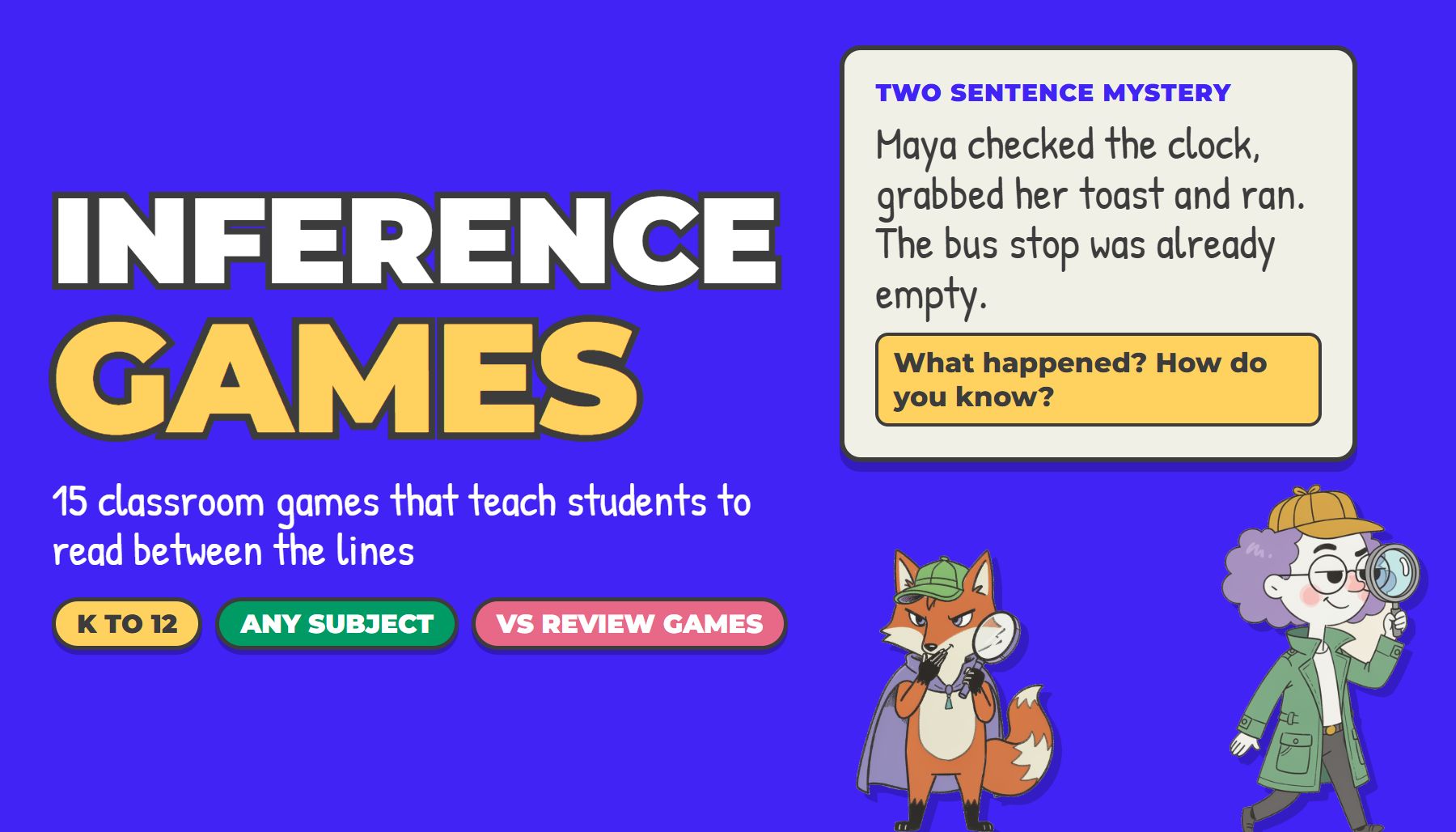
10. Two Sentence Mysteries. Put a tiny text on the board: “Maya checked the clock, grabbed her toast and ran. The bus stop was already empty.” Ask what happened, how Maya feels, and what she will do next. Each answer needs a “because”. Ten of these take fifteen minutes and cover more inference questions than most passages.
11. Who Said It? Give four unlabelled lines of dialogue and four characters or historical figures. Teams match and defend. In ELA it teaches characterisation. In social studies it teaches perspective. It is also very easy to write.
12. Caption Court. Show a single-panel cartoon or a wordless picture book spread with the caption removed. Teams write the caption, then argue for the one that best fits the visual evidence. Jokes are inference machines, since a punchline only works if you fill the gap yourself.
13. The Missing Middle. Give the first and last paragraph of a short story or the first and last step of a historical event or a lab procedure. Teams infer what must have happened in between, then compare with the real thing.
Mystery and deduction games (grades 4 to 12)
14. Case File. Each group gets an envelope of evidence: a receipt, a torn note, a train ticket, a witness statement that contradicts another. They build a timeline and name a suspect, and every claim on their board must point to an exhibit. It takes prep, so keep the envelopes. For a ready made version that doubles as a team builder, my Classroom Whodunit is a detective mystery for grades 6 to 12.
15. Evidence Wager. Any of the games above, with one added rule: before answering, teams bet one, two or three points on how sure they are. A wrong answer loses the stake. The wager forces students to weigh how strong their evidence is, which is the habit that separates inferring from guessing. It also slows down the team that shouts first.
Inference games by grade level
The searches people make are mostly grade specific, so here is the quick sort.
- Kindergarten to grade 2: pictures and objects, all oral. Mystery Bag, Whose Shoes?, What Happened Here?, and feelings inferences from faces and body language. Sentence stem: “I think ___ because I see ___.”
- 3rd, 4th and 5th grade: the years inference shows up in standards and on state tests. Move from pictures to short text: Two Sentence Mysteries, What’s the Link?, Slow Reveal, Password. Stem: “The text says ___, I know ___, so ___.” For print and go reading work at this level I have a Reading Comprehension Games and Activities pack for grades 1 to 5 that works with any book.
- Middle school: students can handle competing inferences and unreliable evidence. Case File, Who Said It?, Forbidden Words, Evidence Wager. Ask for the strongest piece of evidence, not just any piece.
- High school: inference about author purpose, bias, tone and subtext. The Missing Middle with primary sources, Caption Court with political cartoons, and hybrid quiz games in every subject.
- KS2 (UK readers): inference is a named content domain in the reading SATs, so the text games above map closely onto what Year 3 to 6 pupils are assessed on. Two Sentence Mysteries is the closest match to the question style.
Inferencing games for speech therapy and English learners
Speech-language pathologists search for inferencing games as often as classroom teachers do, because social inference (what is she feeling, what does he mean, what will happen next) is a core therapy goal. The picture games work best here, as they remove the reading load and isolate the reasoning. Start with Whose Shoes? and What Happened Here?, use real photographs rather than clip art, and keep the “because” stem visible. For English learners, Password and Guess Who add structured speaking practice on top of the inference. The ESL Password Game is levelled for that purpose.
What about online inference games?
Plenty exist, and many are free: SplashLearn has a set for elementary ELA, Wordwall hosts thousands of teacher-made inference quizzes, ABCmouse has an adventure game for younger children, and any Kahoot can be filled with inference questions. They are useful for independent practice and centers.
They share one limit. Almost all of them are multiple choice, and multiple choice quietly changes the task. Picking the most reasonable of four conclusions is recognition. Producing a conclusion from a blank page, then defending it aloud, is inference. Online games also cannot hear a “because”. Use them for extra repetitions, and keep the whole class, talk-it-out version for teaching the skill. If you do use a quiz platform, add a rule that a team must state its evidence before the answer is revealed.
How to turn any review game into an inference game
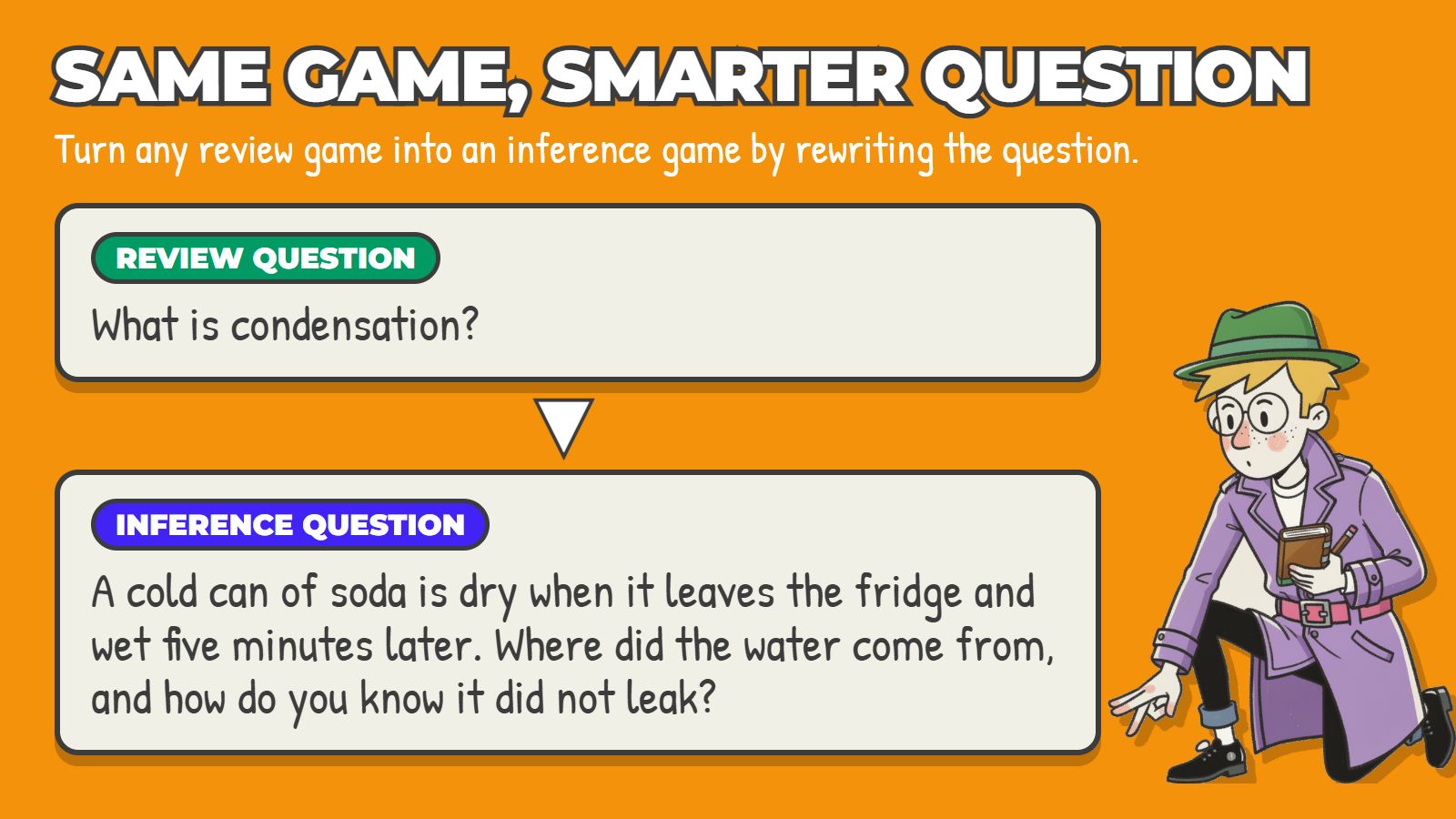
This is the highest-value idea in the article if you are short on time. You do not need a new game. A quiz board, a Mystery Box or a team buzzer game is only a delivery system, and it delivers whatever kind of question you load into it. Change the questions and you change the thinking.
Step 1: replace the fact with a situation. Every question becomes a mini text or scenario of one to three sentences, and the answer is never stated in it.
| Subject | Review question (recall) | Inference question |
|---|---|---|
| Science | What is condensation? | A cold can of soda is dry when it leaves the fridge and wet five minutes later on a humid day. Where did the water come from, and how do you know it did not leak out? |
| History | In what year did the Dust Bowl begin? | A 1935 photograph shows a farmhouse with sand drifted to the windowsills and no fences visible. What can you infer about the family’s last three harvests? |
| ELA | Define foreshadowing. | “She laughed and said the old bridge had held for a hundred years.” What does the author probably want you to expect, and which words do that? |
| Math | What is the formula for the mean? | A class’s mean score is 70 but the median is 85. What can you infer about a few of the scores? |
Step 2: write wrong answers that are literally true. If you use answer choices, the best distractor is something the text actually says that does not answer the question. It catches students who scan instead of think.
Step 3: pay for evidence. Full points for the answer, a bonus for the “because”. On a quiz board this is as simple as announcing that every answer worth 300 or more needs a reason.
Step 4: give thinking time. First hand up rewards recall speed. For inference rounds, every team writes an answer on a whiteboard and all boards go up together.
Step 5: mix on purpose. Low value questions stay as quick recall, which keeps the pace up and gives every student a way in. High value questions are inferences. That single board is now a retrieval session and a reasoning session at once. I go into question writing in more depth in how to write quiz show questions that actually work.
This is how I wrote my own reading games. In the Reading Comprehension Game for middle school, every question is a short text students have to comprehend rather than a terminology question, and the Literature Review Game does the same for novel studies. If you would rather load your own questions, the editable Quiz Show Template and Mystery Box take any of the question types above, in Google Slides or PowerPoint.
Five mistakes that turn inference games into guessing games
- Accepting answers without reasons. The “because” is the skill. No reason, no points.
- Clues that give it away. If the first clue settles it, there was nothing to infer. Order clues from vague to specific.
- Only one acceptable answer when the evidence supports two. Students learn quickly whether you reward thinking or mind reading. If a team defends a different answer well, pay them.
- Skipping the knowledge check. A student who has never seen snow cannot infer much from a melted snowman. If a game falls flat, the missing piece is often background knowledge, and that is a job for teaching and review.
- Never naming the process. After a round, take thirty seconds to say it out loud: here was the clue, here was what we knew, here is what we concluded. That is what helps the skill transfer from the game to the reading test.
Where each game fits in a unit
- Launch (day 1): a picture or object inference game on the new topic. It activates prior knowledge and shows you what students already believe.
- Middle of the unit: text and clue games on the content being taught. This is where inference games earn their time.
- Before the test: a hybrid board, recall at the low values and inference at the high values.
- Weeks later: a quick pure review game to bring the facts back. Spaced retrieval is what keeps them.
Frequently asked questions
What is an inference game? A game in which the answer is never stated and players must reach it by combining clues with what they already know, then explain their reasoning. Guess Who, Password, Mystery Bag and short text mysteries are all examples.
What is the difference between an inference game and a review game? A review game asks students to recall what they were taught, which strengthens memory. An inference game asks them to work out something they were not told, which strengthens comprehension and reasoning. Review games suit the end of a unit and spaced practice. Inference games suit the middle of a unit. A quiz board with recall at low values and inference at high values does both.
What is the difference between an inference and a prediction? A prediction is an inference about the future. “It rained” from a wet umbrella is an inference. “She will miss the bus” is a prediction. Both need evidence.
What is the difference between an observation and an inference? An observation is what you can see or read directly. An inference is what you conclude from it. “The plant’s leaves are yellow” is an observation. “It has had too much water” is an inference. Sorting statements into those two piles is a good five minute game in science.
What grade should students start inference games? Kindergarten. Young children infer from pictures and faces long before they can read a passage, and the research reviews recommend starting early rather than waiting for fluent decoding.
Are there free inference games? Yes. Mystery Bag, Whose Shoes?, Twenty Questions, What’s the Link? and Two Sentence Mysteries need nothing but a board. Online, Wordwall and SplashLearn have free inference quizzes for independent practice.
How long should an inference game take? Five minutes as a warm-up with pictures, fifteen to twenty for a text or clue game, a full lesson for a Case File mystery. Because each turn includes thinking time and a justification, plan for about half as many questions as you would fit in a review game.