
Why Adults Are Turning to Word Search Puzzles (And How to Use Them in Your Classroom)
Word search puzzles designed for adults deliver the mental challenge and complexity that grown-up solvers crave, and the good news is you can access thousands of them completely free online right now. Unlike the simplified grids you remember from childhood, today’s adult word searches feature sophisticated vocabulary, layered themes, and customization options that transform a nostalgic pastime into a genuine cognitive workout.
The surge in adult puzzle-solving isn’t just a trending hobby. Research confirms that adults learn through games more effectively than through passive study, which explains why so many teachers already use these puzzles in their classrooms. Free puzzle sites now offer tools that let you create custom word searches tailored to your specific curriculum, whether you’re reinforcing vocabulary for high school literature units or building content knowledge for college prep courses.
What makes adult word searches particularly valuable in 2026 is their accessibility. These puzzles work seamlessly on any device, from desktop computers to tablets and smartphones, and many include print options for students who prefer working on paper. New puzzles are added regularly across educational and recreational topics, giving you a constantly refreshing resource that doesn’t require subscriptions or complicated software.
The practical classroom applications are straightforward. You get instant engagement, self-paced learning, and vocabulary reinforcement wrapped in an activity that students actually enjoy completing. Whether you need a bell-ringer activity, a review tool before assessments, or differentiated practice for diverse learners, adult-level word searches offer the challenge and customization your older students deserve.
The Adult Word Search Renaissance: What’s Driving the Trend
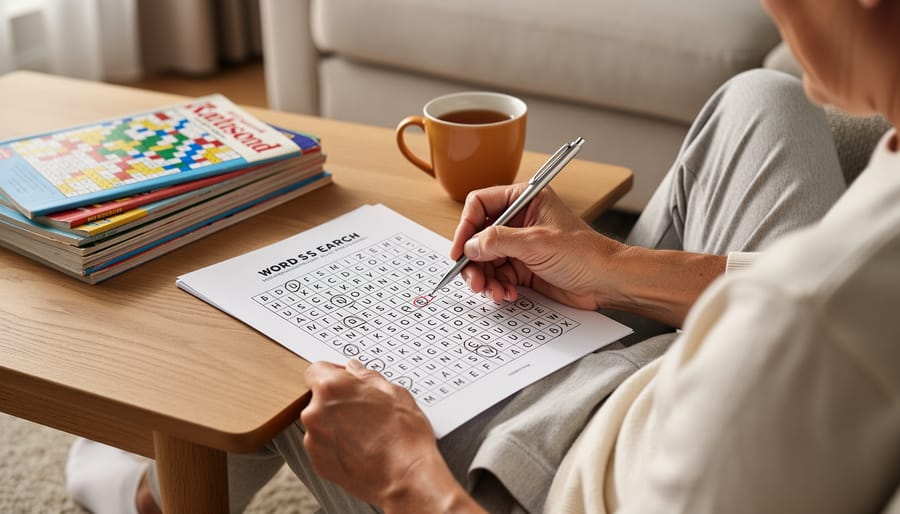
Word search puzzles aren’t just for kids anymore. Adults across the country have rediscovered this classic activity, turning it into a genuine wellness practice. What started as a casual pastime has evolved into something more intentional, with grown-ups deliberately choosing puzzles over scrolling through social media or streaming yet another show.
The appeal is straightforward: word searches offer screen-free mental engagement without the pressure. Unlike Sudoku or crosswords that can feel intimidating, word searches provide a gentle cognitive workout. You’re exercising pattern recognition and visual scanning skills while your mind gets a break from decision fatigue. Many adults describe the experience as meditative, a rare chance to focus on something simple with clear boundaries and a satisfying sense of completion.
There’s also a nostalgia factor at play. Adults remember word searches from childhood, and returning to them now feels comforting rather than childish. The activity connects to simpler times while still offering real benefits. Research on cognitive health suggests that word searches can help maintain mental sharpness, making them particularly popular among older adults looking for accessible brain exercises.
For educators working with high school students, adult learners, or professional development groups, this trend is actually a gift. Your older students face the same stress and screen fatigue as the broader adult population. When you bring word searches into secondary or adult education settings, you’re not dumbing down the curriculum. You’re tapping into a legitimate wellness practice that happens to align perfectly with vocabulary retention and content review. The puzzle format that adults are choosing for stress relief can double as an engaging learning tool that doesn’t feel like typical schoolwork.
Where Adults (and Your Students) Can Find Word Search Puzzles
Finding quality word search puzzles for adults doesn’t require hunting through bookstores or subscription services. Several free online platforms make thousands of puzzles instantly accessible to both you and your students.
The largest free resource offers thousands of word search online puzzles that work seamlessly across desktop, laptop, mobile, and tablet devices. You can play directly in your browser or print puzzles for offline use. New puzzles appear regularly, covering everything from brain-teasing entertainment to curriculum-aligned educational vocabulary. Teachers already use these platforms extensively because they eliminate prep time while delivering engaging content.
| Format | Device Compatibility | Best For |
|---|---|---|
| Online Play | Desktop, mobile, tablet | Interactive screens, one-to-one classrooms, remote learning |
| Printable | Any device with browser | Paper-based activities, homework, sub plans, no-tech days |
| Custom Creation | Desktop, tablet recommended | Unit-specific vocabulary, differentiation, professional development |
These platforms mix fun topics like pop culture and hobbies with educational themes spanning science, history, literature, and professional skills. The built-in Word Search Maker tool lets you create custom puzzles tailored to your exact curriculum needs in minutes, controlling vocabulary difficulty and grid size.
The 100% free model means you can assign puzzles without worrying about student access or subscription barriers. Students can tackle the same puzzle on their phones during a bus ride or print it for quiet study time at home. This flexibility makes word searches practical for diverse classroom scenarios, from bell ringers to enrichment activities, without requiring additional technology investments or complicated account setups.
How to Customize Word Searches for Your Adult Learners
Creating your own word search puzzles gives you complete control over the challenge level and content. The Word Search Maker tool turns this customization process into a quick, straightforward task that takes just minutes.
Start by identifying the vocabulary that matters most to your learners. For a high school biology unit on cellular respiration, you might input terms like mitochondria, glycolysis, ATP, electron transport chain, and Krebs cycle. For adult ESL students, you could build a puzzle around workplace vocabulary they’re actively learning. The key is choosing 10-15 words that reinforce concepts your students actually need to master.
The customization options let you adjust difficulty to match your learners’ skills. Increase the grid size to 20×20 for advanced students who need more challenge, or reduce it to 12×12 for learners who might feel overwhelmed by dense letter grids. You can also control whether words appear horizontally, vertically, diagonally, or backwards. Removing diagonal and backward options makes puzzles more accessible for struggling readers while keeping the vocabulary reinforcement intact.
Professional development themes work surprisingly well for staff meetings and training sessions. Create a puzzle featuring leadership terminology before a workshop on classroom management, or build one around technology tools your school is implementing. These low-stakes activities get everyone engaged and thinking about key concepts before diving into heavier content.
Team-building puzzles offer another practical application. Compile words related to your school’s values, department goals, or even staff members’ names for an ice-breaker activity. The Word Search Maker handles the technical work of arranging letters and generating the puzzle, so you spend your time on what matters: selecting meaningful content.
The customization extends to how you present the puzzles too. Print them for offline work during professional development sessions, or share the digital version for quick brain breaks during virtual meetings. Either way, you’ve created something tailored to your specific educational context rather than settling for generic puzzles that miss the mark.
Adult-Level Puzzle Themes That Work in Educational Settings
The key to successful adult-level word searches in educational settings is choosing themes that feel sophisticated without becoming obscure. Your students should recognize the challenge as intellectually engaging, not juvenile.
Start with content-area vocabulary that reinforces your curriculum. For science classes, create puzzles around biological taxonomy (phylum, genus, mitochondria, chloroplast), chemistry terms (electronegativity, stoichiometry, catalyst, isomer), or physics concepts (momentum, wavelength, thermodynamics, kinetic). History teachers can build puzzles featuring Renaissance figures (Machiavelli, Medici, Michelangelo, Erasmus), Civil War generals, or Cold War terminology. English teachers might use literary devices (foreshadowing, metaphor, personification, allegory) or authors from a specific movement (Fitzgerald, Hemingway, Steinbeck, Faulkner for American modernism).
Professional skills make surprisingly effective puzzle themes for older students and adult learners. Try leadership vocabulary (delegation, accountability, transparency, initiative), project management terms (stakeholder, milestone, deliverable, timeline), or current technology concepts (algorithm, cryptocurrency, metadata, bandwidth). These themes work especially well for career and technical education classes or professional development workshops.
Cross-curricular puzzles get students thinking beyond single subjects. Combine mathematical terms with their real-world applications (statistics, probability, interest, depreciation), pair geographical features with their scientific processes (erosion, precipitation, tectonic, sediment), or mix historical events with their economic impacts (recession, tariff, inflation, embargo). This approach reinforces how knowledge areas connect rather than exist in isolation.
Current events and contemporary culture offer timely themes that resonate with adult learners. Create puzzles around environmental issues (sustainability, biodiversity, conservation, renewable), social justice concepts (equity, marginalization, advocacy, representation), or media literacy terms (algorithm, deepfake, verification, bias). These topics feel relevant and mature while still serving educational purposes.
The customization tools mentioned earlier make creating these themed puzzles straightforward. Pick 15 to 20 terms from your chosen theme, enter them into the Word Search Maker, and you have a ready-to-use activity that reinforces vocabulary in a format students find relaxing rather than tedious.
Making Word Searches Work for Different Classroom Scenarios
Word searches aren’t just for downtime, they’re versatile tools you can slot into nearly any lesson structure. As a quick warm-up, project a puzzle on your board while students settle in; it focuses attention and primes their brains for the day’s topic without requiring extensive setup. For vocabulary review, create puzzles that reinforce key terms from your current unit, letting students hunt for words they’ll need to recall later. Because word search puzzles work on desktop pc, mac, mobile and tablet, students can complete them however works best for your classroom setup.
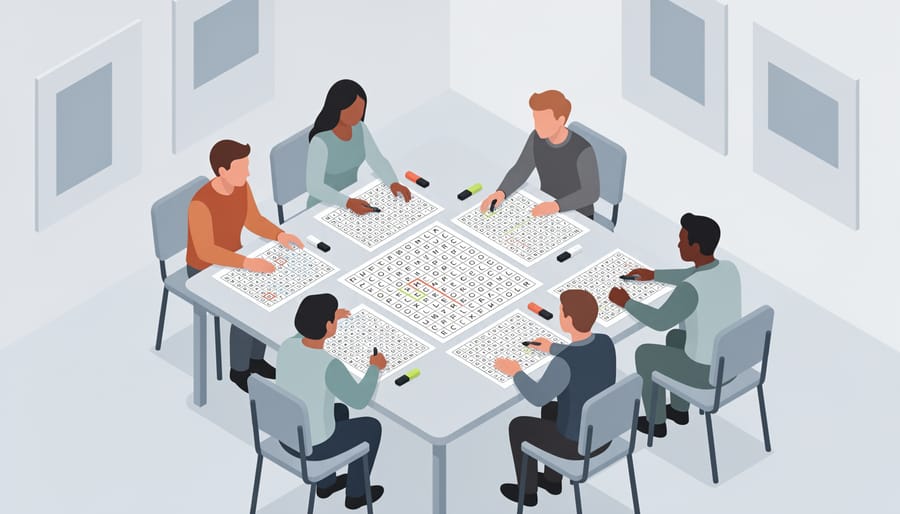
Brain breaks matter more than many teachers realize, especially with older students who’ve been sitting through multiple periods. A five-minute puzzle mid-lesson gives their prefrontal cortex a chance to reset while still keeping them academically engaged. For team-building, try racing pairs or small groups to complete the same puzzle first, or create custom puzzles with staff names and fun facts during professional development sessions.
Differentiation becomes simpler when you incorporate word puzzle games into your strategy toolkit. Struggling readers get the same vocabulary exposure as advanced students but with visual and kinetic support built in. You can adjust grid size, word count, and topic complexity through the Word Search Maker, creating multiple versions of essentially the same content that meet students where they are. The beauty lies in how naturally puzzles scale, what takes one student three minutes might challenge another for ten, yet both stay productively engaged without feeling singled out.
Balancing Fun and Educational Rigor
The skepticism is real: word searches can feel like busywork, especially for secondary and adult learners who expect rigorous academic content. The key is treating them as one tool in your instructional toolkit rather than standalone lessons.
Start by choosing vocabulary that actually challenges older students. Generic puzzles with words like “dog” or “cat” won’t cut it with juniors studying AP Biology. Instead, use discipline-specific terminology: “mitochondria,” “photosynthesis,” “cellular respiration.” The puzzle becomes legitimate vocabulary reinforcement when students grapple with complex terms they need to recognize quickly during exams.
Difficulty matters beyond vocabulary choice. Increase the challenge by using larger grids, allowing diagonal and backwards placement, or including overlapping words. Many teachers report that 20×20 grids with backwards placement engage even their most advanced students without feeling juvenile.
The real magic happens when you pair puzzles with deeper activities. Use them as a five-minute warm-up before launching into analysis or discussion. One chemistry teacher has students complete a puzzle of reaction types, then immediately explains each term they found to a partner. The puzzle primes their brains with key vocabulary they’ll need for the lesson ahead, helping them remember longer than passive reading alone.
Think of word searches as vocabulary primers, not lesson replacements. They work brilliantly for introducing unit terminology, reviewing before assessments, or providing structured brain breaks that keep students in academic mode. The fun element actually reduces cognitive load, making challenging content more approachable without sacrificing rigor.
The rise of word search puzzles for adults isn’t just a passing trend, it’s an opportunity to rethink how we engage older learners. Whether you’re teaching high schoolers, adult education students, or professional development workshops, these puzzles offer a surprisingly effective way to make learning stick. The beauty is in how flexible they are: you can create custom puzzles that match your exact curriculum needs, use them as quick brain breaks, or build entire vocabulary lessons around them.
You’ve got free resources at your fingertips, with thousands of puzzles available to play online or print out. New puzzles are added regularly, and the Word Search Maker lets you design your own in minutes. These tools work across all devices, making them accessible no matter what technology your students use.
The real magic happens when you experiment. Try creating a puzzle around next week’s vocabulary list. Build a team-building activity for your staff meeting. Use them as sub plans that actually teach something. The key is to start small and see what resonates with your learners.
Ready to give it a shot? Pick one lesson this week and add a custom word search. You might be surprised at how something this simple can make learning more interactive and genuinely enjoyable for everyone involved.