
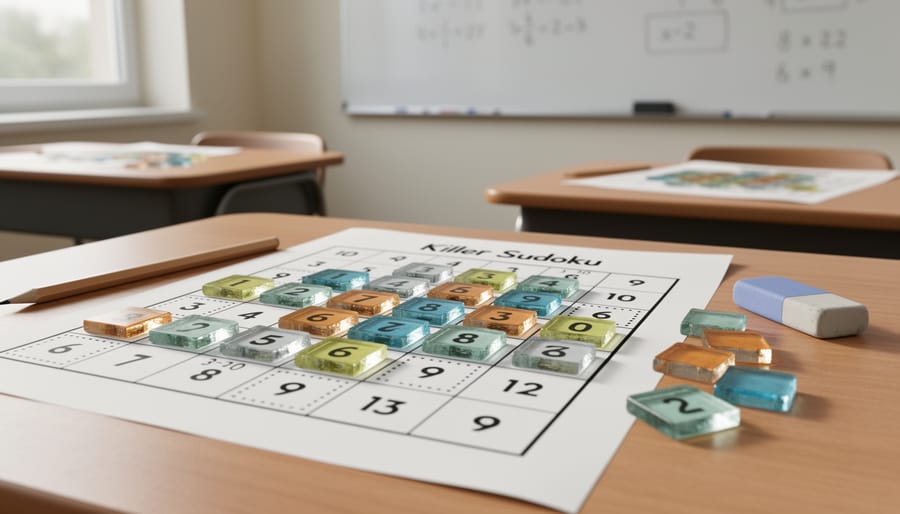
Sudoku Killer Puzzles: A Fresh Twist on Logic Games for Your Classroom
Sudoku killer puzzles are a challenging logic game that combines traditional sudoku grids with cage-based arithmetic, creating a brain-teasing hybrid perfect for students who’ve mastered basic sudoku and are ready for something more demanding. Unlike standard sudoku, these puzzles add dotted-line “cages” where numbers must sum to a target total without repeating, layering mathematical reasoning on top of the classic row-column-box constraints. The result? A powerful tool for building critical thinking and numerical fluency that fits perfectly into game-based learning strategies across middle and high school classrooms.
Teachers love sudoku killer puzzles because they naturally differentiate instruction. Beginners can tackle smaller grids with simple addition cages, while advanced students wrestle with complex 9×9 boards requiring subtraction and multiplication strategies. The format also sneaks in math practice without feeling like a worksheet drill, making it an ideal warm-up activity, early-finisher challenge, or Friday brain break that keeps students engaged. Best of all, you can customize difficulty on the fly by adjusting cage sizes and target numbers to match your students’ skill levels, giving you flexibility that pre-printed puzzle books just can’t match.
What Makes Sudoku Killer Puzzles Different?
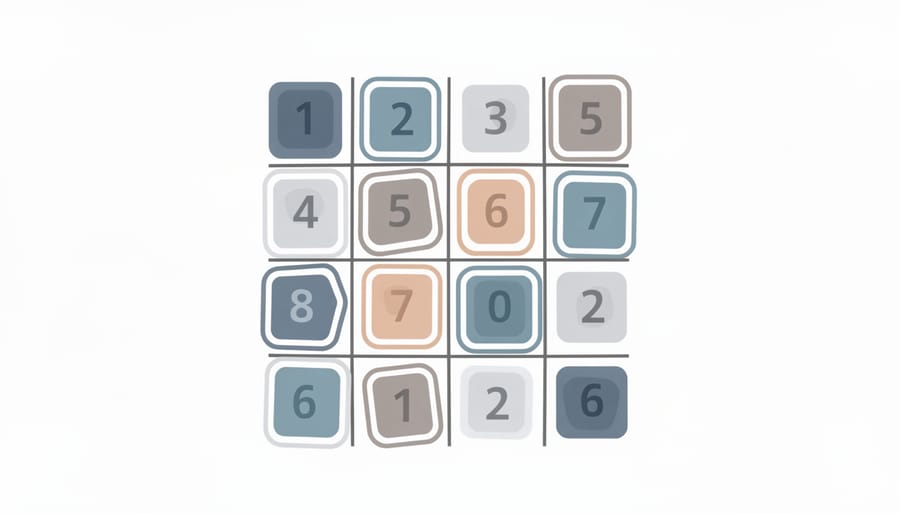
At first glance, sudoku killer puzzles might look like their classic cousins, but they pack a mathematical punch that transforms the solving experience. Instead of giving you pre-filled numbers scattered across the grid, these puzzles present dotted-line cages, groups of cells outlined together with a small number in the corner. That number is your clue: it tells you the sum that all the cells inside that cage must add up to.
Here’s where sudoku killer puzzles get interesting. You still follow the standard sudoku rules, each row, column, and 3×3 box needs the digits 1 through 9 with no repeats. But now you’ve added an extra layer: within each dotted cage, the numbers must add to the target sum, and you can’t repeat a digit inside that same cage. So if a cage shows “15” and covers three cells, you might use 9+5+1 or 7+6+2, but never 5+5+5.
This dual-logic approach is exactly why students find sudoku killer puzzles so engaging. They’re not just scanning for missing numbers; they’re actively calculating which combinations of digits work, considering both arithmetic and spatial constraints. A student might know a two-cell cage totaling “3” can only be 1+2, giving them an instant solving foothold. Meanwhile, larger cages require mental math practice and the ability to test multiple number combinations before committing.
The arithmetic element strengthens number sense in ways that standard sudoku doesn’t reach. Students build fluency with addition facts, learn to quickly identify impossible combinations, and develop strategic thinking about which cages to tackle first, usually starting with the smallest sums or the most restricted spaces.
Why Teachers Are Adding Sudoku Killer Puzzles to Their Classrooms

Teachers are discovering that sudoku killer puzzles strengthen multiple skills simultaneously in ways that standard worksheets can’t match. These puzzles require students to add numbers while respecting the traditional sudoku grid constraints, creating a perfect fusion of arithmetic practice and logical reasoning. Instead of just filling in blanks, students must calculate sums, test hypotheses, and adjust strategies when their initial approach doesn’t work.
The mental math component is particularly valuable. Every cage presents a mini-calculation challenge where students mentally determine which number combinations reach the target sum without repetition. A third-grader working on a 6×6 grid practices basic addition facts, while a middle schooler tackling 9×9 sudoku killer puzzles develops more sophisticated number sense and pattern recognition. This built-in differentiation makes them useful across grade levels without requiring separate materials.
What really sets sudoku killer puzzles apart is how they build perseverance. Students can’t guess their way through these puzzles. They need to work methodically, tracking which combinations they’ve tested and recognizing when they’ve hit a dead end. Teachers report that students who normally give up on challenging tasks will persist with these puzzles because the logic feels like solving a mystery rather than completing an assignment.
The versatility across subject areas adds to their classroom appeal. Math teachers use sudoku killer puzzles for number fact practice and problem-solving skills. Classroom teachers incorporate them during morning work or as brain breaks between subjects. Gifted education programs appreciate how they challenge students who finish regular assignments early. Some teachers even use them in logic units or as part of STEM enrichment activities.
Perhaps the biggest advantage is that sudoku killer puzzles self-differentiate. Struggling students can start with smaller grids and fewer cages, while advanced learners tackle complex 9×9 puzzles with minimal given numbers. Everyone works at their challenge level using the same basic activity format.
Getting Started: Introducing Sudoku Killer Puzzles to Students

The key to successfully introducing sudoku killer puzzles is starting simple and building gradually. Your students might already know traditional sudoku, but the addition of cage sums creates a completely new challenge that requires careful scaffolding.
Begin with a four-by-four grid rather than jumping straight to the standard nine-by-nine format. These smaller puzzles let students grasp the cage concept without feeling overwhelmed by complexity. Walk through one puzzle together on your interactive whiteboard, demonstrating how each cage’s numbers must add up to the target sum while still following sudoku’s no-repeat rules.
Here’s a reliable sequence for your first lesson on sudoku killer puzzles:
- Review basic sudoku rules so everyone starts from the same foundation, even if most students already know them.
- Explain the cage concept using a simple two-cell example, show how a cage marked “3” in a 4×4 grid can only be 1+2, never 2+1 in the same order or any repeating digits.
- Model a complete small puzzle together, thinking aloud as you identify which cages have only one possible combination and which require more strategic thinking.
- Provide guided practice where students work on their own copies while you circulate, asking questions like “What numbers could fit in this cage?” rather than giving direct answers.
- Transition to independent solving once students can articulate why certain number combinations work or don’t work in specific cages.
Effective teaching scaffolds make the difference between frustration and engagement. Create a reference sheet showing common cage sum combinations for smaller grids, students can check that a cage requiring “5” in a 4×4 puzzle must be either 1+4 or 2+3. This support helps them focus on logic rather than mental math.
For whole-class introduction, display one puzzle and solve it collaboratively, letting different students suggest moves while the class discusses whether each suggestion follows both the sudoku and cage rules. For independent practice, provide three or four puzzles at slightly different difficulty levels so students can choose their challenge.
Watch for students who race ahead using only sudoku logic and ignore the cage constraints. Gently redirect them by asking, “Does your answer make the cage sum work?” This reminder helps reinforce that sudoku killer puzzles require checking both rule systems simultaneously.
Customizing Sudoku Killer Puzzles for Different Learners
One of the best features of sudoku killer puzzles is how easily you can adapt them to different skill levels and learning styles. Unlike worksheets that offer one-size-fits-all challenges, these puzzles naturally lend themselves to customization.
Start with grid size. Younger students or puzzle beginners can handle 4×4 or 6×6 grids with simpler cage arrangements, while more advanced learners can tackle the classic 9×9 format. You might keep a collection of different sizes on hand so students can choose their challenge level or progress through increasingly difficult versions.
Providing partial solutions helps struggling learners build confidence. Fill in a few numbers across different cages, or solve one entire row to demonstrate the logic. Some students benefit from having the cage sums highlighted in different colors, making it easier to track which cages they’ve completed.
Team challenges work beautifully with sudoku killer puzzles. Pair a stronger student with someone still learning the ropes, or create small groups where students tackle a large-grid puzzle together. They’ll naturally discuss strategies, explain their reasoning, and learn from each other’s approaches.
For early finishers, keep a puzzle station stocked with various difficulty levels. Students can work independently while you help others, and these brainteasers keep fast workers engaged without requiring your supervision. They’re also perfect five-minute brain breaks between lessons or before dismissal.
Consider creating a progressive challenge system where students earn “puzzle points” for completing increasingly difficult sudoku killer puzzles. This gamification approach motivates learners to push beyond their comfort zone while celebrating small wins along the way. The key is offering enough variety that every student finds an appropriate entry point and a clear path forward.
Making Sudoku Killer Puzzles Interactive and Fun
Transform your standard puzzle time into an energetic classroom activity by making sudoku killer puzzles the centerpiece of interactive learning. Instead of solo worksheets, project a puzzle on your screen and tackle it together as one of your whole-class math games. Students can work in small teams to solve different cages, then share their reasoning with the class, perfect for building mathematical communication skills.
Try a “Puzzle Race Friday” where teams compete to solve the same sudoku killer puzzles, earning points for accuracy and speed. You can also integrate them into your existing PowerPoint game templates by revealing one cage at a time as a bonus challenge between rounds. Students love the strategy element, and you’ll love watching them practice mental math without realizing they’re drilling number facts.
Create a weekly sudoku killer puzzles challenge board where students sign up to attempt increasingly difficult grids. Post completed puzzles with student names, celebrating those who crack the toughest ones. For extra engagement, let students design their own sudoku killer puzzles using simple online tools, then challenge classmates to solve them. This peer-created content turns passive solving into active mathematical design, deepening understanding of how sum constraints and number placement work together. When students become puzzle creators, they internalize the logic in powerful new ways.
Common Questions About Sudoku Killer Puzzles
Teachers often wonder how sudoku killer puzzles fit into their existing classroom routines and which students will benefit most. Here are answers to the most common questions educators ask when exploring this puzzle variant.
What grade level is best for sudoku killer puzzles?
Most students in grades 4 and up can handle sudoku killer puzzles, especially when you start with smaller 4×4 or 6×6 grids. Younger students who are comfortable with basic addition can try simplified versions, while middle and high schoolers enjoy the full challenge of 9×9 grids with complex cage arrangements.
How long does a typical puzzle take to complete?
A 6×6 sudoku killer puzzle typically takes 10-15 minutes for beginners, while a full 9×9 grid can range from 20-45 minutes depending on difficulty and student experience. This makes them perfect for stations, early finisher activities, or dedicated brain break sessions.
Do students need to be strong in math to enjoy these puzzles?
Not at all, sudoku killer puzzles actually help build math confidence because students practice addition and number relationships in a low-pressure, game-like format. Struggling math students often surprise themselves with their strategic thinking skills when the focus shifts from “doing math problems” to “solving a puzzle.”
How do I prevent students from getting frustrated and giving up?
Start with smaller grids, model the solving process together as a class, and encourage students to work in pairs initially. Remind them that getting stuck is part of the puzzle-solving process, and provide hint cards or partially completed grids as scaffolding tools until they build confidence.
Beyond these basics, many teachers ask about assessment approaches. You can evaluate sudoku killer puzzles informally by observing problem-solving strategies and persistence, or more formally by checking accuracy and solution methods. Some educators create rubrics focusing on logical reasoning and willingness to revise approaches rather than just correct answers, which aligns well with the benefits of educational games for building growth mindset.
Finding quality puzzles is easier than you might think. Many free websites offer printable sudoku killer puzzles at various difficulty levels, and several apps provide digital versions students can complete on tablets. You can also create custom puzzles using online generators that let you control grid size and complexity, ensuring the challenge matches your students’ current skill levels perfectly.
Sudoku killer puzzles bring together the best of both worlds, the logical satisfaction of classic sudoku with an extra layer of arithmetic challenge that keeps students engaged and thinking. They’re more than just another worksheet option; they’re a dynamic tool that builds critical thinking, strengthens mental math, and offers endless opportunities for customization to match your classroom’s unique needs.
Whether you’re looking for a quick brain break, a differentiated challenge for advanced learners, or an interactive game that gets the whole class involved, sudoku killer puzzles fit seamlessly into your teaching toolkit. Start small with easier grids, model the cage-solving strategies, and watch as your students develop perseverance and problem-solving confidence.
Ready to add some fresh energy to your math activities? Try introducing sudoku killer puzzles this week, customize the difficulty, make it competitive, or simply let students work at their own pace. These puzzles prove that learning can be both rigorous and genuinely fun when you give students the right interactive tools to explore.