How to Write a Blank Jeopardy Clue That Actually Works in Class
A blank Jeopardy clue is an empty answer slot on a game board, and filling it takes just three parts: a statement that gives a hint, a response written as a question, and a point value that matches the difficulty. Think of it as a tiny puzzle you hand to your students. You describe something, and they have to figure out what it is.
If you’re staring at an empty square in your template right now, take a breath. This is the easy part, and it’s also the most fun part of building a game. The trick is knowing how to word the clue so it’s clear, fair, and just challenging enough to get hands waving in the air.
Say your topic is photosynthesis. A $200 clue might read, “Plants use this green pigment to capture sunlight.” The response? “What is chlorophyll?” Short, specific, and a little satisfying to solve.
Below, you’ll get a quick look at how a clue is built, plus a copy-and-adapt bank of clue wording prompts you can drop right into your board. Swap in your own vocabulary, your own grade level, and your own classroom inside jokes. Make every square yours.
What a Blank Jeopardy Clue Really Is (and Why the Wording Matters)
In Jeopardy, the host gives the answer and players supply the question. That flip is the whole game. A blank Jeopardy clue is simply the empty slot where you type your own answer-style statement, plus the question-style response students need to say to score.
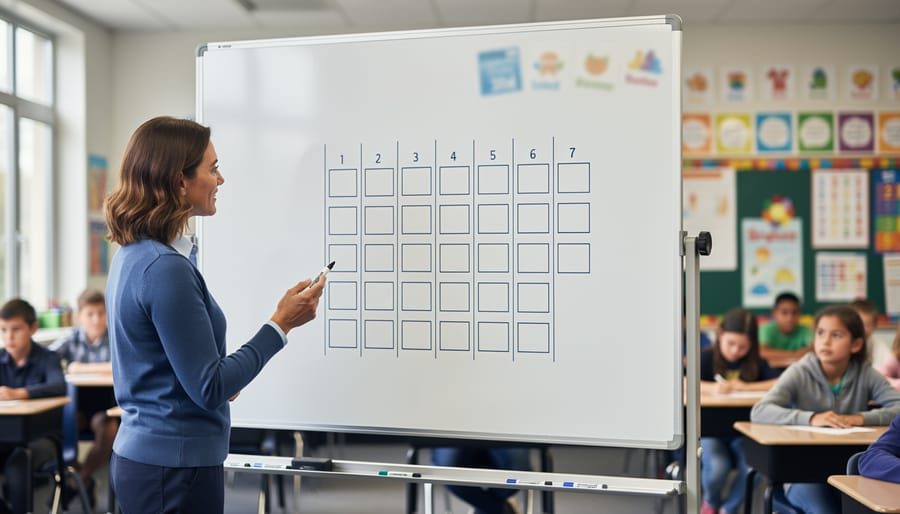
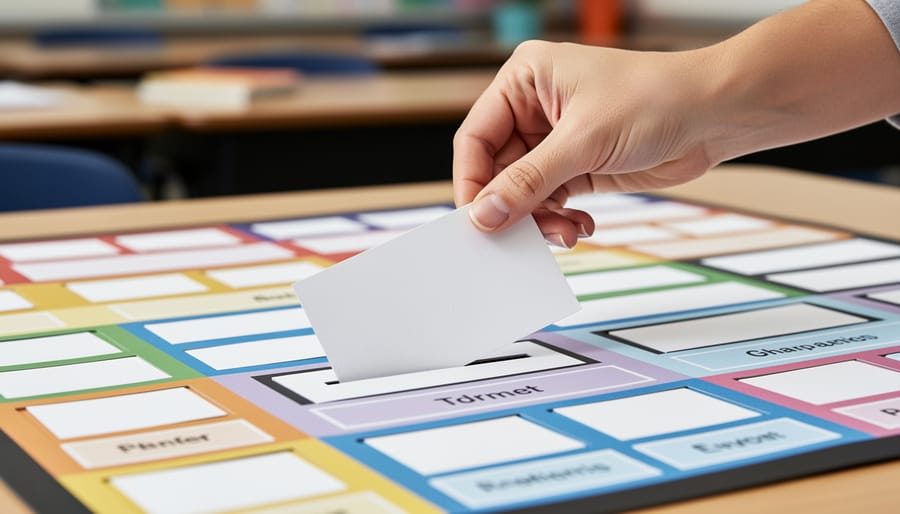
In a PowerPoint template, these blank slots live behind each dollar value on the game board. Click a square, and you land on a slide with a space for your clue. Often there’s a second slide or text box waiting for the response. Until you fill them in, the board is just a lovely, empty frame.
Here’s why wording matters so much. A clue that’s too long slows the whole game down. A clue with two possible right responses sparks arguments. A clue that’s too easy or too tricky for your students takes the fun out of the room. Good wording keeps things moving, keeps scoring fair, and keeps every team in the game. If you want a deeper dive, our guide on Jeopardy question writing covers the full process.
And here’s the best part: customization is the real magic. The same template works for any unit, any subject, and any grade. Fill in new clues for fractions this week and the water cycle next week, and you’ve got a fresh review game each time without rebuilding a thing.
The Building Blocks of a Strong Clue
Start With the Answer, Then Work Backward
Here’s a little secret that makes clue writing so much easier: don’t start with the clue. Start with the response.
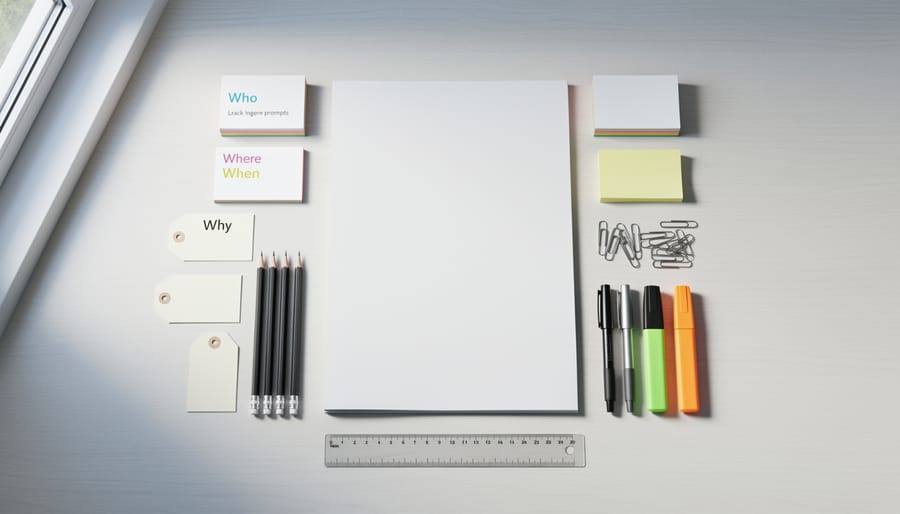
Pick the one thing you want students to say, like “photosynthesis,” “the Declaration of Independence,” or “47.” Write it on a sticky note or the corner of your page. Now you have a target, and every word of your clue should point straight at it.
Next, ask yourself, “What’s the most interesting or helpful thing I can say about this answer without actually saying it?” Maybe it’s what the answer does, where it happened, or how it’s used. Write that down in plain words.
Keep it to one or two sentences. If you need a third, your clue is probably trying to do too much. A short clue keeps the game moving and gives every team a fair shot at ringing in.
Last, read your clue aloud and check that only one response fits. If it does, you’re done!
Match the Difficulty to the Dollar Value
Here’s a simple rule of thumb: the dollar value is a promise about difficulty. When a team picks the $100 clue, they expect a quick win. When they go for $500, they’re ready to think harder. Your job is to keep that promise.
Start with your bottom row. These clues should be ones that almost everyone in the room can answer if they’ve been paying attention, like a key vocabulary word or a basic fact from this week’s lesson. Quick wins build confidence and get shy students into the game early.
For the middle rows, ask students to do a little more. Maybe they connect two ideas, recognize a term from a description, or complete a short process. This is where most of your review happens.
Save the top row for the real stretch. Think “why” or “how” instead of just “what,” or combine two concepts from the unit. A good test: if every team could get it right instantly, it doesn’t belong at $500.
A quick way to check your work is to read each column from top to bottom and ask whether the climb feels natural. If $200 feels harder than $400, swap them. Every student should have a few chances to score, and the top row should still feel like a challenge worth cheering for.
Your Jeopardy-Style Clue Wording Prompt Bank

Definition and Vocabulary Prompts
Vocabulary is the easiest place to start because the answer is already sitting in your word list. Pick a term, then wrap a short clue around it. Here are some starters you can copy and adapt:
– “This term describes ___.”
– “This word means ___.”
– “In science, this is the name for ___.”
– “This is the word for a person who ___.”
– “Use this word to describe something that is ___.”
Here’s how that looks in a real classroom. For a science review, you might write, “This term describes the process plants use to turn sunlight into food.” The response is “What is photosynthesis?” For an ELA game, try, “This word means the opposite of generous.” The response is “What is stingy?”
Keep the definition simple and in student-friendly language, even for tough words. If a clue sounds like a glossary entry, trim it down to the one detail that points to a single answer. That keeps the game moving and lets more students jump in.
Who, What, Where, and When Prompts
Facts about people, places, and dates are some of the easiest clues to write, because the answer is already sitting in your lesson notes. Pick a name, location, or year from your unit, then wrap a short statement around it. These starters work in social studies, science history, and literature:
– Who: “This person ___” or “This author wrote ___.” Example: “This explorer sailed across the Atlantic in 1492.” (Who is Columbus?)
– What: “This event ___” or “This invention allowed ___.” Example: “This 1969 mission put the first humans on the Moon.” (What is Apollo 11?)
– Where: “This place is known for ___” or “This river flows through ___.” Example: “This country is home to the pyramids of Giza.” (Where is Egypt?)
– When: “This happened the year ___” or “This era began when ___.” Example: “This year, the Declaration of Independence was signed.” (When is 1776?)
Keep the clue to one or two sentences, and save the exact detail, like the date or name, for the response.
Problem-Solving and Math Prompts
Math and problem-solving clues work best when the response is short and checkable: a number, a single step, or the name of a method. The clue sets up the problem, and students flip it into the question.
Try these starters and swap in your own content:
– “Solving ___ gives you this value.”
– “This is the first step when you ___.”
– “This method is used to find ___.”
– “If ___ costs $___ each, this is the total for ___.”
– “This is the missing number in the pattern ___.”
Here’s how they look in different classrooms:
– Math, 6th grade: “Multiplying 8 by 7 gives you this product.” Response: What is 56?
– Science: “This is the first step of the scientific method after asking a question.” Response: What is research (or forming a hypothesis)?
– Money skills: “If pencils cost $0.25 each, this is the total for 12 pencils.” Response: What is $3.00?
Keep the math doable in your head within about 20 seconds. If a clue needs paper and a calculator, it will slow the game down, so save those for a bonus round. For the top-dollar spots, add a second step instead of bigger numbers.
Fill-in-the-Blank, Rhyme, and Category Twists
Once your core clues are in place, a few playful twists keep students leaning forward instead of zoning out. Mix these in once or twice per category and watch the energy climb.
Sentence completions. Try “Complete this phrase: ___,” or “The missing word in this famous saying is ___.” They work for vocabulary, idioms, and even science terms. Example: “Complete this phrase: ‘An apple a day keeps the ___ away.'” Response: What is the doctor?
Common thread clues. Use “What do ___, ___, and ___ have in common?” This is perfect for sorting skills. Example: “Mercury, Venus, and Mars all share this trait.” Response: What is being a planet?
Rhyming clues. Try “This ___ rhymes with ___ and means ___.” Example: “This rhyme for ‘dairy’ is a make-believe creature.” Response: What is a fairy? Students love groaning at these.
Category twists. Rename a category to something silly, like “Before and After” or “Mystery Word,” and write every clue in that style. It’s a simple way to personalize any template.
Customizing Clues for Your Grade Level and Subject
The prompt bank works for every classroom, but a few small tweaks make it fit your students like a glove.
For younger learnerskeep clues short and concrete. Swap “This term describes ___” for “This animal says moo.” Picture-based clues and one-step questions help early readers join in without feeling stuck. You can even read the clues aloud so reading level never gets in the way of the fun.
For older studentsadd a layer of thinking. Instead of asking for a definition, ask them to identify a cause, compare two ideas, or pick the right method for a problem. The same starters stretch nicely when you add a “because” or an “unless” to the clue.
For mixed-ability teamsspread the challenge across the board. Put confidence-building clues in the lower rows so everyone can score, then save the tricky ones for the top. Letting teams huddle before answering gives quieter students a chance to contribute.
For different subjectsborrow the starter that fits best. Vocabulary prompts shine in language arts and science, “Who, What, Where, When” works beautifully in social studies, and the problem-solving prompts are a natural for math.
Now for the best part: make it yours. Drop in a class inside joke, name a clue after your classroom pet, or tie a clue to the book you’re reading this week. When students spot a reference only your class would get, they lean in. A clue about this month’s unit, or about something your students are obsessed with right now, turns a review game into something they actually look forward to.
Common Clue-Writing Mistakes (and Easy Fixes)
Even great teachers trip over a few clue-writing snags. The good news is that each one has a quick fix.
The clue is a paragraph. If students need a full minute just to read it, the game loses its snap. Trim it to one or two sentences and keep only the details that point to the answer. Cut anything that’s just there to sound clever.
More than one response could be right. “This planet is known for its rings” could be Saturn, but a sharp student might argue for Jupiter or Uranus. Add a detail that narrows it down: “This planet’s rings are visible even through a small backyard telescope.” Then test it by asking yourself, “Could a smart kid defend a different answer?”
The clue gives away the answer. Watch for the response word hiding inside the clue itself, like “This type of triangle has three equal sides” when the answer is “equilateral triangle.” Swap in a description of what it does or where you’d see it.
The difficulty doesn’t match the points. A 100-point clue shouldn’t need a research project. Reread your top and bottom rows side by side and adjust until the climb feels fair.
The clue is only for you. Inside references your students haven’t learned yet will fall flat. Stick to what you’ve actually covered in class, and read each clue aloud once before game day.
Blank Jeopardy Clue FAQs
Got questions? You’re in good company, because most teachers wonder the same few things when they sit down to fill in a blank clue slot. Here are quick answers to the ones that come up most.
How many clues do I need for a full board?
It depends on your template, but a classic board has five clues in each category column, so a five-category game needs 25. Smaller boards work great for a quick warm-up or exit-ticket review.
How long should a clue be?
Aim for one or two sentences. If students have to reread it, trim it down so the game keeps moving.
Can students write their own clues?
Absolutely! Have teams draft clues with the wording starters from the prompt bank, then swap boards. It’s a sneaky way to get kids reviewing the material while they write.
Can I reuse a template for different units?
Yes, and that’s the real beauty of it. Swap in new categories and clues, and the same board works all year. Our PowerPoint game templates are built for exactly this kind of quick refresh.
If a clue ever has more than one possible response, add a small detail to narrow it down, such as a time period, a number of syllables, or a first letter. Teaching in a multilingual classroom? You can localize game language so every student can join the fun in a way that works for them.
You don’t need to write a whole game from scratch. Grab a few wording starters from the prompt bank, fill in the blanks with your own vocabulary, dates, or problems, and you’ve got a set of clues that actually work. Start with the answer, keep each clue to a sentence or two, and scale the difficulty up the board. That’s really all it takes.
Once your clues are ready, drop them into a customizable PowerPoint game template and you’ve got a low-prep review day your students will actually look forward to. Happy clue writing!