
Transform Any Review Session with a Printable Jeopardy Game Your Students Will Love
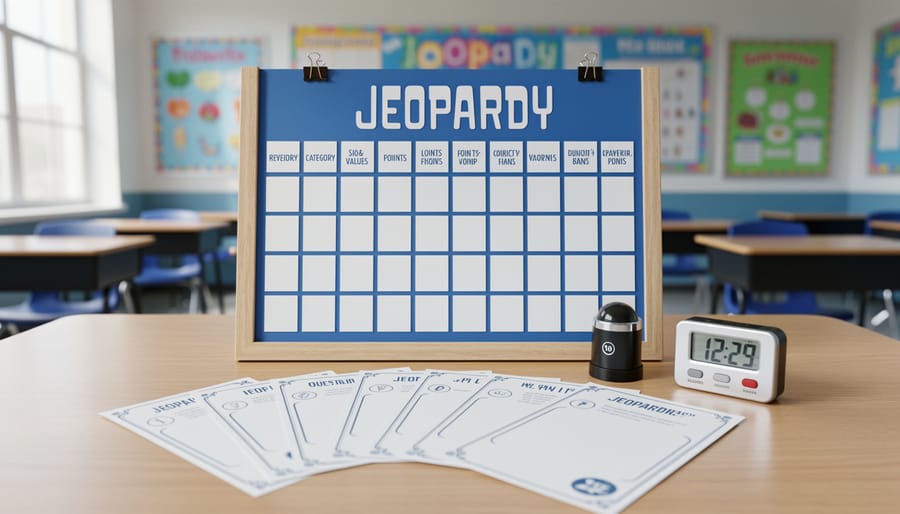
A printable Jeopardy game transforms classic quiz show excitement into a classroom review tool you can download, customize, and launch in under 15 minutes. Teachers use these templates to turn test prep into an energetic, team-based competition that students actually look forward to. The beauty lies in the flexibility: you design the categories and questions around your curriculum, whether you’re reviewing fractions, state capitals, or vocabulary words, then print or project the game board for instant engagement.
The format works because it taps into what makes game shows so addictive. Students buzz with competitive energy while reinforcing concepts they’ve already learned. You control the difficulty level, adjust point values to match your class needs, and reuse the same template across different units simply by swapping out the content. No expensive software or tech troubleshooting required.
Setup couldn’t be simpler. Most printable versions come as editable PDFs or PowerPoint files where you fill in your own categories and answers. Print the board and question cards, divide your class into teams, and you’re ready to play. The question-then-answer format (students respond with “What is…” or “Who is…”) adds an extra layer of challenge that strengthens critical thinking skills while keeping the atmosphere light and fun. Best of all, you build the game once and use it year after year, tweaking questions as your curriculum evolves.
Why Printable Jeopardy Games Work So Well in the Classroom
Students lean forward in their seats when you announce it’s game time. That shift in energy isn’t just about escaping regular work, it’s the competitive spark that makes a printable Jeopardy game such a powerful review tool. When learning feels like play, students engage more deeply with the material without realizing how much they’re actually studying.
The game show format taps into something most kids already know and love. They’ve seen the buzz-in tension, the category choices, the triumphant reveals. That familiarity means you spend almost no time explaining rules, and students jump right into the action. Meanwhile, research confirms what teachers observe firsthand: game-based review boosts engagement and helps information stick.
The competitive element does more than pump up energy levels. Students naturally want to answer correctly when points are on the line, which means they’re actively recalling facts rather than passively listening. Even quiet learners often speak up when their team needs them. That peer accountability pushes everyone to contribute, creating a classroom buzz you rarely get during traditional worksheet reviews.
For you as the teacher, the stress reduction is real. No elaborate prep, no expensive equipment, no tech glitches five minutes before class starts. Print, cut if needed, and you’re ready to run an engaging review that hits multiple learning objectives at once. The game structure handles pacing and student participation naturally, so you can focus on facilitating rather than managing chaos.
Plus, when students have fun reviewing, they actually look forward to the next session. That positive association with studying transforms how they approach test prep throughout the year.
What Makes a Great Printable Jeopardy Game
Game Board Options
You’ll find three main board formats when choosing printable Jeopardy materials, each suited to different classroom situations.
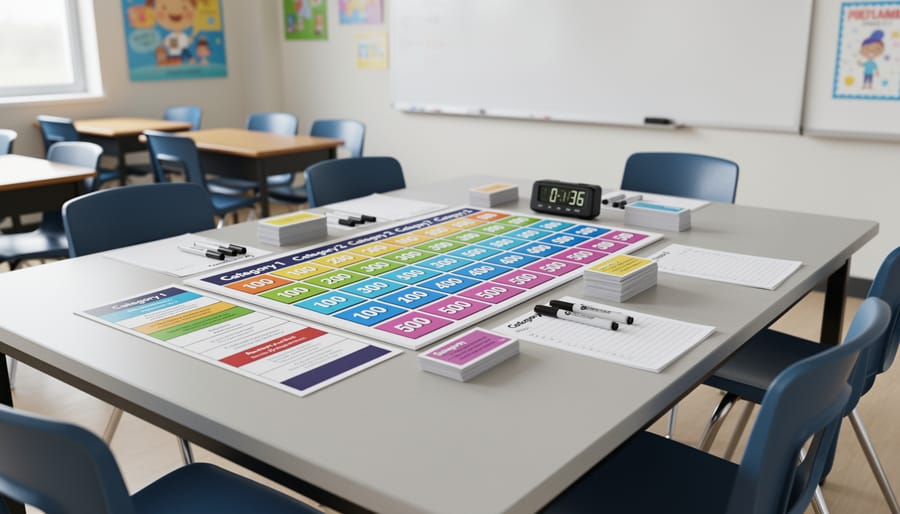
Poster-size boards work best for whole-class games with 20+ students. Print these across multiple sheets and assemble them on your wall or whiteboard. They create a visual focal point that everyone can see from their seats, making them ideal for traditional team competitions in larger spaces.
Individual sheet boards are perfect for small group stations or classes under 15 students. Each team gets their own compact game board (typically one or two pages), which works great when you’re running multiple simultaneous games or have limited wall space. Students can gather around desks to play, making this format excellent for centers or breakout activities.
Card-based systems offer maximum flexibility. Rather than a fixed board, you organize question cards by category in envelopes or pockets. This format shines when you need quick setup, want to mix categories between games, or prefer students to physically interact with the materials. It’s also the easiest to store and reuse across different units.
Question and Answer Cards
Printable question and answer cards form the heart of your Jeopardy game, giving you complete control over content while keeping setup simple. Most sets organize cards by category and point value, with questions printed on one side and answers on the reverse, or as separate cards if you prefer to keep them at your desk.
Group your cards using colored paper or corner marks to distinguish categories at a glance. Within each category, arrange questions from easiest (lowest points) to most challenging (highest points), creating a natural progression that builds student confidence. For younger learners, use 100-500 point scales; older students can handle 200-1000 ranges.
When writing questions, keep language direct and age-appropriate. Phrase each one as a statement requiring students to respond in question form, staying true to Jeopardy’s format. Avoid ambiguous wording or trick questions, clarity helps students focus on demonstrating knowledge rather than decoding confusing language.
Store completed card sets in labeled envelopes or binder pockets organized by subject and difficulty, making them instantly ready for your next review session.
How to Set Up Your Printable Jeopardy Game in Minutes
Getting your printable Jeopardy game ready for class doesn’t require hours of prep work. With a few simple steps, you can transform your downloaded materials into an exciting review activity that students will be asking to play again.
Start by gathering your supplies. You’ll need your printed game materials, scissors or a paper cutter, tape or clips to display the board, and something to track points (a whiteboard works great). If you’re using answer buzzers or bells, grab those too, though they’re completely optional.
Here’s your quick setup process:
- Download your template or pre-made game and print all components. Print the game board on regular or cardstock paper, and run off enough question cards for all categories and point values.
- Cut out your question and answer cards along the lines. Keep each category’s cards together in separate stacks to stay organized.
- Arrange the game board where all students can see it. Tape it to your whiteboard, prop it on an easel, or display it flat on a table depending on your classroom setup.
- Place question cards face-down on or near their corresponding board spaces. You can tape cards directly over point values, use clothespins to attach them, or keep sorted stacks nearby and remove cards as teams select them.
- Divide your class into 2-4 teams of fairly equal size and skill level. Have teams choose names and assign a spokesperson for each group.
- Explain the rules quickly: teams take turns choosing categories and point values, you read the question aloud, the selecting team gets first chance to answer, and points are awarded or deducted based on correct or incorrect responses.
- Write team names on the board with space for scoring, decide which team goes first (coin flip or rock-paper-scissors works), and start the game.
The whole process typically takes 5-10 minutes once you’ve printed everything. Keep your materials in a folder or envelope between uses, and you’ll have an even faster setup next time.
One time-saving tip: prep your game the day before or during your planning period. Having everything cut and organized in advance means you can launch into gameplay immediately when review time arrives, maximizing the fun and learning rather than spending class time on assembly.

Customizing Your Printable Jeopardy Game for Any Subject
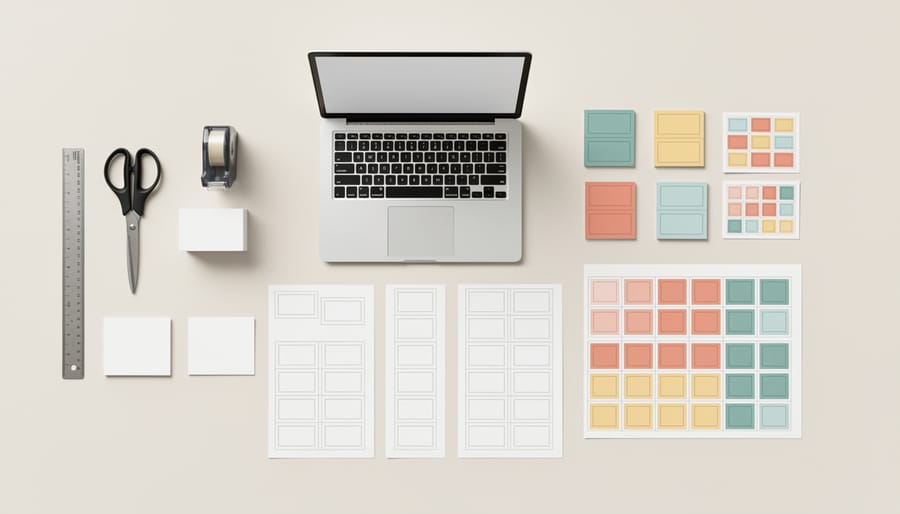
The beauty of printable Jeopardy games lies in their incredible flexibility, you can transform the same template into a completely different learning experience for any subject or grade level. Start by identifying your lesson objectives and the specific concepts you want to reinforce, then build your categories around those themes.
For math classes, create categories like “Multiplication Madness,” “Fraction Fun,” or “Word Problems” with questions that increase in complexity. Science teachers might use “Cell Parts,” “Chemical Reactions,” and “Lab Safety” categories. Language arts educators can focus on “Vocabulary,” “Grammar Rules,” and “Literary Devices.” The category structure naturally guides students through different aspects of your curriculum while keeping the familiar game format they love.
Grade level adaptation is straightforward with printable formats. For younger students, use fewer categories (three instead of five), limit point values to smaller numbers, and include visual clues or pictures alongside questions. Middle schoolers handle the traditional five-category setup well, while high schoolers thrive with challenging categories that require critical thinking or multi-step reasoning.
Don’t hesitate to mix difficulty levels within categories based on your students’ needs. If you’re reviewing a unit where one concept proved trickier than others, weight those questions with higher point values or include more of them. You can also create “Daily Double” cards that target specific skills you want to emphasize.
The real magic happens when you personalize content with classroom inside jokes, references to recent lessons, or connections to your students’ interests. These touches transform a generic review into something that feels made just for your class.
Creative Ways to Use Printable Jeopardy Beyond Traditional Review
Your printable Jeopardy game doesn’t have to wait for test day. Think of it as a versatile tool you can pull out whenever your classroom needs a burst of energy or connection.
Start the year strong by turning your game board into a get-to-know-you activity. Create categories like “Favorite Foods,” “Dream Vacations,” or “Hidden Talents” where students answer questions about themselves. It breaks the ice naturally and gives everyone a voice from day one.
Team-building takes on new life when you design categories around problem-solving scenarios or collaborative challenges. Students work together to tackle “Real-World Math,” “Science Mysteries,” or “Community Helpers” questions, building trust and communication skills while they play.
End-of-year celebrations become more meaningful with a year-in-review game. Fill your board with memorable moments, inside jokes, and lessons learned throughout the school year. Students love reminiscing about their growth, and it’s a perfect way to close the chapter together.
Transform homework review from a chore into a competition. Instead of going over answers one by one, turn completed assignments into game questions. Students stay alert because they might see their own work featured, and you can address common mistakes without singling anyone out.
The beauty of printable formats is that you can theme them for holidays, special events, or even brain breaks between lessons when focus starts to fade.
Tips for Managing Gameplay and Keeping Everyone Engaged
Managing a lively Jeopardy game with multiple teams requires a few strategic moves to keep participation balanced and energy levels steady. Start by establishing clear turn-taking rules before the first question. Rotate which team selects the category, or let the team that answered the previous question correctly choose the next one. This prevents one dominant group from controlling the entire game flow.
If you’re working with larger classes, consider splitting into three or four teams rather than just two. Smaller team sizes mean more students get speaking opportunities and stay actively involved. Assign roles within each team (spokesperson, scorekeeper, time watcher) and rotate these every few rounds so everyone experiences different responsibilities.
When teams huddle to discuss answers, enforce a brief time limit (15-30 seconds works well). This keeps the game moving and adds an exciting pressure element that mirrors the TV show. A small kitchen timer or your phone’s stopwatch displayed on the projector builds anticipation.
Keep quieter students engaged by implementing a “everyone must answer once” rule before anyone can answer twice. Track participation with quick tally marks on the board if needed. For questions that stump all teams, open it to the whole class or offer a bonus chance, turning potential dead air into an opportunity.
Watch for signs of flagging energy around the midpoint. A quick stretch break, a surprise bonus round, or doubling the points for the next category can reinvigorate the room. Celebrate correct answers with genuine enthusiasm and keep incorrect responses light, remind students that mistakes help everyone learn.
Printable Jeopardy games give you a reliable, flexible tool that transforms mundane review sessions into energetic competitions your students actually look forward to. Whether you’re reinforcing vocabulary, prepping for exams, or wrapping up a unit, these ready-to-print resources deliver engagement without hours of prep work.
The beauty lies in their adaptability. You can pull a template off the shelf for a quick Friday review, or spend fifteen minutes customizing categories to perfectly match your current lessons. Either way, you’re creating an experience that gets students talking, thinking, and collaborating while you assess their understanding in real time.
Start small if you’re new to classroom Jeopardy. Print a simple board, write questions on index cards, and see how your students respond. Once you experience the energy shift in your classroom, you’ll find yourself reaching for this format again and again. The combination of familiar game show excitement and meaningful academic content makes printable Jeopardy games one of the most versatile teaching tools in your resource collection. Your next great review session is just a print button away.