Why This Boatload of Crossword Puzzles Is Changing Classroom Review Forever
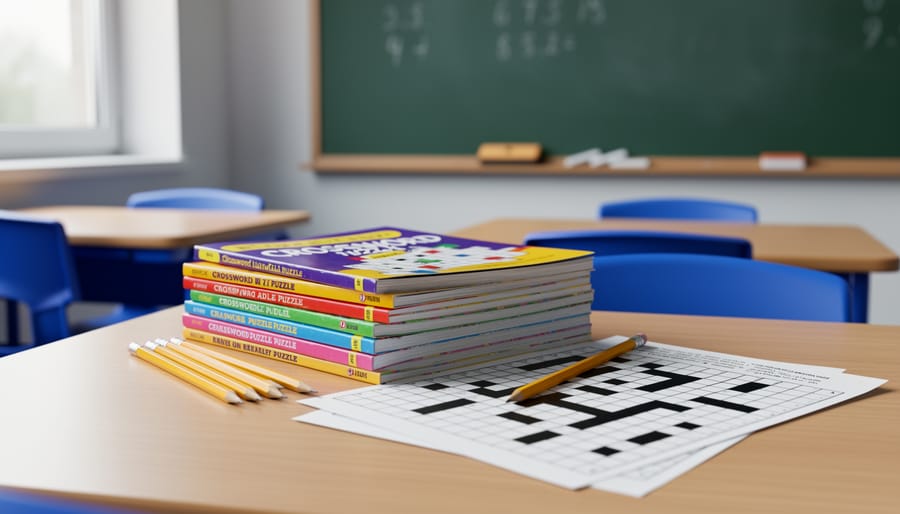
A boatload of crossword puzzles gives teachers instant access to hundreds of ready-made activities that turn vocabulary review into an engaging classroom challenge. Instead of spending precious time crafting a single puzzle, you can choose from an extensive collection that covers multiple subjects, difficulty levels, and grade-appropriate themes. The newly expanded 2026 Boatload Puzzles resource offers educators exactly what the name promises: an enormous variety of puzzles that complement game-based learning strategies already proven to boost student engagement.
Having this many puzzles at your fingertips solves a common teaching dilemma. You know crosswords work brilliantly for reinforcing spelling, definitions, and content retention, but creating custom puzzles eats up planning time you don’t have. A vast collection lets you grab age-appropriate puzzles for quick bell ringers, differentiated assignments for mixed-ability groups, or emergency sub plans that actually keep students learning.
The real power comes from choice. When you’re teaching photosynthesis to fifth graders, you can select from multiple science-focused puzzles and pick the one that matches your class’s current vocabulary level. Teaching high school history? Pull a puzzle that reinforces the specific era you’re covering. This abundance transforms crosswords from occasional treats into regular classroom tools that require minimal prep but deliver maximum educational value. You’ll spend less time hunting for materials and more time watching students actively wrestle with content in a format they genuinely enjoy.
What Makes a Boatload of Crossword Puzzles Perfect for Your Classroom
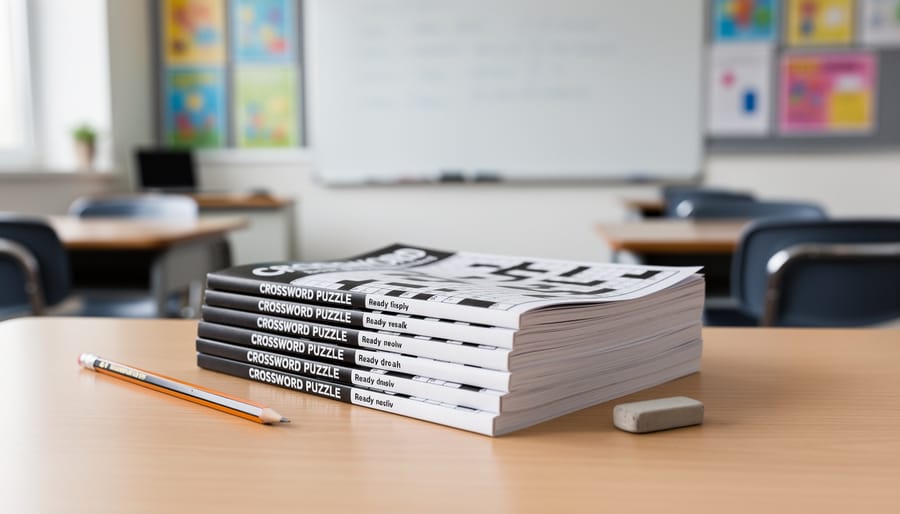
Think about walking into a classroom where every student is working at just the right level, not bored by puzzles that are too easy, not frustrated by ones that are too hard. That’s the power of having extensive crossword puzzle resources at your fingertips.
When you have access to a wide variety of crossword puzzles, you’re not stuck with a one-size-fits-all approach. You can pull a vocabulary-focused puzzle for your English learners, grab a science terminology grid for your advanced biology students, and select a simplified version for those who need extra support, all within the same class period. This flexibility transforms crosswords from a generic worksheet into a targeted learning tool.
The real magic happens when you can match puzzles to specific learning objectives. Teaching photosynthesis? You need a puzzle that reinforces those exact terms. Reviewing state capitals? There’s a puzzle for that, too. With Boatload Puzzles’ newly expanded collection (2026), you’re not hunting through outdated resources or creating everything from scratch. The variety means you can rotate puzzles throughout the year without students seeing the same content twice.
Quantity also matters for maintaining engagement. When students encounter fresh puzzle formats and varying difficulty levels, crosswords stay interesting rather than becoming predictable busywork. You can use simpler grids as warm-ups, medium-difficulty puzzles for group work, and challenging ones as extension activities for early finishers.
Having diverse puzzle options means you can differentiate seamlessly without making students feel singled out. Everyone gets a crossword, everyone participates, but each student works at their appropriate level. That’s differentiated instruction that actually works in real classrooms.
Smart Ways to Use Crossword Puzzles for Review and Assessment
Turn Crosswords Into Interactive Team Challenges
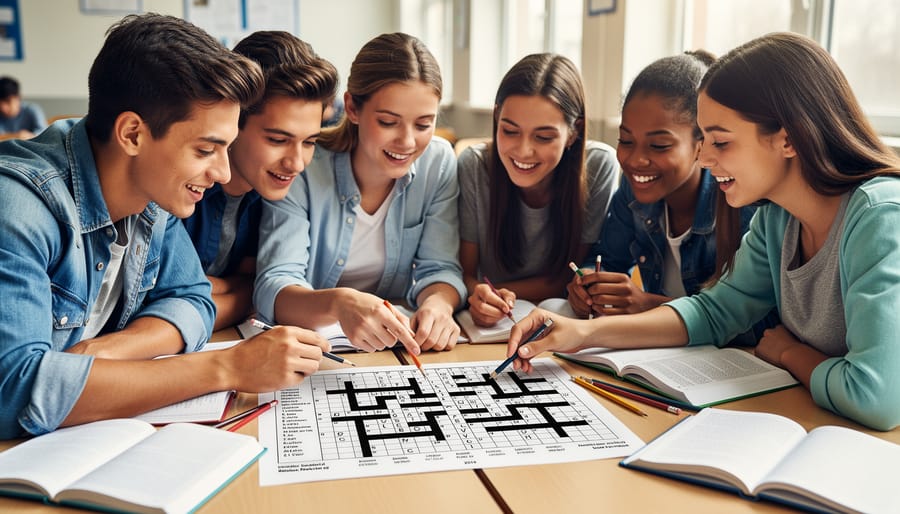
Divide your class into teams of three or four students and watch those crossword puzzles transform into dynamic learning competitions. Give each team a single puzzle and time them as they race against other groups to complete it first. This setup naturally encourages discussion about vocabulary, critical thinking about clues, and collaborative problem-solving as students debate answers together.
Try the “relay race” format where team members rotate taking turns to fill in clues, or create stations where teams move between different puzzles focused on specific unit topics. You can even project puzzles on your board for whole-class participation, letting teams buzz in with answers.
The competitive element taps into the same benefits of play-based assessment reducing test anxiety while revealing what students actually know. Keep a leaderboard across review sessions to build excitement, or award bonus points for teams who explain their reasoning.
These team challenges work especially well before tests or at the end of units when you need active review that keeps energy high and participation widespread.
Quick-Fire Review Sessions That Actually Work
When you only have five to ten minutes, crossword puzzles become powerful micro-learning tools. Start class with a “Speed Clue Challenge”, project one puzzle on your board and give students two minutes to solve as many clues as possible in their notebooks. This wakes up brains and activates prior knowledge without eating into instruction time.
Try “Exit Ticket Crosswords” at the end of lessons. Hand out mini three-by-three grids featuring the day’s key vocabulary. Students complete them before leaving, giving you instant insight into who grasped the concepts and who needs follow-up. The low-stakes format reduces test anxiety while still providing valuable assessment data.
For transitions between activities, use “Lightning Rounds” where you read clues aloud and students race to shout correct answers. This keeps energy high during potentially dead time and reinforces terms through verbal repetition.
The beauty of having abundant puzzle options is mixing difficulty levels throughout the week. Monday’s warm-up might use simpler clues, while Friday’s challenges students with trickier wordplay, all targeting the same core content. You’re building mastery through spaced repetition without redundancy.
Customizing Crossword Puzzles to Match Your Curriculum
The real power of crossword puzzles in your classroom emerges when you move beyond generic puzzles and create content that matches exactly what your students are learning. With a substantial puzzle collection at your fingertips, you can tailor every grid to reflect your curriculum’s vocabulary, concepts, and learning objectives.
Start by identifying the key terminology your students need to master for each unit. Pull 10-15 essential terms from your lesson plans and build crosswords around them. For a middle school science unit on ecosystems, your puzzle might include words like “photosynthesis,” “decomposer,” and “food web” alongside simpler terms for scaffolding. The clues become your teaching tool, write them to reinforce specific definitions your class has discussed rather than using generic dictionary descriptions.
Grade-level appropriateness matters tremendously. Third graders need shorter words, straightforward clues, and smaller grids (maybe 8×8 or 10×10), while high schoolers can tackle 15×15 grids with complex vocabulary and clues that require higher-order thinking. Adjust your clue writing accordingly. A fifth-grade history puzzle might ask “President during the Civil War (7 letters)” while an AP US History version could challenge students with “Commander whose Emancipation Proclamation shifted war aims in 1863.”
The customization process also means thinking about standards alignment which specific learning goals does each puzzle address? When you design puzzles around state standards or district curriculum maps, they become legitimate assessment tools rather than just filler activities. Note which standards each puzzle covers so you can document how these resources support your instructional goals.
Consider creating puzzle variations for the same content. Make three versions of your geometry vocabulary puzzle at different difficulty levels, or design one version with visual clue hints and another with text-only clues. This differentiation approach lets every student access the material while working at an appropriate challenge level.
Subject-Specific Success Stories
Crossword puzzles aren’t just for English class anymore. Teachers across every subject are discovering how these versatile tools reinforce learning in surprisingly effective ways.
Language arts teachers see the most obvious fit. A seventh-grade teacher used a boatload of vocabulary-focused puzzles to prepare students for a novel unit, creating weekly challenges that introduced literary terms like “foreshadowing” and “protagonist” before students encountered them in reading. The puzzles made abstract concepts stick because students had to actively recall definitions rather than passively recognize them. Poetry units become less intimidating when figurative language terms appear in crossword format throughout the week.
Science classrooms benefit from crosswords that target technical vocabulary. A biology teacher created themed puzzles for each system studied, circulatory, digestive, respiratory, with clues that required students to understand function, not just memorize terms. “What carries oxygen-rich blood from the heart” works better than “largest artery” because it tests comprehension. Chemistry teachers use puzzles for element symbols, bonding types, and lab equipment names. The repetition builds familiarity without feeling like drill work.
| Subject Area | Puzzle Focus | Classroom Application |
|---|---|---|
| Language Arts | Literary devices, vocabulary, grammar terms | Pre-reading prep, weekly word study, figurative language review |
| Science | Technical terms, processes, element symbols | System reviews, lab safety reinforcement, classification practice |
| Social Studies | Historical figures, geographic features, events | Unit summaries, map skill building, timeline reinforcement |
| Math | Geometry terms, operations, mathematical properties | Formula recall, vocabulary building, concept connections |
Social studies teachers use crosswords to cement names, dates, and places that students struggle to retain. A world geography puzzle might include clues about capital cities, mountain ranges, and major rivers, all the facts that slip away between units. History teachers create puzzles around key figures and events from each era studied, making timeline review more engaging than flashcards.
Even math teachers are getting creative. Geometry vocabulary sticks better when students complete puzzles featuring terms like “hypotenuse,” “supplementary,” and “congruent.” The visual-spatial nature of crosswords actually complements mathematical thinking.
The pattern across subjects is clear: crosswords work best when clues require understanding, not just rote recall. When you have access to a boatload of puzzles, you can pick and customize ones that match exactly what your students need to master, regardless of what you teach.
Making Crossword Puzzles Work for Every Student
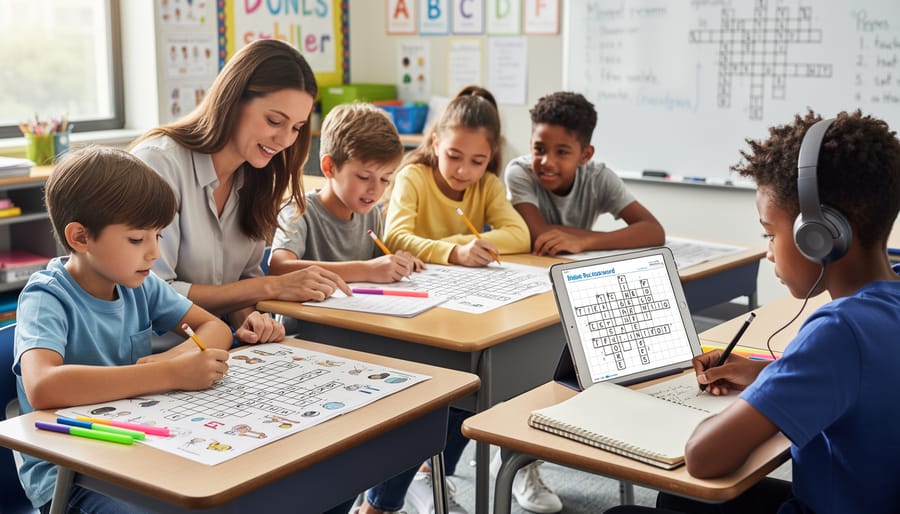
Every student walks into your classroom with different strengths, challenges, and learning speeds. The beauty of having access to numerous crossword puzzles is that you can match the right challenge to the right learner without creating entirely separate lesson plans.
Start by offering puzzles at three difficulty tiers for the same topic. Your struggling readers get a version with a smaller grid, simpler vocabulary, and more direct clues. On-level students tackle the standard puzzle. Advanced learners receive extended grids with synonyms, contextual clues, or discipline-specific terminology that pushes their thinking further.
Partner work transforms crosswords into scaffolded learning experiences. Pair a student who needs support with a peer mentor, and watch them talk through clues together. The conversation itself becomes the learning, not just filling in boxes. For students with processing challenges, provide the word bank printed separately so they can physically cross off answers as they go.
Visual learners benefit when you project a master puzzle on the board and solve the first few entries as a class. This modeling shows your thought process and builds confidence before independent work begins. Students with fine motor difficulties appreciate digital versions they can complete on tablets or laptops, while English language learners gain traction when you allow bilingual dictionaries or include picture clues alongside text.
Challenge your quick finishers to create their own crosswords for classmates, flipping them from consumers to creators. This metacognitive shift deepens their content mastery while giving you fresh review materials. When crosswords become flexible tools rather than one-size-fits-all worksheets, every student finds an entry point into the learning.
A robust collection of crossword puzzles isn’t just another classroom resource, it’s a flexible teaching partner that adapts to your schedule, your students, and your goals. Whether you need a five-minute brain break, a collaborative team challenge, or targeted vocabulary reinforcement, crosswords fit seamlessly into diverse teaching moments without the setup time that many interactive tools demand.
The real power lies in variety. Having access to numerous puzzles means you’re never scrambling to find age-appropriate content or settling for something that almost matches your current unit. You can choose puzzles that align perfectly with your curriculum, adjust difficulty on the fly for different learners, and refresh activities throughout the year without repetition.
This approach complements the broader toolkit of game-based review strategies that transform passive learning into active engagement. Crosswords work beautifully alongside PowerPoint games, digital quizzes, and hands-on activities, each serving different learning styles and classroom dynamics. The key is having enough options to keep things fresh and relevant.
As you explore what works best for your students, remember that effective teaching often comes down to having the right tool at the right moment. With Boatload Puzzles’ newly expanded 2026 collection, you’ve got that versatility at your fingertips. Start small, experiment with different formats, and watch how these simple grids spark unexpected conversations and genuine learning in your classroom.