TpT’s New AI Policy: What It Says, What I Think, and Your Turn
This morning an email from Teachers Pay Teachers landed in my inbox, and if you sell there, probably in yours too. Six weeks after the Town Hall, the written AI policy is here. TpT published it on the Seller Blog on November 19, 2026, and is holding a webinar about it on Thursday, December 3 at 7pm Eastern.
Last week I wrote down what I hoped the policy would contain. So this article is three things at once: a plain summary of the rules, a check against my own wish list, and a question for you. For the first time I have opened the comments under an article, because I would like to hear what teachers who buy and teachers who sell make of this.
The short version
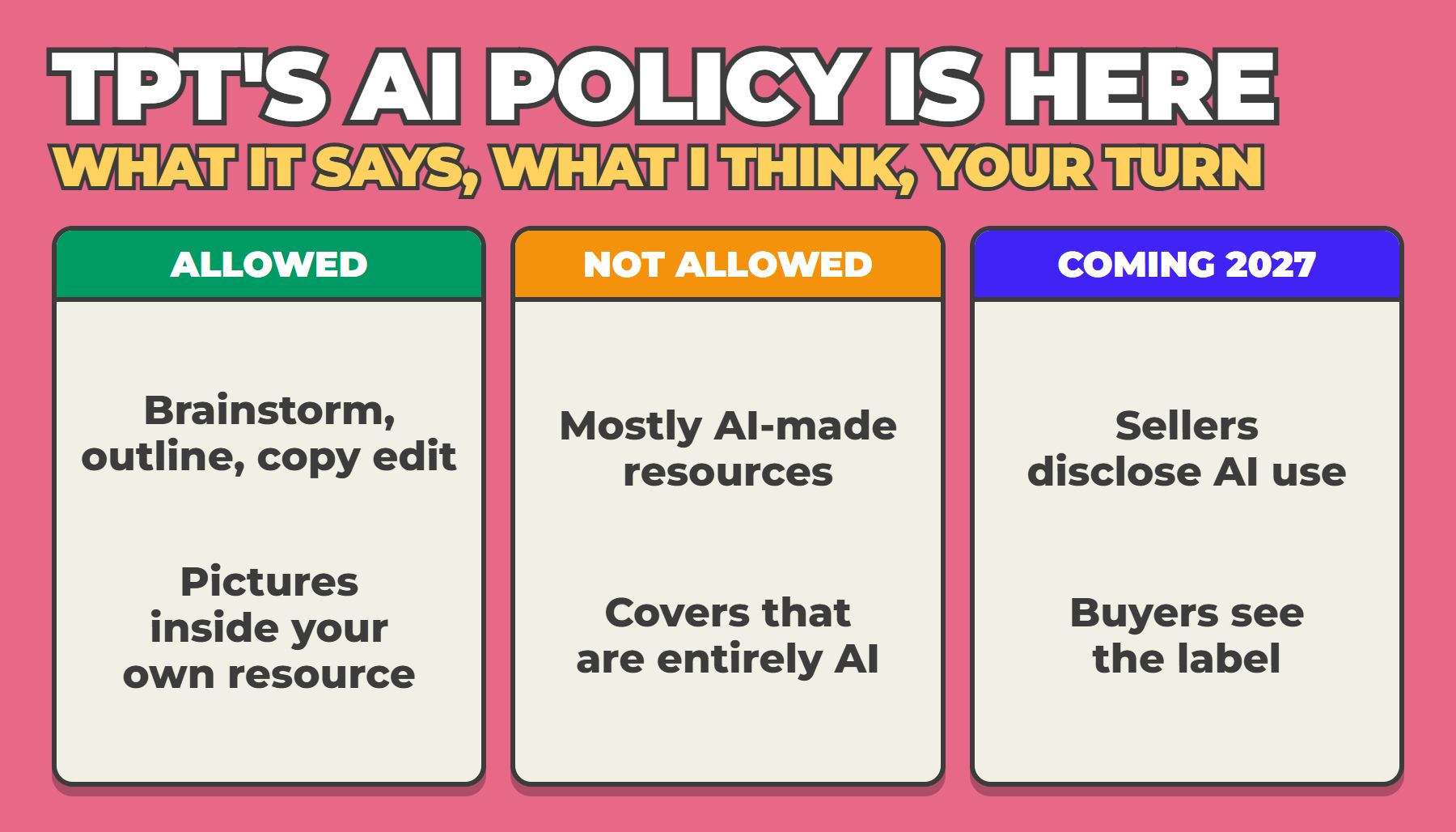
- AI is not banned. The email says resources that are “substantially AI-generated and low-effort” are not allowed, and that “a limited amount of AI assistance is allowed.” The word “AI-free” from October is gone.
- Allowed: AI for brainstorming, research and outlining; AI copy editing of your own writing; AI features inside tools like Canva; AI-assisted images and small decorative elements that support a resource you designed.
- Not allowed: resources that are entirely or mostly AI-made, such as AI coloring pages, posters and clip art sets; AI text with little or no editing; covers or thumbnails that are entirely AI-generated; titles and descriptions pasted from AI; unedited AI translations.
- It applies to everything buyers see: files, covers, thumbnails, previews, titles, descriptions, store banners and profile photos. New and existing listings alike.
- No deadline. TpT asks sellers to fix or inactivate affected listings “as soon as possible,” covers and thumbnails first.
- People decide. Software and reports from buyers and sellers only flag a resource. TpT says a team member makes every decision, normally with a warning and time to fix first.
- A label is coming. From 2027, sellers will have to disclose AI use, and buyers will eventually see it.
What I asked for, and what I got
In my article on the ban I listed five wishes. Here is how the policy measures up against them.
| What I wished for | What the policy delivers |
|---|---|
| A definition in plain words | Partly. There is no percentage. Instead there are examples, and two questions a reviewer asks. Would a reasonable person conclude the resource was mainly AI-generated? And could another teacher easily make something of equal value with AI tools? |
| A clear difference between a resource AI produced and a resource a teacher made with some help | Yes. This is the heart of the policy, and it is the part I am most relieved about. |
| An honest label instead of a guessing game | Coming. Disclosure starts in 2027. Details early next year. |
| A date | No. “As soon as possible” is not a date. In practice the rules apply today, to listings that are already live. |
| A fair way to appeal | Mostly. Humans decide, a warning comes first, and support reviews each case. The exception is what TpT calls egregious cases, where action can come without a warning first. Stores with large amounts of low-effort AI content can be closed without notice. |
What I like
The distinction. In October the message was an AI-free marketplace. The written policy instead separates AI as a helper from AI as the author. That is exactly the line I argued for, and it is the right one. A teacher who lets a program check her spelling, tidy a picture or help her outline a unit has not stopped being a teacher.
People make the decisions. Tools that claim to detect AI often get it wrong. TpT says software only flags, and that it will contact a seller and give her time to fix things before anything is removed, except in extreme cases. That is how it should work.
The translation rule. I make language resources, so this one is close to home. Machine translations are often wrong in ways a non-speaker cannot see. Asking for a human check is good for students.
The credits page. TpT recommends a page in each resource that credits fonts, clip art and other elements you did not make. Many of us already do this. It is a small habit that builds trust.
What still worries me
The second question. “Could another teacher easily create something of equal value using AI tools themselves?” is not a question about where a resource came from. It is a question about how much it is worth. Taken literally, it puts every simple resource at risk, whether or not AI was involved. A ten-word spelling list is a ten-word spelling list. I hope this question is a tiebreaker and not the test.
The warning signs. The policy lists hallmarks of low-effort AI content: AI watermarks, blurry pictures and inaccurate content, but also overuse of sparkles and sprays of accents, lots of bulleted lists and emoji bullets. Teachers have decorated worksheets with sparkles for twenty years, and overuse is in the eye of the reviewer. Some of these signs describe a style, not a tool. Honest sellers with a bright style now have a reason to be nervous, and a competitor has a report button.
Closure without notice. TpT says stores with high volumes of low-effort AI content, especially newer stores without a track record, may be closed without warning. New sellers are the people who know the rules least. I would want one warning for everyone.
No date, but it applies now. No deadline sounds generous. It also means nobody knows when the checking begins, while the policy already covers listings that are live today. If you sell, read that as: start this week.
“Minor element.” The email allows AI-assisted images that support a resource you designed. The blog post adds that AI image content must be a minor element and cannot be the cover or thumbnail. Where does minor end? A picture-matching game for four-year-olds is mostly pictures. If a teacher designs the game and lets AI draw the apples, is that minor? I do not know, and the policy does not say yet.
What it means if you buy on TpT
- Nothing you own is affected. The policy says nothing about resources already bought, and I would not expect it to.
- You will still see AI-assisted resources. That is allowed, and in my view rightly so. What should disappear is the pile of unchecked posters, coloring pages and clip art sets that nobody ever read.
- From 2027 you will see a label. Until then, the same three checks protect you: open the preview, look for the small mistakes, read the newest reviews.
What it means if you sell on TpT
The first two steps are the order TpT itself suggests. The rest are mine.
- Covers and thumbnails first. If a cover is nothing but an AI picture, replace it. This is what TpT asks sellers to fix first.
- Then resources that are mostly AI. Edit them properly or inactivate them. Inactivate rather than delete, so your reviews survive if you rework the resource.
- Descriptions pasted from AI. Rewrite them in your own words. They are easy to spot and quick to fix.
- Translations. Have a speaker check them, or take them out.
- Keep your working files and licenses. If you are flagged by mistake, these show how the resource was made.
- Start a list of where you used AI. You will need it for the 2027 disclosure anyway.
- Watch the webinar on December 3, or the recording afterward. TpT has promised more information on the disclosure early next year, and the gray areas above are the questions to ask at the webinar.
Where I stand
I said last week that I use AI tools in parts of my own work, for example for artwork, and that I check what goes into my shop before it goes live. That has not changed, and the new policy does not ask me to hide it. I will go through my covers one by one with the policy next to me, and if one of them leans too heavily on a picture, I will change it. When the disclosure comes in 2027, I will fill it in truthfully. I would rather a buyer knew how my work is made than wondered.
On the bigger picture my view is the same as in my honest opinion on selling on TpT. A resource is good when a teacher stands behind it: it is correct, someone checked every page, and it works in a real classroom. That was the right test before AI, and it is still the right test now. This policy gets closer to it than I expected in October. Together with the Exclusive Seller change, it will shape what TpT looks like next year, and some sellers told Chalkbeat in October that they doubt the company’s reasons. I cannot see inside the company. I can only say that this text is more careful than the announcement was, and I am glad about that.
Your turn
Comments are open below for the first time on this blog. I would like to hear from both sides.
- If you buy: Would you buy a resource labeled “made with AI help” if a teacher had checked and tested it? Would you expect to pay less for it?
- If you sell: Will you change anything in your store this week? Do the two reviewer questions make sense to you?
- Everyone: Is asking whether another teacher could easily make this with AI a fair test for a teaching resource?
Please be fair to other sellers and to TpT. I will read every comment, and I will add to this article after the December 3 webinar.