
Description
What’s Included
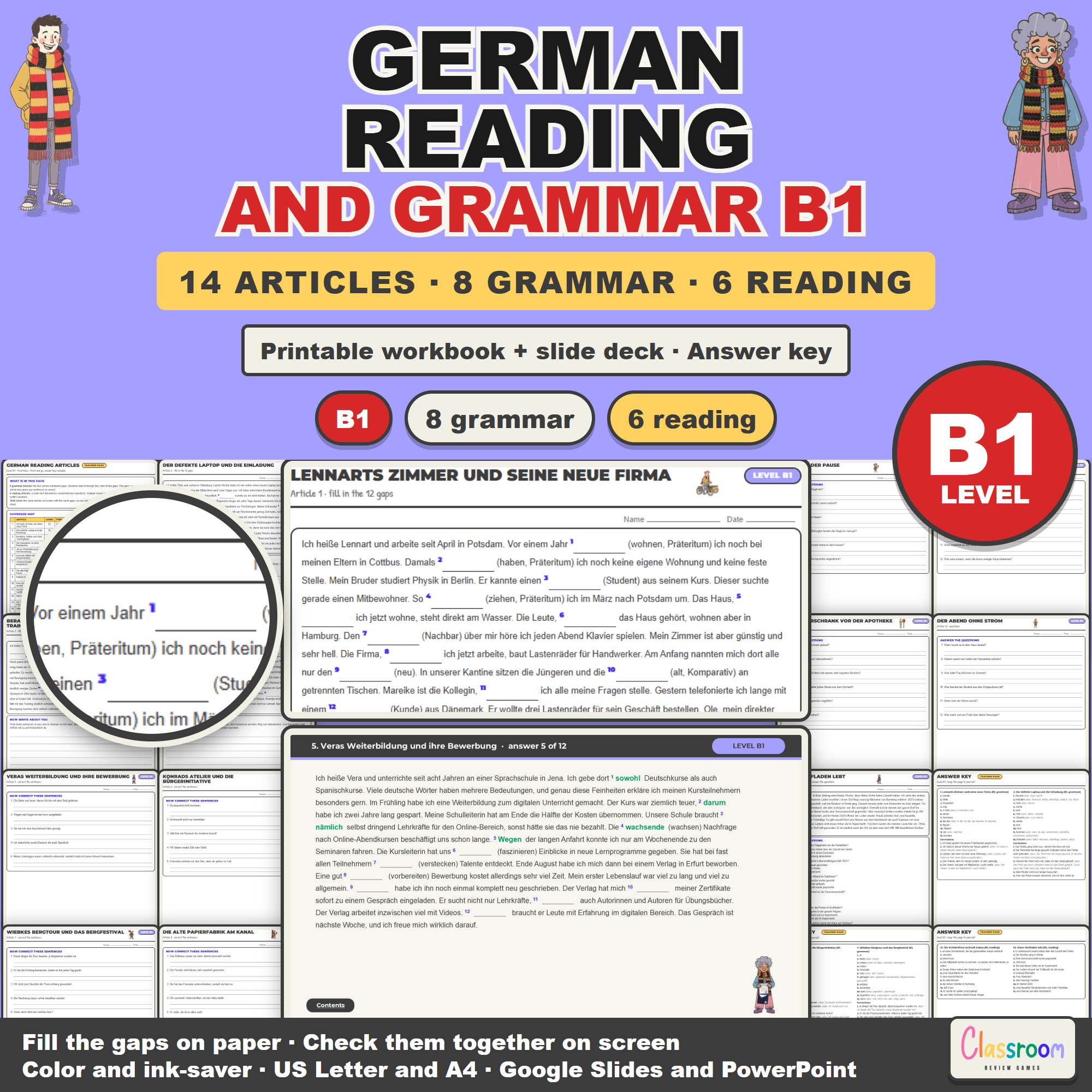
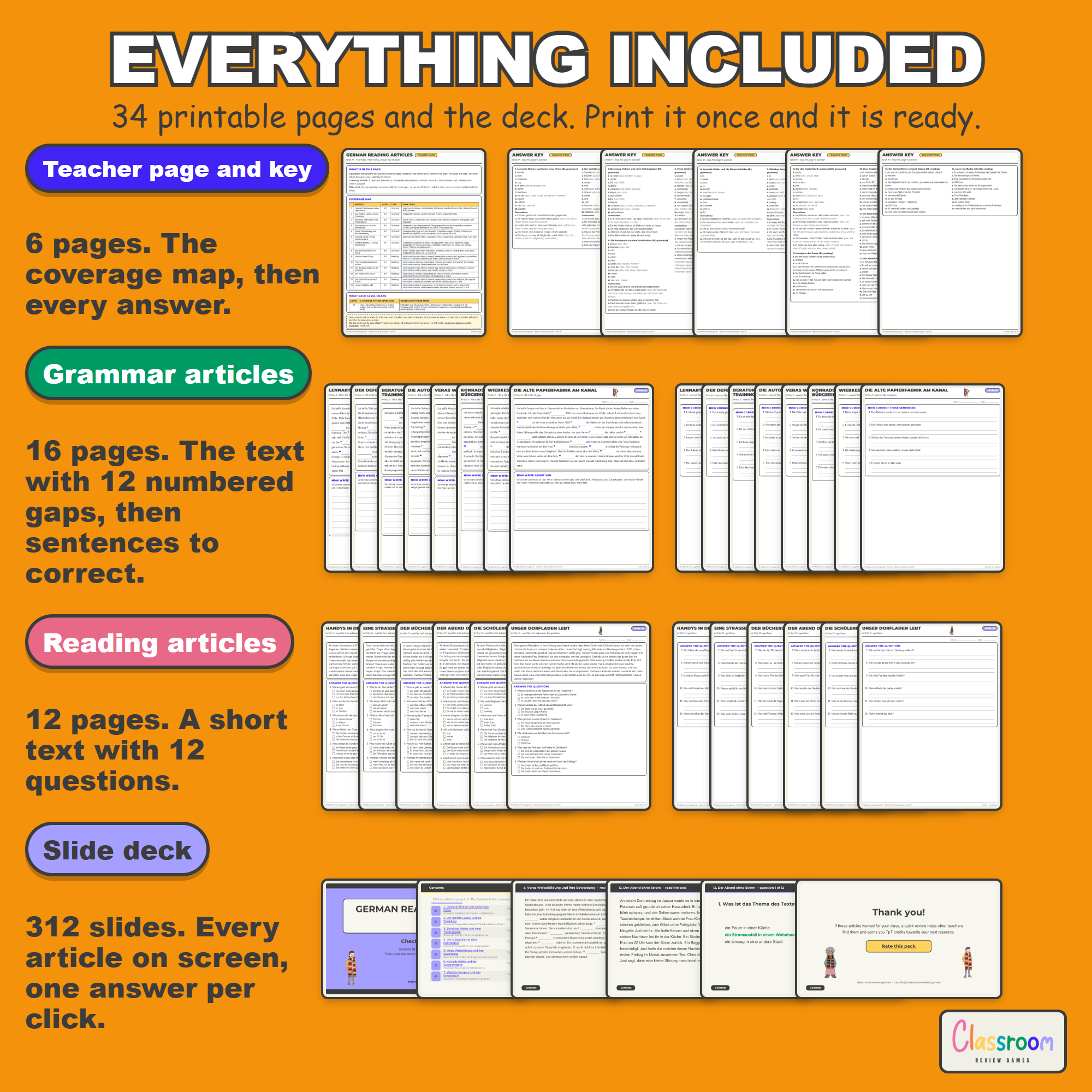
- Printable workbook PDF: a teacher page with the coverage map and a what this level means table, two pages for each of the 8 grammar articles (the gapped text, then the five sentences to correct), two pages for each of the 6 reading articles with their questions, and a full answer key
- 8 grammar articles at B1 with 12 open gaps each, 96 gaps in total, plus 5 sentences to correct and a short write in German task at the end of every page
- 6 reading articles at B1 with 72 comprehension questions in total, half multiple choice and half short answer, in German
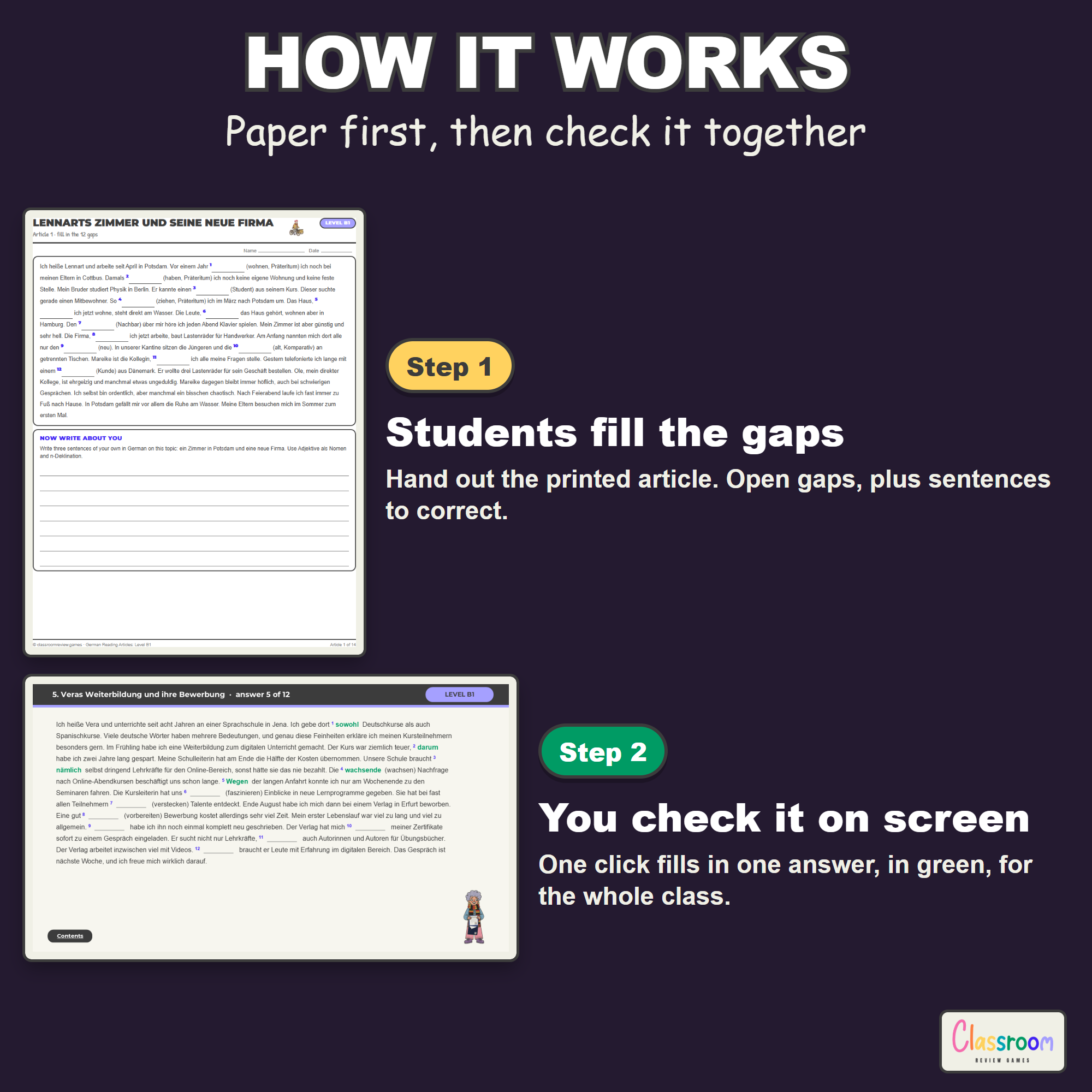
- Answer deck in Google Slides or PowerPoint, 312 slides: the same articles on screen with the same numbered gaps, one answer per click in green, a how to use this deck slide, a clickable contents page and a Contents button on every slide
- Color and ink-saver black and white, US Letter and A4
Open Gaps, Not Two Choices
At A1 and A2 every gap in my articles offers two choices in brackets. At B1 that crutch goes. The student sees a blank line and has to produce the word, the ending or the tense themselves, which is the whole point of the level. Where a gap asks for one specific word rather than one specific form, the text prints a short prompt in brackets, so the task stays fair without giving the answer away. The answer key lists the other answers a teacher should accept for every open gap, so marking a set of these does not turn into an argument.
Five Sentences to Correct on Every Grammar Page
Each grammar article finishes with five sentences that contain a real mistake in the grammar that article practises, and the student rewrites them correctly. That is 40 correction sentences across the pack. Finding an error is a different skill from filling a gap, and at B1 it is the one that shows whether a student has actually understood the rule or has just been pattern matching.
Written At the Level, Not Cut Down
Every article was written to B1 from the first word. The texts use Präteritum and Plusquamperfekt, the n-Deklination, Relativsätze in the dative and with prepositions, Konjunktiv II of the past, the Genitiv, the Passiv in the present, the past and the perfect, Partizipien as adjectives, the two part conjunctions, the Modalpartikeln, and the Infinitivsätze with anstatt zu, ohne zu and um zu. Nothing in here is a harder article with the difficult words swapped out, which is why a third year student can finish one in a single lesson.
One Grammar Article Per Module
The eight grammar articles follow the order a standard B1 course uses, one article per module. Module one is the Adjektive als Nomen, the n-Deklination, the Präteritum and the Relativsätze in the dative and with prepositions. Module two is obwohl and trotzdem, the Futur I and falls. Module three is the Infinitiv mit zu, da, während and bevor, and the adjective endings with the Komparativ and the Superlativ. Module four is the Konjunktiv II of the past, the Plusquamperfekt with nachdem, the Genitiv and the preposition trotz. Module five is the adverbs of consequence and cause, the preposition wegen, the Partizip Präsens and Perfekt as adjectives, and nicht nur sondern auch and sowohl als auch. Module six is brauchen with the Infinitiv mit zu, the expressions with es, and weder noch, entweder oder and zwar aber. Module seven is je desto, the Modalpartikeln, indem and sodass, the prepositions innerhalb, außerhalb, um herum and am entlang, and the Passiv Präsens with modal verbs. Module eight is the Passiv Perfekt and Passiv Präteritum, anstatt zu and ohne zu, and damit, um zu and als ob.
A Complete B1 Review
Run the eight grammar articles in order and you have a full B1 review, one module at a time, with the reading articles as the comprehension practice in between. I wrote them alongside the Menschen B1 course, so they follow that order module by module, but every article practises standard B1 grammar. That means they work for reviewing any B1 content, whichever course you use, and you can just as easily pull the single article that matches the unit you taught this week.
What the Articles Are About
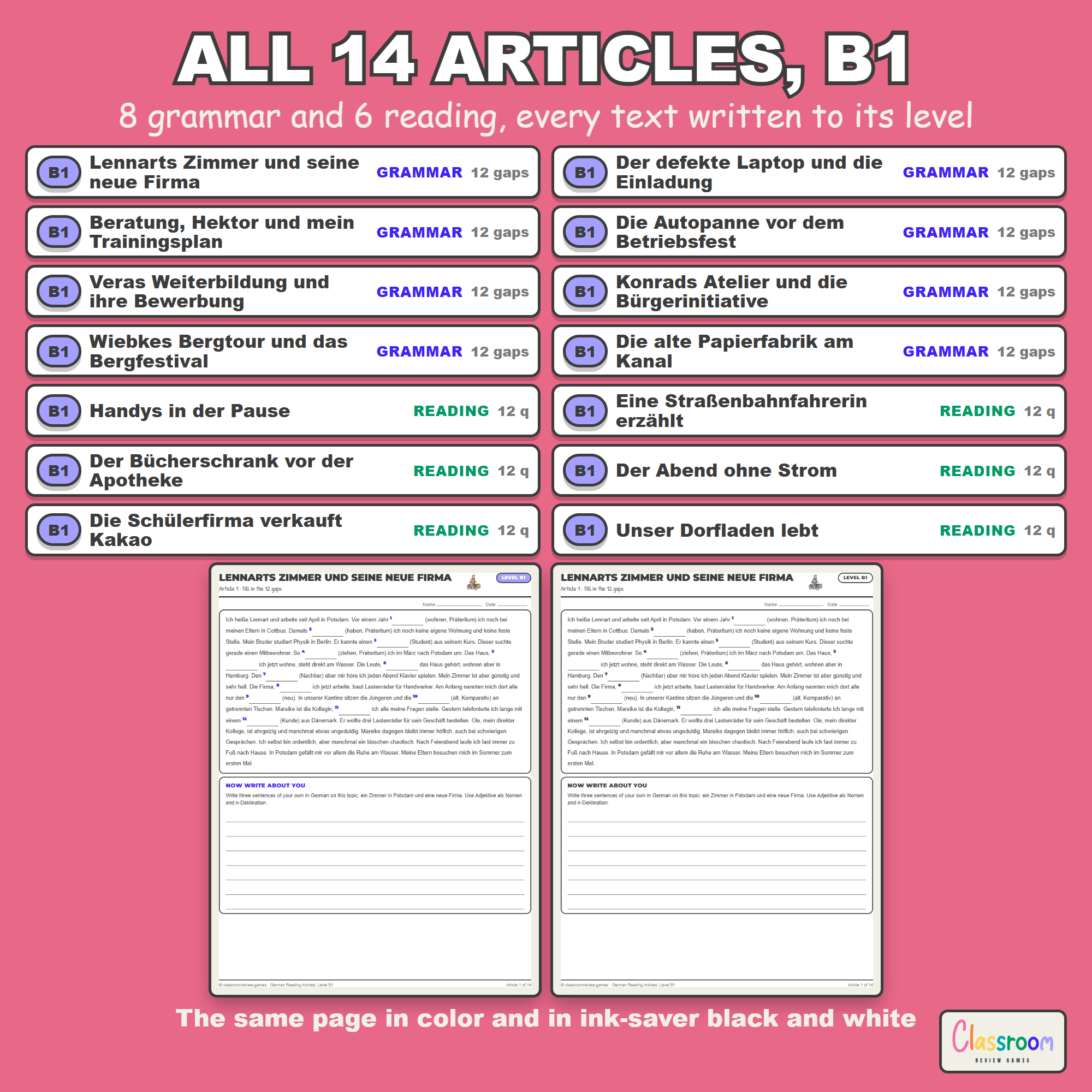
Grammar articles: Lennarts Zimmer und seine neue Firma, Der defekte Laptop und die Einladung, Beratung Hektor und mein Trainingsplan, Die Autopanne vor dem Betriebsfest, Veras Weiterbildung und ihre Bewerbung, Konrads Atelier und die Bürgerinitiative, Wiebkes Bergtour und das Bergfestival and Die alte Papierfabrik am Kanal. Reading articles: Handys in der Pause, Eine Straßenbahnfahrerin erzählt, Der Bücherschrank vor der Apotheke, Der Abend ohne Strom, Die Schülerfirma verkauft Kakao and Unser Dorfladen lebt. Everyday topics from Germany, Austria and Switzerland, classroom safe, and written so a third year class can read one on its own.
Marking Together on Screen
The deck is built for the moment after students have written on paper. Open the article in Present mode and click. Gap one fills in, in green. Click again for gap two. Students mark their own sheet as you go, so you are not reading out twelve answers while half the room loses its place. The contents page links to every article and the Contents button on every slide brings you back.
Works On
Windows, Mac, and Chromebooks. Print the PDFs, project the slides, or do both. No student devices or logins required.
Important
Play the deck in Slideshow (Present) mode so the click through answers and the contents links work. The printable workbook is the same in the Google Slides and the PowerPoint route, so you only choose how you want to show the answers.

Help
Email me any time with questions or requests. Thank you for supporting a small teacher-run shop.
Carolin
carolin@classroomreview.games

Reviews
There are no reviews yet.