How Game-Based Learning Can Support Social-Emotional Skills in Students
Students learn through more than textbooks, lectures, and written assignments. Classroom experiences also shape how they communicate, respond to challenges, work with peers, and understand their own emotions. Game-based learning can create opportunities to practice these skills while students remain engaged with academic content.
Educational games provide students with a structured setting in which they can interact, make decisions, solve problems, and respond to various situations. With the right activities, teachers can use these experiences to support social-emotional development alongside traditional learning objectives.
What Game-Based Learning Actually Means
Game-based learning involves using full digital or physical games to help students develop specific skills. It is different from gamification, which incorporates game-like features such as points, badges, and leaderboards into regular lessons.
A higher-education case study shows that effective game-based courses are created with learning in mind rather than entertainment alone. They provide students with opportunities to participate actively and connect with the material in meaningful ways.
“There are so many amazing ways to use games, game-like experiences and the design process to engage students, not just in academic things, but in things that have to do with conflict or processing feelings,” says Middle school Guidance Counselor Rachelle Vallon.
The demand for game-based learning is, therefore, growing exponentially. It is estimated to be $24.29 billion in 2026. However, market study reports expect it to rise to $118.45 billion by 2034. This exhibits a 21.9% CAGR during the forecast period.
Creating Opportunities for Communication
Communication is a major part of social-emotional development. Students need regular opportunities to express their ideas, listen to others, ask questions, and respond respectfully when they have different opinions.
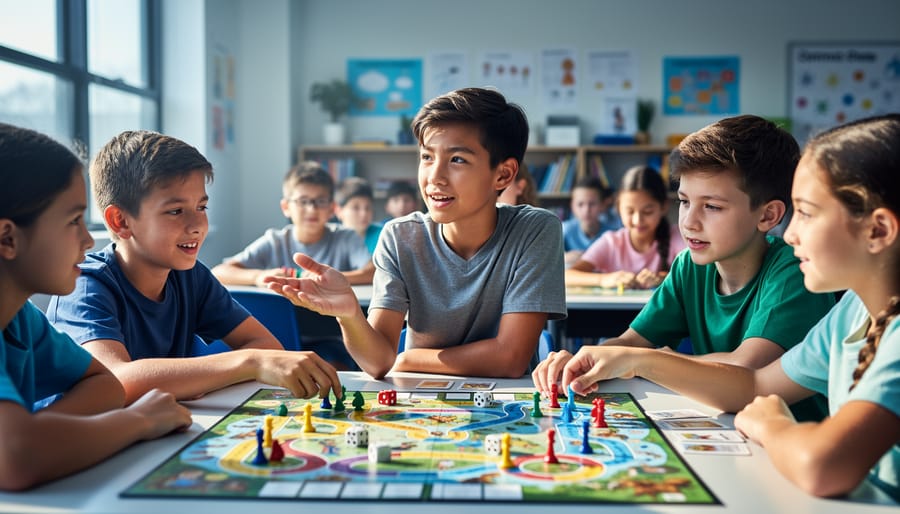
Classroom games can create these opportunities in an engaging setting. These activities can help students practice:
- Expressing ideas: Students explain their answers, opinions, or strategies to their teammates.
- Active listening: Team members need to pay attention to different suggestions before making decisions.
- Asking questions: Students can seek clarification when they do not understand an answer or strategy.
- Respectful disagreement: Games can teach students how to consider different opinions without dismissing their classmates.
- Participation: Students who are usually quiet during traditional lessons may feel more comfortable contributing during interactive activities.
Regular practice can gradually make students more comfortable communicating with their peers.
Connecting Game-Based Learning With Student Support
Social-emotional development is an important part of student support. Teachers, counselors, and other education professionals may help students strengthen communication, manage emotions, build relationships, and respond to everyday challenges. These skills can also shape how professionals approach their work with young people.
This connection can also shape the preparation of future school counselors. According to Walsh University, developmentally informed trauma, crisis, and grief interventions are an important part of master’s programs for school counseling. And more often than not, these challenges arise because of a lack of social-emotional skills.
Thus, professionals can enroll in school counseling master’s programs online to lay the foundation to help students. All the coursework for these programs is available online, which makes them very flexible.
Game-based learning can create natural opportunities to observe and practice these skills for both students and professionals working with them. Students may need to cooperate with teammates, manage frustration, and communicate ideas. These interactions give educators useful insight into students’ social-emotional development.
Reducing Anxiety Through Thoughtful Game Design
Not every game naturally develops emotional skills; the way an activity is designed plays a major role. Researchers who developed a three-stage scaffolded game for communication training found an interesting difference between learning approaches.
Participants who used interactive, video-based scenarios reported considerably lower anxiety than those who worked with static case studies. The study, published in the Springer Nature Link journal, also reported greater engagement and stronger acceptance of the game among participants in the interactive group.
Both groups, however, achieved similar results when it came to learning the core content. The main difference appeared in the emotional experience, with interactive learners reporting less stress. They showed greater willingness to continue practicing challenging interpersonal situations.
This finding is relevant to social-emotional learning because developing lasting skills requires repeated practice rather than relying on a single classroom lesson.
Teamwork Skills Under Competitive Pressure
Games that include meaningful consequences and require teams to make decisions can provide another way for students to develop social skills. A study in pharmacy education transformed “Who Wants to Be a Millionaire?” into a collaborative quiz activity.
Students who participated in the game-based format reported greater teamwork and engagement compared with those attending traditional seminars. However, both groups demonstrated similar levels of knowledge retention.
During the game, students needed to discuss strategies, rely on teammates while under pressure, and handle both collective successes and setbacks. These experiences give students opportunities to practice interpersonal skills that conventional lectures often do not address directly.
This type of activity can also help students recognize how their behavior affects a group. Working toward a shared outcome encourages them to communicate clearly, manage disagreements, and support teammates when pressure increases.
Low-Tech Options Widen Access
Not every classroom has the budget for sophisticated digital platforms. But this does not have to prevent teachers from using game-based learning. A case study on low-tech serious games in higher education found that hands-on, screen-free activities can improve students’ thinking and academic performance.
The researcher noted that an excessive focus on digital tools could widen the technology gap between schools with greater resources and those with fewer. Simple physical games that encourage inquiry and discussion can promote collaborative reasoning much like digital activities.
Teachers can use simple materials such as cards, printed scenarios, question sheets, dice, or classroom boards to create interactive activities. These options are also easier to adapt for different group sizes, learning levels, and classroom settings. As a result, students can practice communication, cooperation, and problem-solving without relying on expensive technology.
Frequently Asked Questions
How can teachers assess social-emotional growth through classroom games?
Teachers can look for changes in specific behaviors rather than relying only on test scores. They can observe whether students take turns, listen to classmates, handle disagreements, ask for help, or recover after making mistakes. Short reflection forms, peer feedback, and teacher observations can also provide useful information about how students are developing these skills over time.
How often should teachers use games to support social-emotional development?
There is no fixed number of games that every classroom needs. Teachers can include short activities regularly rather than relying on occasional large game sessions. A five- or ten-minute activity can provide useful practice when it has a clear purpose. Consistency also gives students repeated opportunities to apply communication, cooperation, and self-management skills.
Can game-based learning work with students of different ages?
The format can be adjusted to suit different developmental stages. Younger students may benefit from simple turn-taking and cooperation games, while older students can work with scenarios involving decision-making and leadership. Teachers should consider students’ maturity, attention span, existing skills, and academic level when selecting or adapting an activity.
Game-Based Learning: Key Stats and Facts
Game-based learning market | $24.29 billion in 2026 to $118.45 billion in 2034 (21.9% CAGR) |
Interactive game study | Lower anxiety reported by learners using interactive video scenarios |
Team quiz study | Higher reported teamwork and engagement but similar knowledge retention between game-based and traditional seminar groups |
Low-tech games | Hands-on, screen-free activities improved thinking and academic performance |
Social-emotional skills | Cooperation, emotional management, confidence, and problem-solving |
Game-based learning can provide students with practical opportunities to develop social-emotional skills as they engage with academic content. Many social-emotional skills can be integrated into the classroom experience when activities are selected and structured with these goals in mind.
The strongest results come when games are treated as learning experiences rather than occasional breaks from regular instruction. A well-planned activity can encourage students to communicate with their peers, manage setbacks, consider different perspectives, and reflect on their own behavior.