

How to Use Keywords to Solve Math Word Problems (Plus a Word Search Twist Students Love)
To solve a math word problem with keywords, circle the clue words, match each one to an operation, and then check that your answer makes sense in the story. It takes about two minutes per problem and works for most students from second grade up. All you need is a pencil and a short keyword list.
Why does it work? Word problems hide simple math inside a story. Words like “total,” “each,” “left,” and “twice as many” are signals, and once kids learn to spot them, the story stops feeling like a wall of text.
There’s a catch, and we’ll cover it. Keywords are clues, not commands. “More” can mean add or subtract depending on the sentence, so we’ll pair the list with a quick reasonableness check that keeps students from grabbing the wrong operation.
This guide walks through the materials, a ready-to-use keyword reference, common traps, and a step-by-step routine you can teach today. You’ll also see how the same highlighting skill carries over to word search puzzles, which makes it easy to turn practice into a game. Better still, every piece is easy to customize for your grade level, your students, and your favorite review activities.
What You’ll Need: Tools, Materials, and a Few Fun Extras
Good news: you don’t need fancy supplies to get started. Most of what you’ll use is already in your classroom supply closet, and a few fun extras can make practice feel more like play than homework.
Here’s your simple checklist:
- A set of word problems at the right grade level (start with one-step problems before moving on)
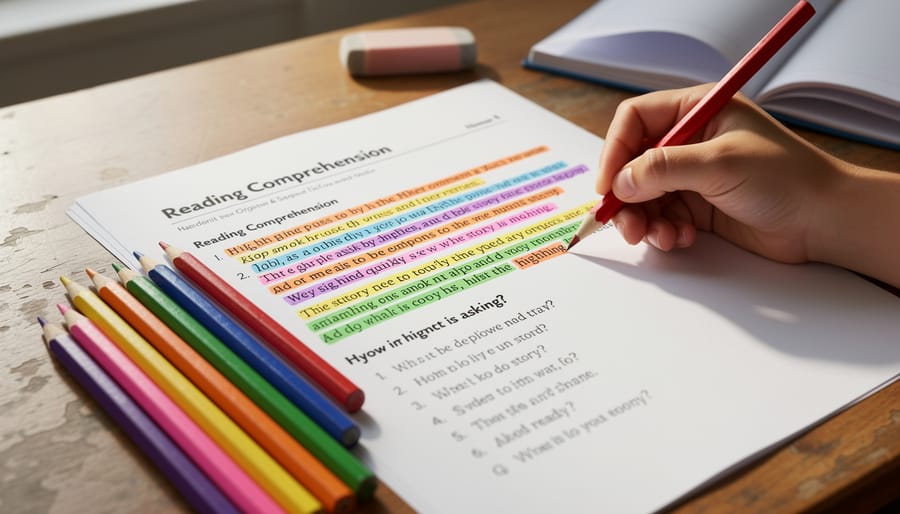
- Highlighters or colored pencils for circling and marking clue words
- A keyword cheat sheet or anchor chart posted where everyone can see it
- Scratch paper for turning keywords into number sentences
- An optional word search puzzle built from math keywords
- A customizable PowerPoint review game template with a scoreboard
Color is your friend here. Try assigning one color per operation, say green for addition clues and blue for subtraction, so students can spot patterns at a glance. It’s a small touch that makes the thinking visible.
The anchor chart doesn’t have to be perfect, either. Let students help build it, and they’ll remember the clue words far better than if you simply hand them a printout.
Ready for some extra fun? A keyword word search is a great warm-up because students hunt for words like “total” and “each” before they ever touch a problem. And a customizable PowerPoint review game turns practice into a team activity. Split the class into groups, let them race to find the clue words, and watch the scoreboard bring out their enthusiasm. You can tailor the questions to your grade level and curriculum in minutes.
The Keyword Cheat Sheet: Clue Words for Each Operation
Addition and Subtraction Clues
Addition clues usually signal that parts are joining together. Look for words like “in all,” “total,” “combined,” “altogether,” and “sum.” If a problem asks how many apples there are in all, your students are probably adding.
Subtraction clues point to taking away or comparing. Words like “remain,” “left,” “difference,” “fewer,” and “how many more” often mean subtract. For example, “Mia had 12 stickers and gave away 5. How many remain?” signals 12 − 5.
Think of these words as puzzle hints. Just as solvers learn crossword clue types to spot what each clue is asking for, students learn to spot what each math word is asking them to do.
Have students circle the clue word first, then decide.
Multiplication and Division Clues
Multiplication clues usually show up when the same amount repeats. Watch for words like “each,” “every,” “per,” “groups of,” and “times.” If a problem says there are 4 boxes with 6 crayons in each box, “each” is waving at you to multiply: 4 × 6 = 24.
Division clues work the other way. They signal that something is being broken into equal parts. Look for “split,” “shared equally,” “divided among,” and “per” when you’re finding a rate. If 20 stickers are shared equally among 5 students, “shared equally” points to 20 ÷ 5 = 4.
Notice that “per” can go either way, so remind students to check what the problem is actually asking.
A Quick Heads-Up: When Keywords Can Lead Students Astray
Keywords are wonderful clues, but they’re not magic. Sometimes a problem sets a little trap, and it helps to tell students about it before they fall in.
Take this one: “Mia has 5 stickers. She has 3 more than Leo. How many does Leo have?” The word “more” screams addition, but Leo actually has fewer, so students need to subtract. The same thing happens with “left.” In “Sam had 12 cookies and ate 4, how many are left?” it’s subtraction, but “turn left at the corner” has nothing to do with math at all.
That’s why the very first move is always reading the whole problem. Seasoned puzzlers do this too. The best advanced word search strategies start with scanning the full grid before circling a single word, and math works the same way.
Teach your students to slow down and reread when:
– The answer is bigger or smaller than they expected
– A keyword points one way but the story feels like it points another
– The problem has more than one question or more than two numbers
– The word they circled could mean something different in everyday life
A quick pause now saves a lot of erasing later!
Step-by-Step: Hunting Down Keywords Like a Word Search Pro
Scan First, Then Search
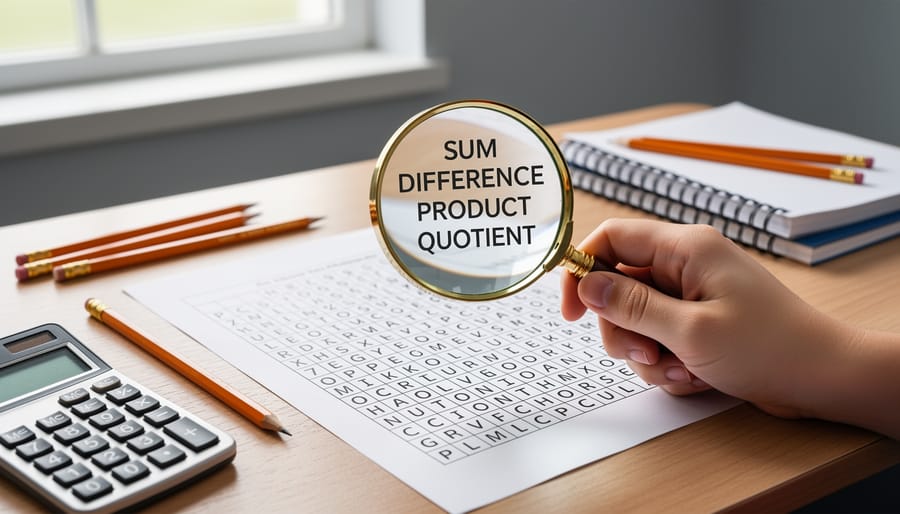
Anyone who’s a word search pro knows the secret: don’t dive in at the first letter you see. Let your eyes drift over the whole grid first. You’ll spot rows, patterns, and clusters of letters before you ever circle a single word.
Word problems work the very same way. Before anyone grabs a highlighter, have students read the entire problem from start to finish, just to get the big picture. What’s the story? What’s the question at the end? It helps to ask, “What is this problem actually asking me to find?”
Once they’ve scanned, it’s time to search. Now students can go back through and hunt for their target words: the clue words, the numbers, and the units. Circling too early often means circling the wrong things, so a quick first read saves a lot of frustration.
Try giving students a few seconds of silent scanning time before any marking begins. It’s a small habit with a big payoff.
Turn Your Keywords Into an Equation
Once your keywords are circled, the fun part begins: turning them into a number sentence. Think of it like swapping words for symbols. Each circled clue tells you which symbol to use, and the numbers tell you what goes on either side.
Try this one: “Maya has 12 stickers. She gets 8 more from a friend. How many stickers does she have in all?”
Circle “12,” “8 more,” and “in all.” That last phrase is your clue to combine. So the equation is 12 + 8 = ?
Have students write the equation right beside the problem. Then they say it back in plain words: “Twelve plus eight equals how many?” If it sounds like the story, they’re on track.
For a fun twist, let students use a different color for each operation. Over time, those colors become a quick visual shortcut.
Make It a Game: Keyword Word Searches and Review Activities
Once students know the clue words, games are the fastest way to make them stick. Here are a few ideas that keep practice fun.
Build a keyword word search. Hide words like “total,” “each,” “left,” and “shared equally” in a grid, and have students hunt them down. Better yet, let them create their own puzzle for a partner. Making one forces them to think about which words really matter.
Race to sort the clues. Write keywords on index cards and give each team a stack. Set a timer and have them sort the cards under four headings: add, subtract, multiply, and divide. Teams get bonus points for spotting a tricky word that could go either way, which sparks great conversations.
Turn review into a showdown. A customizable PowerPoint review game with a built-in scoreboard and sound effects makes word problem practice feel like game night. Swap in your own questions, and it works for any grade level or subject. If you prefer paper, a printable Jeopardy game can hold your keyword problems just as well.
Older students might even make a Blooket game using their own word problems. Writing questions is a powerful way to learn the clues!
Check Your Work and Keep Growing: Verification and Next Steps
Once your students have an answer, the work isn’t quite done. A quick check turns a lucky guess into real understanding, and it only takes a minute.
Teach students this simple routine:
1. Reread the question. Did you answer what was actually asked, or just the last thing you calculated?
2. Ask if it makes sense. If a class of 24 students splits into teams and the answer is 150 per team, something went wrong.
3. Estimate. Round the numbers and do a quick mental calculation. Your answer should land close.
4. Plug it back in. Put the answer into the story and see if it fits.
Encourage students to check the units too. Is the answer in dollars, apples, or minutes? A number without its label is only half an answer.
When students feel steady with keywords, it’s time to grow. Multi-step problems are the perfect moment to introduce quick sketches or bar models. Drawing the situation shows how the parts fit together, which a single clue word can’t always do.
You can also slowly fade the cheat sheet. Start by covering half the chart, then let students build their own from memory. Before long, they’ll spot the clues and understand the story, no chart required.

Quick Answers to Common Questions About Math Keywords
Are keywords enough on their own?
Not quite. Keywords are helpful clues, but they work best alongside reading the whole problem and asking whether the answer makes sense. Think of them as a great starting point, not the finish line.
What about multi-step problems?
Have students hunt for keywords sentence by sentence and jot down a mini equation for each step. Then they connect the pieces, much like finding one word at a time in a puzzle before the whole grid comes together.
How can I help students who still get stuck?
Pair the cheat sheet with a quick picture or bar model, and let them retell the problem in their own words before circling anything. A little teamwork in small groups can work wonders, too.
How often should we practice?
Short and frequent beats long and rare. Five to ten minutes a few times a week, maybe as a warm-up or a review game, keeps the strategy fresh without feeling like a chore.
These quick answers cover the most common worries, but every classroom is different. Feel free to tweak the pace, the cheat sheet, and the practice activities so they fit your students’ grade level and personality.
Solving math word problems doesn’t have to feel like cracking a secret code. Spot the clue words, circle them, translate them into a number sentence, and then check that the answer makes sense. Keep that rhythm going, and students will start to see the patterns on their own.
Remember that keywords are helpful clues, not guarantees. Reading the whole problem first keeps students from getting tripped up by sneaky wording.
The best part is that practice can be playful. When your class approaches a problem like a word search, scanning, hunting, and highlighting, the whole thing feels more like a game than a chore. A little friendly competition between teams goes a long way, too.
So make it your own! Build a keyword puzzle, tweak the cheat sheet for your grade level, or design a customizable review game with your own questions and scoreboard. When practice feels fun, students stay curious, and that’s when the real learning sticks.