
Never Arrive Empty-Handed: What to Bring as a Substitute Teacher
The plans say “students know what to do.” The students do not know what to do. The projector needs a login nobody gave you, the worksheet copies are in a room that is locked, and 28 eighth graders are watching to see what happens next. Every substitute teacher has stood in that spot. The ones who enjoy the job carry a bag that makes the spot survivable. This is what goes in mine, and how I use it in the first five minutes.
Rule one: never arrive empty-handed
A teacher’s sub kit is what they leave for you. Your sub bag is what you bring for yourself. You need both, because the first one is not always there. Plans get lost, printers jam, and an emergency absence at 6 a.m. rarely comes with a neat folder. Assume you will have to fill at least one period on your own, and pack for it.
I pack in three layers: the things that keep me functioning, the folder that fills a period, and the small professional touches that get me asked back.
Layer one: the essentials
- Your ID and any sub badge or clearance letter. Front offices ask, and a badge on a lanyard saves five awkward conversations a day.
- Water, a real snack, and a phone charger. You may not get a lunch at the time you expect.
- Pens, pencils, a stack of sticky notes and a roll of tape. The classroom supply drawer is always somewhere else.
- A small kitchen timer or a visible countdown app. “You have four minutes” is calmer than “hurry up,” and students trust a timer they can see.
- Blank name tents or masking tape. Names on desks in the first two minutes change the whole day. You can address students by name, and they know it.
- A book or a quiet task for yourself. Some periods are silent reading. Model it.
Layer two: the folder that fills a period
This is the layer that matters. The work you carry has to pass three tests: it needs no login, no projector and no subject knowledge, because you will have none of those at 8:15. It also has to be genuinely quiet, because a strange adult plus a loud room is the combination that gets you a bad report. Here is the mix that has never let me down.
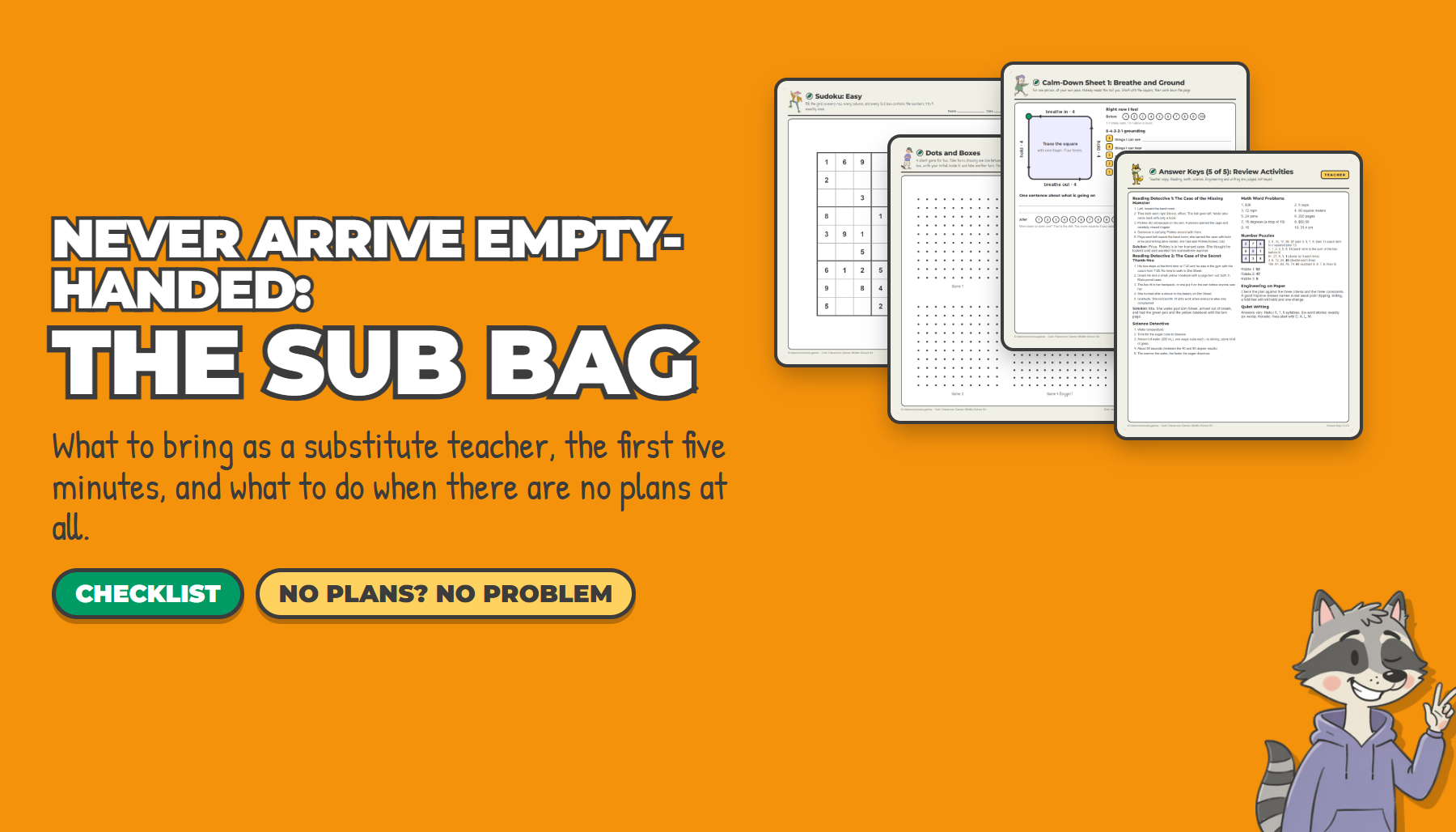
- Quiet solo puzzles. Sudoku, word searches, secret codes, logic grids, mazes. Students already know the rules, so nothing needs explaining. Carry more copies than you think you need; the fast finishers eat through them.
- Whisper partner games on paper. Battleship, dots and boxes, connect four in a grid. Two pencils, one page, no talking. Silence is part of the game, so the noise stays down without you policing it.
- Two or three calm-down sheets. Box breathing, 5-4-3-2-1 grounding, a brain dump. A sub day is a wobbly day for some students. A sheet gives one student a way out of a spiral while you keep the room moving.
- Short review tasks with an answer key. A reading passage with questions, a page of word problems, a science data sheet, a writing prompt. Practice, not new content. The key lets you check work in seconds, or hand it out so students mark their own.
- One card of whole-class calm games. Silent ball, silent line-up, count to twenty as a class. For the last ten minutes, or when the room needs a reset.
I got tired of rebuilding this folder, so I made it once. The Calm Classroom Games and Activities Kit is that folder for grades 6 to 8: 43 pages, 20 quiet games and 4 review activities, five answer-key pages, in color and ink-saver black and white. Print it, put it in a plastic sleeve, and it is ready for any class. For younger rooms the Quiet Classroom Games Kit covers grades 2 to 5.
Layer three: the professional touches
- A one-line introduction you have practiced. “Good morning. I am Ms. Hinck, I am here for Mr. Diaz today, and here is what we are doing.” Confident, short, done.
- A blank seating chart. Sketch the room as students settle. Names plus positions is how you keep control in period 6 when you are tired.
- A “how it went” note for the teacher. Half a page: what got done, who helped, what to know. Teachers remember the subs who leave a clear note, and they request them.
- A small card with your name and contact. Leave it with the note. Requests by name are how substitute work turns into steady work.
The first five minutes
- Be at the door. Greet students as they come in. It tells the room an adult is in charge before anyone tests it.
- Names on desks. Hand out the name tents or tape as they sit. Two minutes, and you can call on anyone.
- Read the plans in full before you speak. Even if the plans are a sticky note. Especially then.
- Say the plan out loud, with times. “First fifteen minutes, this page, on your own and quiet. Then we check it together.” A visible timer makes it real.
- Start something within five minutes. A room that is working is a room you can manage. If there is nothing to start, open your folder.
When there are no plans at all
It happens. Do not panic and do not apologize to the students; they will treat the day as a free period the moment you do. Run a quiet, self-contained period from your folder and treat it as intended.
- Elementary: a read-aloud if there is a book, then puzzle pages, then a partner game to finish. Keep transitions short and narrated.
- Middle school: a solo puzzle page first, in silence, for ten minutes. It settles the room. Then a review page with its key, then a partner game for those who finish. Whole-class calm game for the last ten minutes if they have earned it.
- High school: offer a choice of two or three quiet pages and let them work. Older students respond to being treated like adults, and a quiet room of independent work is a good report.
The sub bag checklist
- ID, badge, clearance letter
- Water, snack, charger
- Pens, pencils, sticky notes, tape
- Timer
- Name tents or masking tape
- A book for yourself
- Class sets of quiet solo puzzles
- Whisper partner games
- Two or three calm-down sheets
- Review tasks with their answer keys
- A card of whole-class calm games
- Practiced introduction, blank seating chart
- “How it went” note and your contact card
Pack the bag once, top up the puzzle pages after each job, and the sticky-note morning becomes a normal one. If you are still working out how to get into substitute teaching, start with How to Become a Substitute Teacher, and if you are the teacher on the other side, What Is in Your Sub Kit? is the folder to leave behind.