How to Become a Substitute Teacher in 2026: Requirements, ESS, MCPS and EdJoin Explained
Substitute teaching is one of the few jobs in education you can start without a teaching degree, on a schedule you set yourself, in a school you get to choose. It is also confusing to get into, because every state and district does it differently, and half the searches people make (“ESS substitute teacher”, “MCPS substitute teacher”, “EdJoin”) are really about one particular door. This guide walks through the general path first, then explains those three doors, then covers what to bring on your first day.
The short version
- Check your state’s minimum education requirement. It ranges from a high school diploma to a bachelor’s degree.
- Get the permit or certificate your state asks for, if it asks for one.
- Pass a fingerprint-based background check, and in many states a TB test.
- Apply to the district directly, through a staffing company such as ESS, or through a job board such as EdJoin.
- Complete any orientation or training, then pick up assignments through the district’s sub system.
Step 1: know your state’s requirements
Requirements are set at the state level and then often tightened by districts. Roughly two in five states require a college degree or a set number of college credits. The rest accept an associate degree, 60 or so credits, or a high school diploma plus a background check. The degree, where required, usually does not have to be in education.
A few examples, current as of 2026 and worth double-checking with your state department of education before you apply:
- California: a bachelor’s degree, a 30-Day Substitute Teaching Permit from the Commission on Teacher Credentialing, fingerprint clearance, and a negative TB test.
- Illinois and Arizona: a bachelor’s degree plus a state substitute license or certificate.
- New York: no statewide minimum, but most districts want a bachelor’s degree; without certification you are limited to 40 days a year in one district.
- Texas: set by each district, from a high school diploma up to 60 or more college hours.
- Washington, D.C.: 60 or more credit hours, a background check, a TB test and a drug test.
Step 2: the background check
Every state requires a criminal background check for anyone working with children, and nearly all of them do it by fingerprint through the FBI and the state’s department of justice. Budget for it: the fee is usually yours to pay, and processing can take a few weeks. Many states also want a TB test result dated within the last few years. Get both started early, because you cannot take a single assignment until they clear.
Step 3: choose your door
There are three common ways in, and this is where the search terms come from.
Apply to the district directly
Most districts still run their own substitute pool. Look for “substitute” on the district’s human resources page. You apply once, clear the checks, attend an orientation, and then take assignments through the district’s automated substitute system by phone or app. Pay is set by the district and often rises with your credentials and with long-term assignments.
ESS substitute teacher: applying through a staffing company
ESS (formerly Source4Teachers) is the largest substitute staffing company in the United States. It partners with more than 900 school districts, and in those districts ESS, not the school, hires, trains, pays and places the substitutes. If your district has outsourced its sub pool, “apply to be a sub” means “apply to ESS”.
What ESS typically asks for: you are at least 21, you hold at least a high school diploma or GED (a bachelor’s degree is preferred and unlocks more assignments and higher pay), you pass the state-required background check, and you complete ESS’s own training before your first day. The education minimum follows your state’s rules, so it is higher in bachelor’s-degree states. ESS runs a Career Kickstart program that reimburses some of the cost of getting your district credentials, which helps with the permit and fingerprint fees.
To apply, go to ess.com/apply and search by district, county or zip code. A recruiter walks you through the credential steps for your state. Once hired you pick up jobs through the district’s system, and ESS handles your pay.
MCPS substitute teacher: Montgomery County Public Schools, Maryland
“MCPS” is Montgomery County Public Schools in Rockville, Maryland, one of the largest districts in the country, and it hires its own substitutes. (There is also a Montgomery County Public Schools in Virginia; make sure you are on the Maryland site, montgomeryschoolsmd.org.)
The minimum to substitute teach in MCPS is 60 college credits or an associate degree. Pay is hourly and tiered by your credentials, with a higher rate for long-term assignments. As listed on the MCPS substitute page in 2026:
| Credential | Daily rate (per hour) | Long-term rate (per hour) |
|---|---|---|
| Associate degree or 60 credits | $20.95 | $29.91 |
| Bachelor’s degree or higher | $22.21 | $31.70 |
| Maryland professional certificate | $23.62 | $33.64 |
You apply at mcpscareers.org, complete fingerprinting through the district, and then choose your own schedule and preferred schools through the MCPS automated substitute system, which is open day and night. Questions go to the substitute staffing office at substaffing@mcpsmd.org.
EdJoin: the job board, mostly California
EdJoin (edjoin.org) is an education job board run by California’s county superintendents association and used by nearly every district and county office of education in California, plus some employers in other states. If you are in California, substitute pools are posted there as jobs: search “substitute teacher” and your county.
You create one EdJoin account and profile, attach your documents once (resume, transcripts, letters of recommendation, and your 30-Day Substitute Permit or credential), and apply to as many postings as you like. Postings usually ask for the same set: a completed EdJoin application, a current resume, one or two recent letters of recommendation, and proof of your transcript or permit. Applicants are required to list every school district, county office or charter school they have worked for before. If you get stuck, the EdJoin help desk is (888) 900-8945.
Step 4: training and your first assignment
Most districts and ESS run a short orientation: classroom management, emergency procedures, how the sub system works. After that you will get your first call, often the night before or early in the morning. Say yes to the schools that treat you well, and they will start requesting you by name.
What experienced subs bring on day one
The teacher’s plans are sometimes excellent and sometimes a sticky note (the full packing list is in Never Arrive Empty-Handed: The Sub Bag). The subs who get requested back carry their own backup: a folder of quiet, self-contained work that needs no login, no projector and no subject knowledge.
- Quiet solo puzzles students already know how to do: sudoku, word searches, secret codes, logic grids, mazes.
- Whisper partner games on paper: battleship, dots and boxes, connect four in a grid.
- A calm-down sheet for the student who is spiraling on a strange day.
- Review tasks with an answer key, so you can check work or let students mark their own.
- A card of whole-class calm games for the last ten minutes: silent ball, silent line-up, count to twenty.
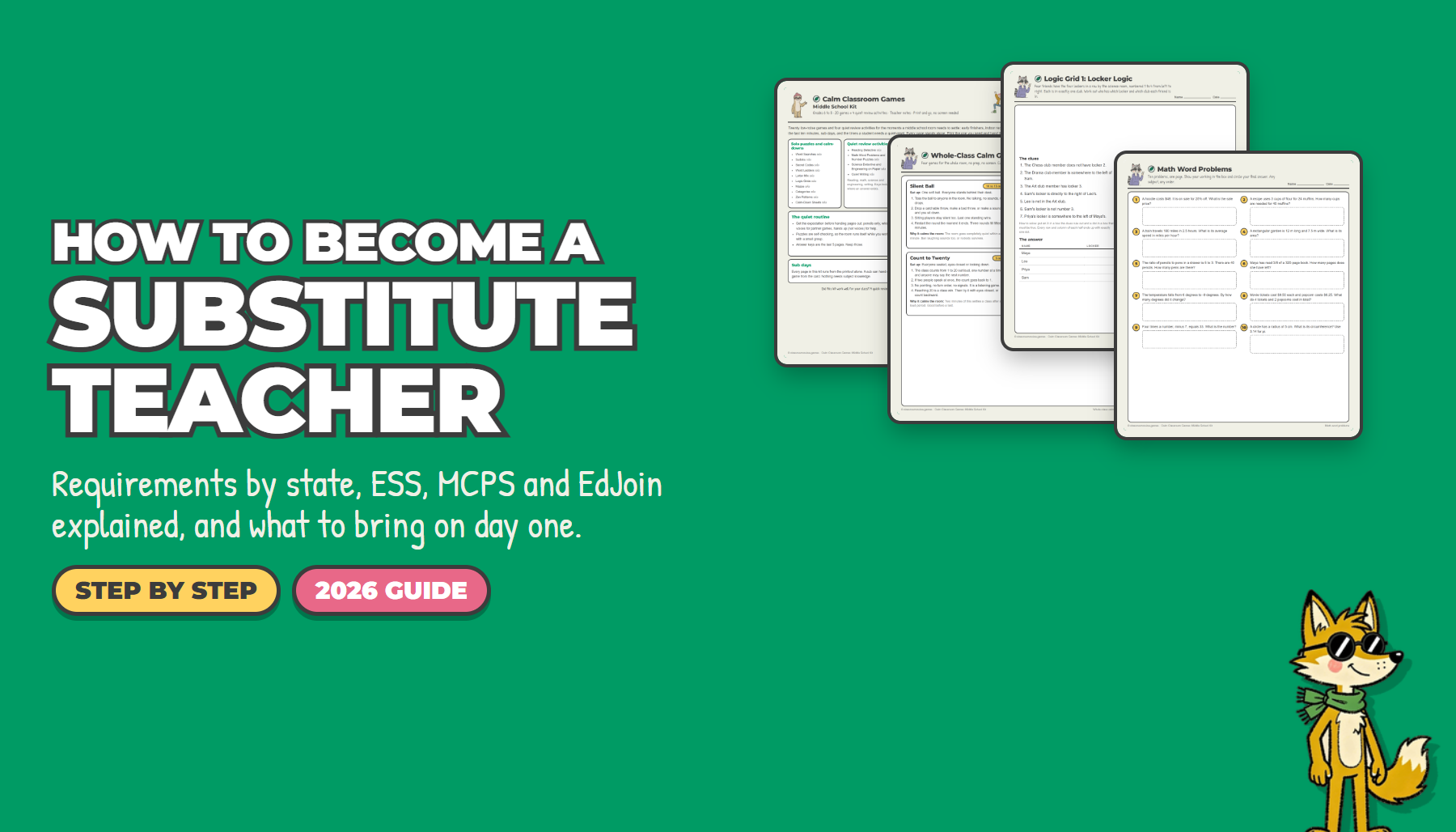
I built exactly that folder for grades 6 to 8: the Calm Classroom Games and Activities Kit, 43 print and go pages with 20 quiet games, 4 review activities and five answer-key pages, in color and ink-saver black and white. For younger classes the Quiet Classroom Games Kit covers grades 2 to 5, and the Sub Plans binders hold the information pages a teacher should leave you. If you want the full list of what belongs in that folder, read What is in your sub kit?
Frequently asked questions
Do I need a teaching degree to be a substitute teacher? No. Some states require a bachelor’s degree in any subject; many accept an associate degree or 60 credits; a few accept a high school diploma with a background check.
How long does it take to get started? Usually two to eight weeks, most of it waiting for the background check and, where needed, the permit.
Can I substitute in more than one district? Yes, but each district (or ESS, for its districts) has its own application, and each may want its own copy of your clearances.
Is substitute teaching a path to a full-time job? Often. Long-term assignments are where principals get to know you, and many districts hire their teachers from their sub pool.