
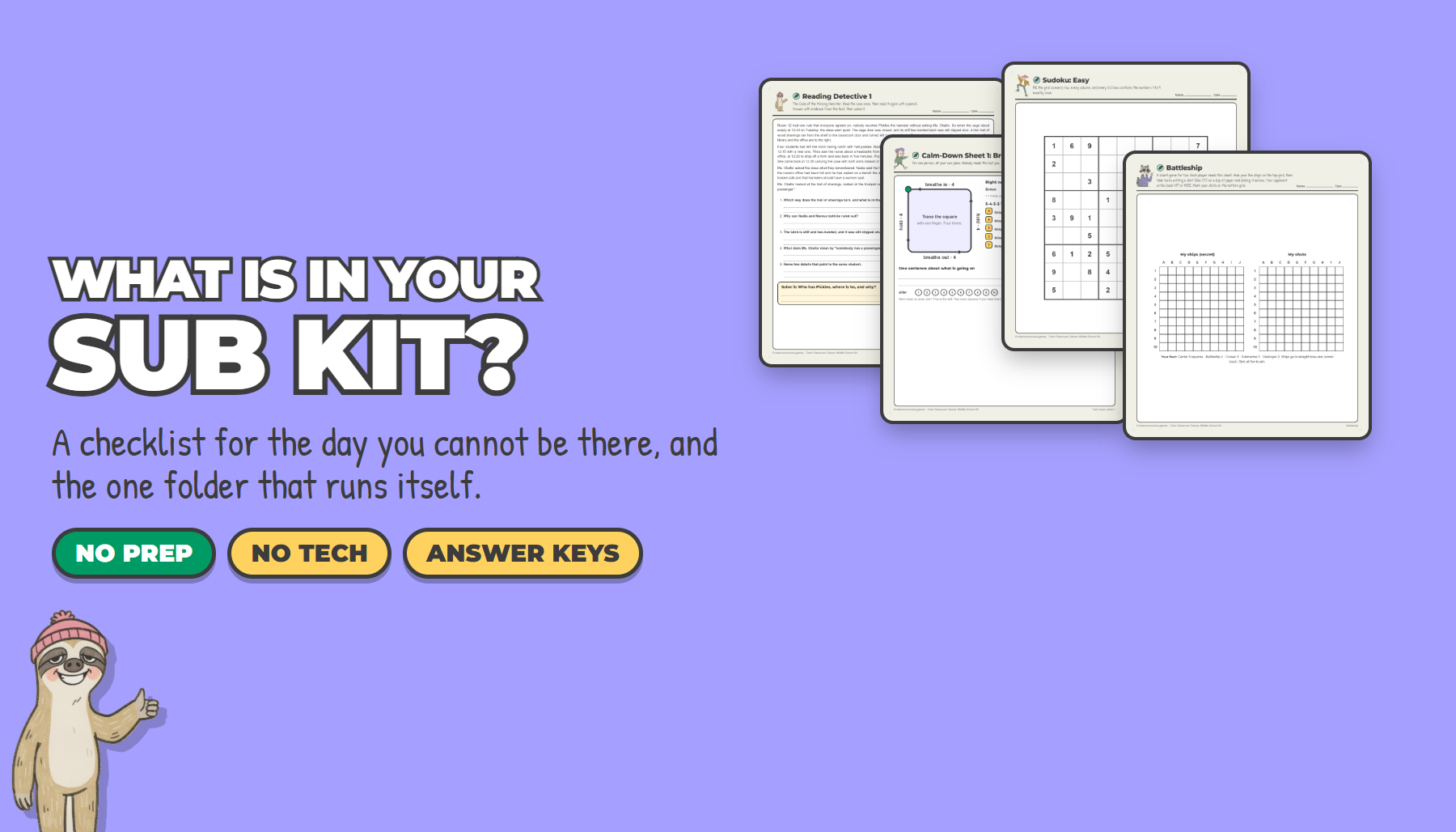
What Is in Your Sub Kit? A Checklist for the Day You Cannot Be There
Every teacher has had the 6 a.m. moment: the fever, the sick child, the car that will not start. You are not going in, and a stranger is about to run your room. What you leave behind decides whether that day is calm or chaos. This is the sub kit I keep in a folder by my desk, what goes in it, and the one part that runs itself.
What a sub kit is (and what it is not)
A sub kit is a printed folder a substitute can open cold and teach from for a full day. It is not your lesson plans. Lesson plans assume subject knowledge and your routines. A sub kit assumes neither. Everything in it should work for a stranger with no login, no projector, and no idea what page you were on.
I build mine in two halves: the information a sub needs about the class, and the work students can do without me.
Half one: the information pages
- A note to the sub. Half a page. Where things are, how attendance works, who to call, and one sentence about the tone you want: “This class is chatty but kind. Quiet work is fine.”
- The schedule of the day. Times, periods, breaks, and which activity goes where. Subs do not know what “block 3” means.
- A class list with dismissal notes. Bus numbers, pickups, allergies, and the two students who are genuinely helpful.
- Emergency procedures. Fire, lockdown, medical. Copy the school page. Do not make a sub go looking for it.
- A “how it went” slip. One page the sub fills in at the end. You will want to know what happened, and subs appreciate being asked.
If you want these pages already laid out, my Middle School Sub Plans binder has all of them as fill-in templates, with seven no-prep activities behind them. There are versions for elementary, high school, and preschool too.
Half two: work that runs itself
This is where most sub folders fall apart. A worksheet that needs explaining is not sub work. A game that needs a projector is not sub work. What survives a sub day is quiet, self-contained, and self-checking. Here is the mix I aim for.
1. Quiet solo puzzles
Word searches, sudoku, secret codes, logic grids, mazes. Students know the rules already, so nothing has to be taught, and the room goes quiet in about a minute. Print more than you think you need. Early finishers eat through these.
2. A calm-down sheet or two
Sub days are wobbly days. Some students act up, some shut down. A calm-down sheet (box breathing, 5-4-3-2-1 grounding, a brain dump) gives one student a way out of a spiral without the sub having to manage it. Keep three or four printed in the front pocket and tell the sub they are there.
3. Whisper partner games
Battleship on paper, dots and boxes, connect four in a grid. Two students, two pencils, no talking. These are the ones students remember, and the noise level stays low because silence is part of the game.
4. One or two review tasks with a key
A reading passage with questions, a page of math word problems, a short science or writing task. Not new content, just practice a sub can hand out and, this is the important part, check against a key. Better still, hand the key to students when they finish so they mark their own work.
5. Whole-class calm games on a card
For the last ten minutes, or when the room needs a reset: silent ball, silent line-up, count to twenty as a class. Write the rules on one card so the sub does not have to invent anything.
The folder that runs itself
I got tired of rebuilding half two every time, so I made it once. My Calm Classroom Games and Activities Kit is 43 pages for grades 6 to 8: 20 quiet games and 4 review activities, every puzzle checked by computer, five answer-key pages, color and ink-saver black and white, US Letter and A4. It is built so a sub can hand out any page cold. Nothing needs subject knowledge and nothing needs a screen.
Inside: word searches, sudoku, secret codes, word ladders, letter mix, logic grids, mazes, categories, zen patterns, two calm-down sheets, six whisper partner games, four whole-class calm games on teacher cards, and quiet review pages for reading, math, science and engineering, and writing.
If you teach younger students, the Quiet Classroom Games Kit does the same job for grades 2 to 5, and the Conflict Resolution Scenario Games are a good add for a class that needs to talk something through.
The sub kit checklist
- Note to the sub, half a page
- Schedule of the day with the activity for each slot
- Class list with dismissal and medical notes
- Emergency procedures
- Quiet solo puzzles, more than one class set
- Three or four calm-down sheets in the front pocket
- Two or three whisper partner games
- One or two review tasks with their answer keys
- A card of whole-class calm games
- A “how it went” slip
Build it once in September, top up the puzzle pages after each sub day, and the 6 a.m. moment becomes a five-minute email instead of a scramble. And if you are the one covering the class, the other half of this story is the sub bag you never arrive without.