

Why the Question Word Game Transforms Even Your Most Reluctant Students into Eager Participants
Transform your classroom into an engaging learning hub by introducing question word games—simple yet powerful tools that sharpen critical thinking while energizing your students. These interactive activities challenge learners to formulate questions using who, what, when, where, why, and how, turning passive vocabulary practice into dynamic communication exercises.
Question word games work because they flip traditional learning on its head. Instead of answering teacher-led questions, students create their own, developing higher-order thinking skills and deeper content comprehension. The beauty lies in their flexibility: you can adapt them to any subject, grade level, or learning objective with minimal prep time.
Setting up takes just minutes. Choose your topic, establish simple rules about which question words to use, and let students work individually, in pairs, or teams. Whether you’re reinforcing grammar concepts, reviewing historical events, or exploring scientific phenomena, these games naturally differentiate instruction as students engage at their own cognitive levels.
The results speak for themselves. Students become more confident communicators, develop stronger analytical abilities, and retain information longer because they’re actively constructing knowledge rather than passively receiving it. Best of all, the competitive element keeps motivation high while the customizable nature means you’ll never run out of fresh ways to keep learning exciting.
What Makes the Question Word Game Different From Other Classroom Activities
The Core Mechanics That Keep Students Hooked
Here’s how this engaging game works, and trust me, you’ll be amazed at how simple it is to get started!
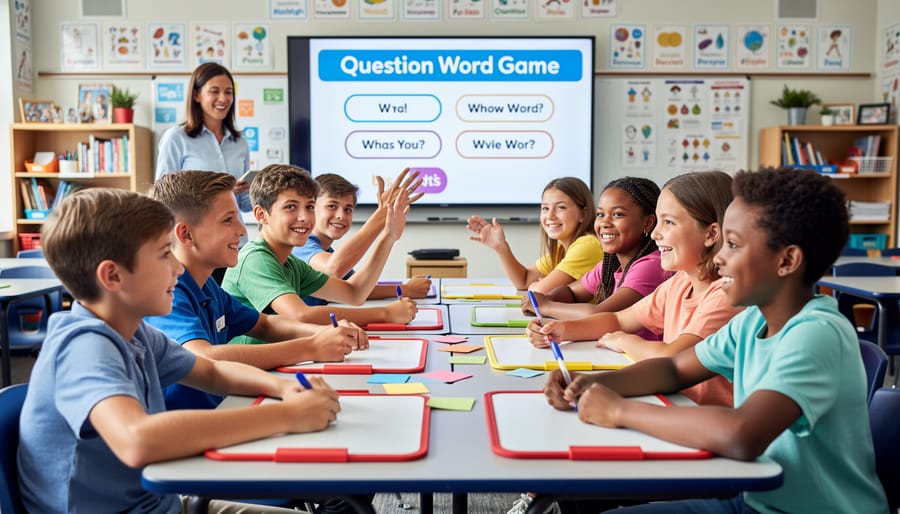
The basic setup is wonderfully straightforward. You present students with a question word (like who, what, where, when, why, or how), and they race to come up with answers that fit specific categories or criteria you’ve set. For example, if the prompt is “WHERE can you find animals?” students might shout out “zoo,” “jungle,” or “ocean.”
What makes it brilliant is the flexibility. You can play it as a whole-class shout-out session, divide students into competing teams, or use it as a quick partner activity. Each round typically lasts just 30-60 seconds, keeping energy high and minds sharp.
The game naturally encourages critical thinking because students must process the question word, connect it to the category, and retrieve relevant vocabulary quickly. It’s one of those word games for students that feels like pure fun while secretly building language skills and quick recall abilities.
You can easily customize difficulty by adjusting time limits, requiring full sentences instead of single words, or adding point systems for unique answers that no one else thought of.
Why Question Words Matter for Learning
Question words are the building blocks of curiosity and critical thinking in your classroom! When students master who, what, when, where, why, and how, they’re not just learning vocabulary—they’re developing essential comprehension skills that unlock deeper understanding across all subjects.
These six powerful words teach students to dig beneath surface-level information. Instead of passively receiving facts, learners actively engage with content by forming meaningful questions. This process strengthens reading comprehension, encourages analytical thinking, and helps students make connections between ideas.
Question words also give students a practical framework for problem-solving. Whether they’re tackling a math word problem, analyzing a historical event, or conducting a science experiment, knowing which question word to use guides their investigation. A student who can ask “Why did this happen?” or “How does this work?” is developing the critical thinking skills they’ll use throughout their academic journey and beyond.
Best of all, question word games make this learning fun and memorable! By turning these essential tools into an engaging activity, you’re helping students internalize these concepts naturally while keeping energy levels high in your classroom.
The Hidden Benefits Teachers Don’t Expect
Building Critical Thinking Skills Without the Boring Worksheets
Here’s the best part: while your students are laughing and competing to guess the mystery word, they’re actually developing serious critical thinking skills. The question word game turns analytical thinking into a natural process rather than a forced exercise.
Every question students ask requires them to categorize information and make strategic decisions. When they ask “Is it alive?” or “Can you find it outdoors?”, they’re learning to break down complex problems into manageable yes-or-no questions. This process mirrors scientific inquiry and logical reasoning without feeling like work.
The game also builds deductive reasoning skills. Students must listen carefully to all previous questions and answers, then use that information to eliminate possibilities and narrow their focus. They’re creating mental categories, making connections, and adjusting their thinking based on new information.
What makes this especially powerful is the immediate feedback loop. Students quickly learn which types of questions yield the most useful information. Should they start broad or specific? Which categories help most? These insights transfer directly to problem-solving in other subjects.
The competitive element keeps everyone engaged, so students practice these thinking skills repeatedly without realizing they’re doing the mental heavy lifting. It’s skill-building disguised as pure fun.
Getting Shy Students to Speak Up
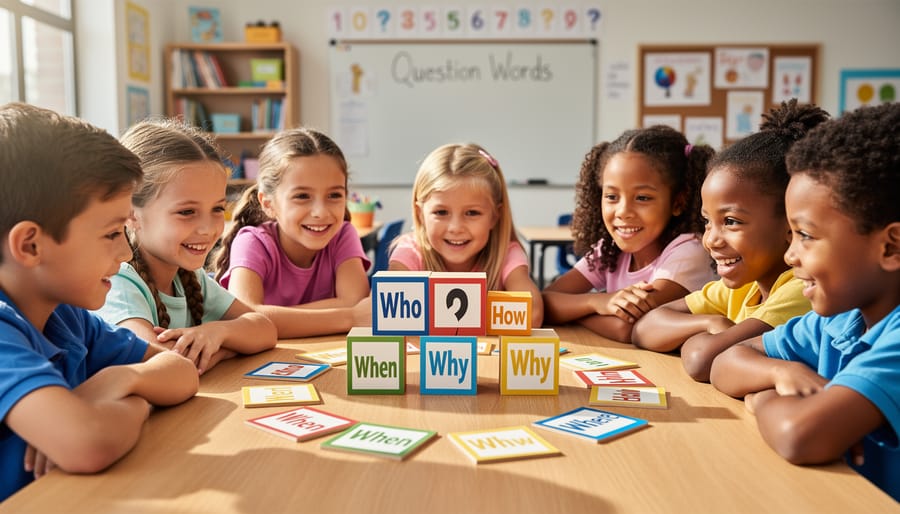
One of the most powerful aspects of question word games is how they naturally draw in even your quietest students. The game structure creates a low-pressure environment where everyone can participate at their own comfort level.
When shy students know they’re working with a predictable framework of question words, they feel more confident jumping in. Instead of worrying about saying the wrong thing, they can focus on creative answers within safe boundaries. The repetitive nature of who, what, when, where, why, and how becomes familiar quickly, reducing anxiety about participating.
The game format also removes the spotlight effect. Since multiple students are answering or asking questions simultaneously, shy learners don’t feel singled out. They can practice speaking up in pairs or small groups before facing the whole class. This graduated approach builds confidence gradually.
Another benefit is the equality factor. Every student gets the same type of prompt, so there’s no perceived favoritism or targeting. Shy students appreciate knowing they’ll get their turn with the same fair treatment as everyone else. Research shows that games increase student engagement across all personality types, making them ideal for inclusive classrooms.
You can further support hesitant speakers by offering writing options first, letting students prepare their responses on paper before sharing aloud. Some teachers also use think-pair-share variations, where students rehearse with a partner before contributing to larger discussions. These simple modifications ensure every voice gets heard, transforming passive observers into active participants.
How to Set Up Your Question Word Game in Minutes
Customizing Your Game for Any Subject or Grade Level
The beauty of question word games lies in their incredible flexibility across subjects and grade levels. Let’s explore how you can make this game work perfectly for your classroom!
For math classes, transform abstract concepts into engaging challenges. Use “How many sides does a pentagon have?” for younger students or “Why does the Pythagorean theorem work?” for older learners. Question words like “How” and “What” naturally fit mathematical problem-solving.
Science teachers can spark curiosity with questions like “What causes photosynthesis?” or “Why do volcanoes erupt?” This approach reinforces the scientific method since students learn to ask better questions themselves. Adjust complexity by choosing grade-appropriate topics—simple machines for elementary versus chemical reactions for middle school.
Language arts adapts beautifully to this format. Ask “Who is the protagonist?” or “When does the climax occur?” to reinforce story elements. For grammar lessons, try “Which sentence uses proper punctuation?” Vocabulary development shines when students must identify “What does ‘benevolent’ mean?”
Social studies comes alive with questions like “Where did the American Revolution begin?” or “Why did ancient civilizations develop near rivers?” Geography, history, and civics all work wonderfully.
Age-appropriate adjustments matter greatly. Kindergarteners thrive with simple, concrete questions using picture clues. Middle schoolers handle multi-step thinking questions. High schoolers can tackle analysis and evaluation questions that require deeper critical thinking.
Remember, you can mix subjects too! Create interdisciplinary rounds that connect concepts across your curriculum. The game grows with your students, making it a year-round favorite that never gets stale.
Adding Scoreboards and Sound Effects That Amplify Excitement
Ready to turn your question word game into an electrifying classroom experience? The built-in scoreboards and sound effects in many PowerPoint templates are absolute game-changers for creating that buzzing competition vibe students love!
Most templates come with automatic scoring features that track points as you click through answers. This means less work for you and more excitement for your students. Simply assign point values to different questions based on difficulty, and watch as teams eagerly track their progress on the big screen. The visual scoreboard keeps everyone invested in the action from start to finish.
Sound effects add that extra layer of fun that makes learning memorable. Think triumphant chimes for correct answers and friendly buzzer sounds for incorrect ones. These audio cues provide immediate feedback and help maintain energy levels throughout the game. The best part? You don’t need any technical expertise to use them since they’re already embedded in quality templates.
Here’s a pro tip: customize the point system to match your classroom goals. Award bonus points for explaining answers, showing teamwork, or demonstrating improvement. This flexibility lets you emphasize the learning aspects you value most while keeping the competitive spirit positive and inclusive.
Remember to preview your sounds before game day to ensure they work properly. Nothing disrupts the flow quite like technical hiccups, but a quick test run ensures smooth sailing. Your students will appreciate the polished presentation, and you’ll love how these simple features transform a basic review session into an unforgettable learning adventure!
Real Classroom Scenarios Where This Game Saves the Day
Perfect for Review Days When Energy Is Low
We all know those days when students walk into class already exhausted. Whether it’s the afternoon slump, pre-test anxiety, or those final weeks before break, keeping kids engaged during review can feel impossible. That’s exactly when question word games shine brightest.
Unlike passive review methods like worksheets or flashcards, this game gets students moving and participating without demanding too much mental energy. The physical movement of tossing a ball combined with quick-fire questions creates natural momentum that pushes through fatigue. Students often don’t realize they’re reviewing because they’re too busy having fun.
The beauty is in its simplicity. You don’t need elaborate preparation or complicated rules. Just grab a soft ball, call out a category, and start tossing. Students respond with question words, and suddenly your drowsy classroom transforms into an energized learning space. It works perfectly alongside other quiet classroom games when you need to vary the energy level throughout the day.
This game particularly excels during those dreaded review sessions because it keeps everyone alert and accountable. No student can zone out when they might catch the ball next, yet the low-stakes nature means they won’t feel overwhelmed during already stressful times.

Team-Building Without the Awkwardness
Here’s the beautiful secret about question word games: they create connections without forcing anyone into awkward trust falls or uncomfortable icebreakers. When students work together to guess answers, something magical happens. They’re naturally communicating, strategizing, and celebrating wins as a team.
The game structure itself encourages participation from everyone. Quieter students feel safe asking yes-or-no questions, while more outgoing learners can take risks with creative guesses. There’s no spotlight pressure because everyone contributes to the collective detective work.
You’ll notice students spontaneously developing collaboration skills. They learn to build on each other’s questions, listen actively to narrow down possibilities, and think strategically together. One student might ask about vowels while another focuses on word length, creating an organic division of labor.
The best part? Students don’t even realize they’re practicing teamwork. They’re too busy having fun solving the puzzle. This natural approach to community building works across all grade levels and creates a supportive classroom environment where risk-taking feels safe and collaboration becomes second nature. Plus, you can customize difficulty levels to ensure every student can meaningfully contribute to the group’s success.
Common Mistakes to Avoid (And How to Fix Them Fast)
Even the best classroom activities come with a learning curve! Here are the most common bumps teachers hit with question word games, plus super-quick fixes to keep things running smoothly.
Students finish at wildly different speeds. This can create chaos when some kids are done in two minutes while others need ten. The fix? Keep a “bonus challenge” ready, like asking fast finishers to create their own question word puzzle for a partner or write three sentences using their found words. You can also differentiate by giving advanced students grids with fewer clues or requiring them to use each question word in a complete sentence.
The game feels too easy or too hard. Finding that sweet spot takes practice! If students breeze through too quickly, increase your grid size or hide words diagonally and backwards. If they’re struggling, start with smaller grids and only hide words horizontally and vertically. You can also provide a word bank initially, then remove it as students gain confidence.
Classroom management gets tricky during gameplay. When everyone’s excited and talking, things can get loud fast! Set clear expectations before starting: use “inside voices” and designate specific times for partner discussion. Consider using a visual timer so students know exactly how much time remains, which naturally keeps them focused.
You forget to customize for your lesson. It’s easy to grab a generic puzzle, but the magic happens when you tailor it! Spend just two minutes before class thinking about which question words connect to your current unit. Teaching about weather? Focus on “where” and “when.” Studying character motivation? Emphasize “why” and “how.”
Remember, every hiccup is just a chance to fine-tune your approach for next time!
The question word game truly deserves a spot in your teaching toolkit. It’s one of those rare classroom activities that delivers real learning benefits while keeping students genuinely engaged and excited. Whether you’re working on reading comprehension, vocabulary building, or critical thinking skills, this flexible game adapts beautifully to your specific goals and grade level.
The best part? You don’t need hours of prep time or complicated materials. With instant download availability, you can grab the game template and have it ready for your class in minutes. It slides seamlessly into your existing lesson plans, whether you need a quick warm-up activity, a review session, or an engaging center rotation.
Your students will love the interactive format, and you’ll appreciate how easily you can customize the content to match whatever topic you’re covering. Give the question word game a try in your classroom this week and watch your students light up as they practice essential language skills through play.