
Why Facilitation Beats Lecturing (And How to Start Today)
Step back from lecturing and start asking questions that make students think rather than simply recall information. Transform statements into prompts like “What patterns do you notice?” or “How would you solve this differently?” to shift yourself from answer-giver to thinking-partner.
Create structured opportunities for students to teach each other through pair-shares, small group discussions, or student-led demonstrations. When you give clear time limits and specific discussion prompts, students engage more deeply with content than they would passively listening to you explain the same concept.
Design activities where you genuinely don’t know what students will discover or create. Set up investigations, challenges, or open-ended problems that allow multiple solution paths. Your role becomes circulating, observing, and asking probing questions rather than directing every step.
Use wait time strategically after asking questions—count to seven silently before calling on anyone. This simple shift dramatically increases participation because students actually have time to formulate thoughts rather than watching the fastest hand-raisers dominate discussions.
Replace traditional worksheets with interactive games and collaborative challenges that require students to apply concepts actively. When learning feels playful and social, facilitation becomes natural because students drive the energy while you guide the learning targets.
Facilitation isn’t about doing less work—it’s about doing different work. You’ll prepare thoughtful questions, design engaging structures, and observe student thinking more carefully than ever before. The payoff comes when students take ownership of their learning, think critically without prompting, and develop skills that extend far beyond memorizing content for your next test.
What Facilitation Really Means in Your Classroom

The Shift from Teaching to Facilitating
Think of traditional teaching like a tour guide who walks ahead, pointing out every landmark and explaining each detail. Everyone follows the same path at the same pace. Facilitation, on the other hand, is like being a hiking companion who provides the map, asks great questions, and lets learners choose their own route to the summit.
In traditional classrooms, you’re front and center, delivering information while students absorb it. With facilitation, you step to the side and create conditions where students discover and construct knowledge themselves. You’re still essential, but your energy shifts from telling to asking, from lecturing to listening, and from answering to guiding students toward their own answers.
This doesn’t mean less work for you. Actually, it means more intentional planning. You’re designing experiences, preparing thought-provoking questions, and organizing activities that spark curiosity. The beautiful payoff? Students become active participants rather than passive receivers. They develop critical thinking, collaborate naturally, and take ownership of their learning journey.
The best part about this shift is that it’s customizable to your teaching style and your students’ needs. You don’t have to abandon everything you know. Start small, experiment with one facilitated activity per week, and watch how your classroom energy transforms.
Why Students Learn Better Through Facilitation
When you shift from traditional teaching to facilitation, something wonderful happens in your classroom! Students become active participants rather than passive listeners, and that changes everything.
First, engagement skyrockets. Instead of zoning out during lectures, students are discussing, problem-solving, and collaborating. They’re genuinely interested because they’re doing the thinking, not just absorbing information. You’ll notice more hands shooting up and fewer glazed-over expressions.
Facilitation also builds deeper understanding. When students wrestle with concepts themselves and talk through ideas with peers, they create stronger mental connections. They’re not just memorizing facts for a test—they’re actually getting it at a fundamental level.
Critical thinking gets a major boost too. As a facilitator, you’re asking questions that make students analyze, evaluate, and create rather than simply recall. They learn to question assumptions and defend their reasoning, skills they’ll use far beyond your classroom.
Perhaps most importantly, students develop ownership of their learning. They become more confident and self-directed because they’re contributing to the learning process. This sense of agency motivates them to take risks, persist through challenges, and genuinely care about their progress.
Core Facilitation Skills Every Teacher Needs
Asking Questions That Spark Thinking
The magic of facilitation happens when you shift from giving answers to asking questions that make students think deeper. Instead of “What’s the answer to number 5?” try “What strategy did you use to solve this?” or “Why do you think that approach worked?”
Open-ended questions are your best friends here. Questions like “What patterns do you notice?” or “How might we solve this differently?” invite multiple perspectives and keep curiosity alive. When students ask you a question, resist the urge to answer immediately. Instead, bounce it back with “That’s interesting! What do you think?” or “Where could we look to find that out together?”
Try the “Why, How, What if” technique to deepen discussions. Start with “Why did this happen?” move to “How does this connect to what we learned yesterday?” and finish with “What if we changed one variable?”
Remember, silence is powerful too. After asking a question, wait at least five seconds before calling on anyone. This think time helps all students formulate thoughtful responses, not just quick ones. You’ll be amazed at how these small tweaks transform passive listeners into active thinkers who drive their own learning forward.
Creating Space for Student Voice
The magic of facilitation happens when every student feels their voice matters! Start by building in intentional wait time after asking questions—count to at least five seconds before calling on anyone. This gives all learners time to process and formulate their thoughts, not just your quickest responders.
Try different participation structures to reach every student. Use turn-and-talk partnerships, small group discussions, or even written responses before whole-class sharing. These variations help quieter students find their confidence while giving everyone multiple entry points.
Create a culture where all contributions are valued. Acknowledge responses with genuine curiosity: “Tell me more about that thinking” or “That’s an interesting perspective—can you explain how you got there?” This approach validates student ideas while encouraging deeper reflection.
Mix up how you call on students. Random selection tools, talking chips (where each student gets tokens to “spend” when they speak), or structured rotation systems ensure participation doesn’t fall to the same few voices. The goal is making your classroom a space where students know they’ll be heard, respected, and encouraged to share their unique perspectives. When students feel genuinely valued as contributors, engagement naturally follows!
Reading the Room and Adapting on the Fly
Great facilitation is all about staying tuned in to your students and being ready to pivot when needed. Think of yourself as a DJ reading the dance floor – you need to know when to change the music!
Watch for those telltale signs of engagement. Are students leaning forward with bright eyes, or slumping back with glazed-over looks? Listen to the energy in the room. Excited chatter during group work is great, but confused silence might mean you need to clarify instructions.
When you notice energy dipping, don’t be afraid to switch gears mid-activity. If a discussion is falling flat, break students into smaller groups or introduce a quick movement break. Conversely, if students are totally absorbed in something you planned for 10 minutes, give them more time to explore!
Keep a few backup activities in your pocket for these moments. Sometimes the best teaching happens when you abandon your perfectly planned lesson because students are curious about something unexpected.
The key is staying flexible without losing your objective. You might change the path, but you’re still heading toward the same learning destination. This responsiveness shows students that their engagement matters and that learning can be dynamic and exciting rather than rigidly scripted.
Your First Steps: Simple Facilitation Techniques to Try Tomorrow
Turn and Talk: The Easiest Facilitation Move
The turn and talk is your secret weapon for instant engagement. Here’s how it works: pose a question or prompt, then give students just 30-60 seconds to discuss with a partner before sharing with the whole class. That’s it!
Why does this simple move work so well? It gives every student processing time and a low-stakes space to rehearse their thinking. When you return to whole-class discussion, you’ll notice more hands raised and more confident responses because students have already tested their ideas.
Try starting with questions like “What do you predict will happen?” or “Why do you think this character made that choice?” Keep pairs nearby to minimize transition time, and signal when time’s up with a fun attention-getter like a chime or countdown.
This quick facilitation technique transforms passive listeners into active participants within seconds, making it perfect for any lesson, any time you need to spark thinking.
The Power of ‘What Do You Think?’ Instead of ‘Here’s the Answer’
Here’s a game-changer for your classroom: swap “Here’s the answer” for “What do you think?” This simple shift puts students in the driver’s seat of their own learning.
When a student asks a question, resist the urge to immediately provide the answer. Instead, try responses like “That’s interesting! What’s your thinking so far?” or “How might we figure this out together?” This encourages students to trust their reasoning abilities and builds confidence.
Other powerful language shifts include asking “Can you explain your thinking?” when reviewing work, or “Who has a different approach?” during discussions. These phrases signal that you value the process of thinking, not just correct answers.
The beauty is that these small tweaks require zero prep time but create major impact. Students become more engaged, take ownership of their learning, and develop critical thinking skills naturally. You’re not lecturing less, you’re facilitating more, and your students will surprise you with their insights when given the space to share them.
Let Students Teach Each Other
One of the most powerful facilitation strategies is letting students become the teachers! When students explain concepts to their peers, they solidify their own understanding while helping classmates grasp new ideas. Start with simple think-pair-share activities where students discuss a concept with a partner before sharing with the class. You can also try jigsaw learning, where each student becomes an expert on one part of a topic and then teaches their piece to a small group. For quick comprehension checks, have students create their own quiz questions and swap with classmates. The beauty of peer teaching is that students often explain things in ways that resonate more with their peers than traditional instruction might. Plus, it builds confidence and communication skills. Keep it fun by rotating roles regularly and celebrating when students find creative ways to explain tricky concepts. The key is creating a supportive environment where everyone feels comfortable being both teacher and learner.

Use Games to Facilitate Natural Learning Moments
Classroom review games naturally transform you from lecturer into facilitator. When students play games to review content, they’re actively wrestling with concepts, making connections, and learning from each other while you step back and guide the process.
During game play, you’ll notice something wonderful happens. Students ask questions, debate answers, and explain their thinking to teammates. Your role shifts to observing where confusion exists, asking strategic questions to deepen understanding, and celebrating those aha moments when concepts click.
The beauty of games is that they create a low-pressure environment where mistakes become learning opportunities rather than failures. You can pause mid-game to address common misconceptions, encourage students to explain their reasoning, or challenge groups with follow-up questions that push thinking deeper.
Best of all, you can customize game content to target exactly what your students need to practice, making facilitation more intentional and responsive to your classroom’s unique needs.
Building Your Facilitation Toolkit with Interactive Games
Why Games Are Natural Facilitation Tools
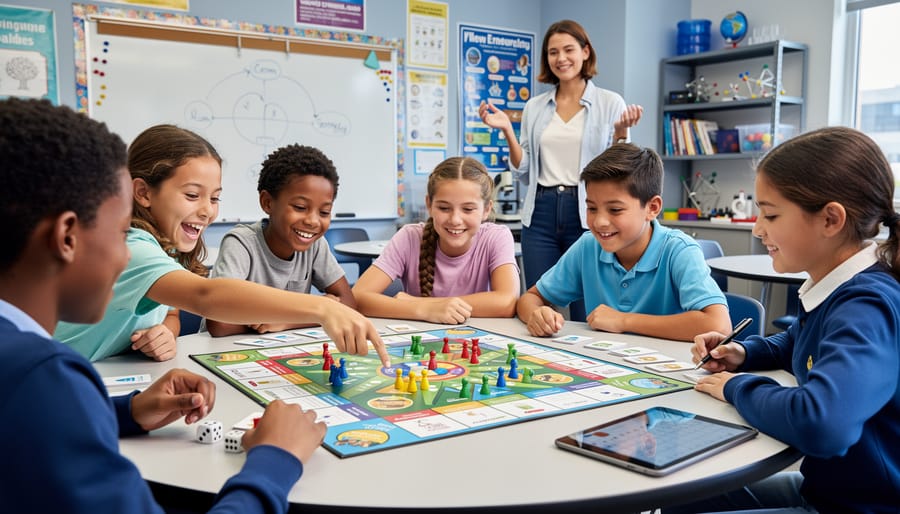
Games naturally shift your role from lecturer to learning guide, and that’s exactly what facilitation is all about! When students play educational games, they’re actively participating rather than passively listening. You’re no longer standing at the front delivering information—you’re moving around the room, observing progress, asking thought-provoking questions, and stepping in when students need support.
Here’s the beauty of game-based learning: engagement is built right in. Students want to participate because games tap into their natural curiosity and competitive spirit. You don’t have to constantly redirect attention or motivate reluctant learners. The game structure does that heavy lifting for you.
Games also create organic opportunities for collaboration. Students discuss strategies, debate answers, and learn from each other’s thinking. Your job becomes facilitating these peer-to-peer interactions rather than being the sole source of knowledge. You can customize games to match your learning objectives while maintaining that fun, interactive atmosphere.
The best part? You’ll find yourself with more time to truly assess understanding, identify misconceptions, and provide targeted help exactly when students need it most.
Customizing Games to Match Your Facilitation Style
The beauty of classroom games is their flexibility—you can easily tweak them to match how you naturally teach and what your students need most. Think of game templates as your starting point, not a rigid script.
If you love discussion-based learning, adjust games to include more open-ended questions and pause points. Instead of racing through rounds, build in time for students to explain their thinking or debate different approaches. Turn individual challenges into whole-class conversations where everyone contributes to finding solutions together.
For collaborative facilitation, modify games to require teamwork. Create stations where groups must work together to advance, or design activities where each student holds a piece of information needed to solve the puzzle. This naturally encourages peer teaching and builds community.
Prefer a little friendly competition? Keep score, add time limits, or create team challenges. Some students thrive on that energizing race-against-the-clock feeling. Just balance it by celebrating effort and improvement, not just winners.
If reflection is your thing, add journaling prompts or exit tickets after games. Ask students to write about strategies they used, mistakes they learned from, or connections to previous lessons. You can even have students design their own game variations, which deepens their understanding tremendously.
The key is starting simple. Pick one game, try it as-is, then ask yourself: What would make this feel more like me? Small adjustments—changing the pacing, group size, or reflection component—can transform a good activity into something that perfectly fits your classroom vibe.
Common Facilitation Challenges (And How to Handle Them)
When Students Are Silent or Resistant
Silent classrooms can feel discouraging, but remember that participation is a skill students develop over time. Start small by using low-risk activities like think-pair-share, where students discuss with one partner before sharing with the class. This builds confidence gradually.
Create multiple ways to participate beyond raising hands. Try written responses, anonymous question submissions, or quick polls. Some students express themselves better through drawing, writing, or digital tools rather than verbal contributions.
Make your classroom a judgment-free zone by celebrating all contributions and modeling how to respectfully disagree. When you ask questions, provide wait time of at least 5-7 seconds. This gives everyone time to process and formulate thoughts.
For particularly resistant students, meet them individually to understand their concerns. Sometimes silence stems from language barriers, learning differences, or past negative experiences. Build trust through one-on-one connections before expecting public participation.
Game-based activities naturally encourage participation because they feel less intimidating than traditional discussions. Students often engage more freely when learning feels playful rather than evaluative.
Managing Time When Discussions Run Long
When discussions get juicy, it’s tempting to let them flow, but you still need to reach your learning goals. Try the “parking lot” technique: keep a visible space (whiteboard corner or chart paper) where you jot down amazing tangents worth revisiting later. This validates student thinking without derailing your lesson.
Set a friendly timer that students can see. Give a two-minute warning before wrapping up discussions. You might say, “We have two more minutes for this great conversation. Let’s hear one final thought!”
Another helpful trick is using hand signals for quick agreement or adding-on, which speeds up sharing without cutting students off. If discussions consistently run long, you might be asking questions that are too broad. Break them into smaller chunks or save the meatier questions for days when you’ve built in extra time. Remember, good facilitation means balancing depth with progress, not choosing between them.
Balancing Facilitation with Curriculum Requirements
Good news: facilitation and curriculum standards are actually great partners! You don’t have to choose between engagement and meeting requirements. The key is seeing facilitation as your delivery method, not a replacement for content.
Start by mapping your required standards, then identify where student-led discussions, problem-solving activities, or discovery learning naturally fit. For example, instead of lecturing about ecosystems, facilitate a group investigation where students analyze real data and draw conclusions. You’re covering the same standards, just through guided exploration.
Time management is crucial here. Set clear learning objectives for each facilitation session so students stay on track. Use focused questions that guide them toward the specific concepts you need to cover. Think of yourself as a GPS—you know the destination, but students navigate the journey.
Mix facilitation with direct instruction when needed. Some concepts require explanation before students can explore them meaningfully. A quick mini-lesson followed by facilitated practice often works beautifully. This blended approach ensures you’re thorough while keeping students actively engaged.
Remember, facilitation often leads to deeper understanding, which means students actually retain more of your curriculum content. It’s efficient learning disguised as fun!
Growing Your Facilitation Skills Over Time
Here’s the truth: you won’t become a facilitation expert overnight, and that’s completely okay! Think of facilitation as a skill you’re building alongside your students’ learning journey. Every small shift you make counts.
Start with one technique that feels comfortable. Maybe it’s asking more open-ended questions during your next lesson, or trying just one game-based activity this week. Notice what happens. Did students engage differently? What surprised you? These observations are your growth markers.
Give yourself permission to experiment without perfection. That discussion that went off-track? It’s valuable feedback about pacing. The activity that flopped? Now you know what to adjust next time. Your students won’t remember every stumble, but they’ll definitely remember the energy you brought to trying something new.
Consider keeping a simple facilitation journal. Jot down quick notes after lessons: what worked, what didn’t, and one thing you’d change. Over months, you’ll spot patterns and celebrate real progress.
Remember, even experienced facilitators continuously refine their approach. The goal isn’t to transform your entire teaching style immediately. It’s about gradually shifting from doing all the talking to creating more space for student voices. Each question you pose instead of answering, each moment you step back and let students collaborate, you’re facilitating.
Be patient with yourself. Small, consistent changes create classrooms where students think critically, collaborate authentically, and truly own their learning. You’ve got this!
Here’s the exciting truth: facilitation transforms your classroom one small step at a time. You don’t need to overhaul everything overnight or become a completely different teacher. The shift from instructor to facilitator happens through simple, intentional moves that gradually reshape how your students engage with learning.
Start small tomorrow. Try one question instead of giving one answer. Incorporate a quick game-based activity that puts students in the problem-solving seat. Notice what happens when you step back just a bit and let them step forward. These moments accumulate into something powerful: a classroom culture where students think critically, collaborate naturally, and take ownership of their learning journey.
Game-based tools make this transition even smoother because they’re designed for student-centered exploration. They create the perfect environment for you to practice facilitation while keeping everyone engaged and motivated.
Remember, facilitation isn’t about perfection. It’s about progress. Every time you guide instead of tell, you’re building skills that will serve your students far beyond your classroom walls. Need ongoing support as you experiment? Check out the Implementation Playbook for strategies you can reference whenever you need a facilitation refresh. You’ve got this!