Word Association Game: 100 Words, Rules and Examples
For a Word Association Game, the goal is to think of words that are commonly associated or related to a given word. This can be based on synonyms, antonyms, categories, activities, or any other logical connection.
Here’s an example of how one round of a Word Association Game could unfold:
Player 1 says “Rain”
Player 2 hears “Rain” and responds with “Umbrella”
Player 3 hears “Umbrella” and says “Beach”
Player 4 hears “Beach” and responds with “Sand”
Player 5 hears “Sand” and says “Castle”
Player 6 hears “Castle” and responds with “Knight”
Player 7 hears “Knight” and says “Armor”
Player 8 hears “Armor” and ends the round by saying “Shield”
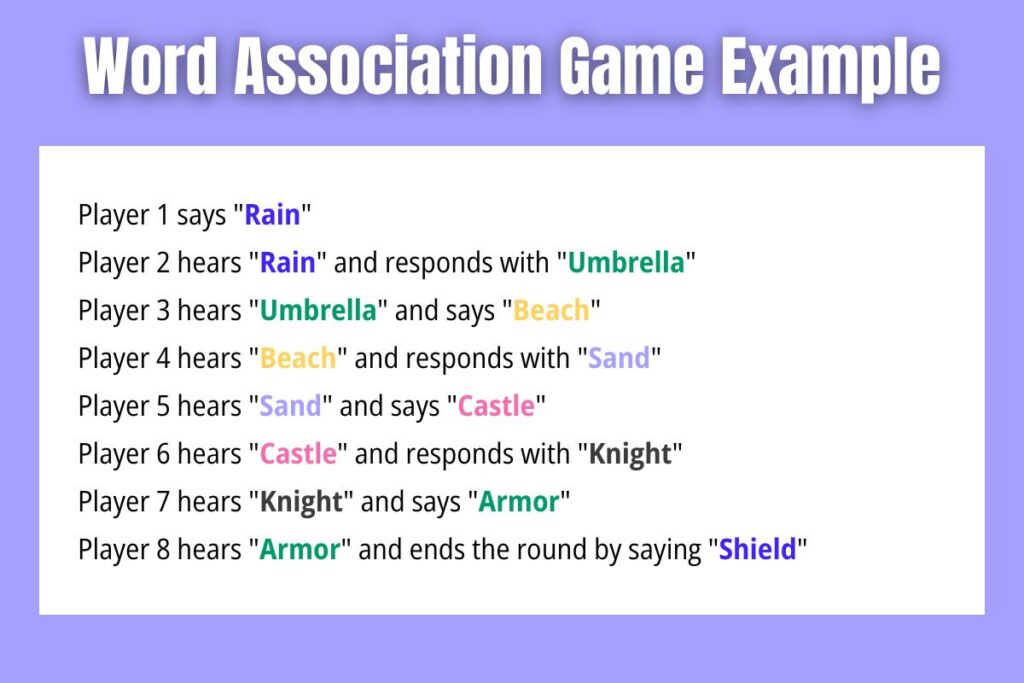
Each player’s word is associated with the word before it, creating a chain of related words. The round can end after a predetermined number of turns, when players run out of words, or if someone repeats a word or takes too long to respond.
Here is a diverse list of 100 words that are great for such games, spanning various categories and themes:
- Apple
- Ocean
- Happy
- Mountain
- Music
- Book
- Light
- Tree
- Coffee
- Sun
- Moon
- Star
- Flower
- Bird
- Fish
- Heart
- Fire
- Ice
- Snow
- Rain
- Wind
- Forest
- Desert
- Beach
- City
- House
- Car
- Train
- Bicycle
- Road
- Bridge
- River
- Lake
- Sea
- Island
- Earth
- Sky
- Space
- Universe
- Galaxy
- Science
- Technology
- Art
- History
- Geography
- Mathematics
- Physics
- Chemistry
- Biology
- Language
- Literature
- Poetry
- Film
- Theater
- Dance
- Sport
- Football
- Basketball
- Tennis
- Golf
- Chess
- Cooking
- Baking
- Painting
- Drawing
- Sewing
- Knitting
- Gardening
- Fishing
- Hiking
- Camping
- Swimming
- Skiing
- Surfing
- Yoga
- Meditation
- Fitness
- Health
- Medicine
- Hospital
- School
- University
- Library
- Museum
- Park
- Zoo
- Aquarium
- Circus
- Festival
- Concert
- Party
- Wedding
- Birthday
- Christmas
- Halloween
- Easter
- Thanksgiving
- New Year
- Summer
- Winter
Want this exact list ready to play? The Word Association Classroom Game comes with all 100 words above pre-loaded: an editable PowerPoint (works in Google Slides too) with one big word per slide in 10 themed rounds, plus printable word cards and a chain score sheet. Project it or print it, no prep needed.
Types of Word Association Games
Word association games come in several formats, each offering a different spin on the core mechanic of connecting related words. The classic version involves players sitting in a circle and building a chain where each person must respond with the first word that comes to mind. If someone says “ocean,” the next player might say “waves,” followed by “surfing,” and so on until the chain breaks or someone repeats a word.
A competitive variant adds scoring rules. Players earn points for creative connections, and judges can award bonus points for particularly clever or unexpected associations. This version works well in classroom settings where you want to encourage critical thinking about how words relate to one another.
Timed word association ramps up the pressure. Each player gets only three to five seconds to respond, which strips away overthinking and reveals genuine mental connections. The speed element makes this format particularly engaging for energetic groups who thrive on quick-fire gameplay.
Then there’s thematic word association, where all responses must fit within a predetermined category. If the theme is “kitchen items,” a player who says “refrigerator” might be followed by “ice,” then “winter,” and “skiing.” The category constraint adds complexity while helping players practice vocabulary within specific domains.
Reverse association flips the traditional format. Instead of responding to a single word, players receive two words and must find the connecting concept. Given “pilot” and “ocean,” someone might say “navigation” as the link between them. This variation strengthens analytical skills and forces players to think about relationships from multiple angles.
Digital versions have emerged as well, with apps and online platforms tracking responses, measuring reaction times, and even analyzing the cognitive patterns behind word choices. These tools offer data-driven insights but lack the spontaneous energy of face-to-face play.
How to Play Word Association Games
Word association games follow a simple structure that makes them easy to start but surprisingly challenging to master. The basic gameplay involves one player saying a word, and the next player responding with the first related word that comes to mind. Play continues in a chain, with each new word connecting to the one immediately before it.
The most important rule? Speed matters. Players typically have just 3-5 seconds to respond, which prevents overthinking and keeps the energy high. This time pressure is what makes the game engaging for classrooms and group settings.
You can play with as few as two people or scale up to entire classrooms. In larger groups, players sit in a circle and take turns clockwise. If someone hesitates too long, repeats a word already used, or can’t make a clear connection, they’re out. The last player remaining wins that round.
Setting Clear Boundaries
Before starting, decide on any category restrictions. Some versions allow completely free association (where “apple” might lead to “teacher” via the classic gift-giving tradition), while others require direct connections like synonyms, opposites, or same-category items. For younger players or ESL learners, sticking to concrete, category-based connections makes the game more accessible.
Keep a list of used words visible on a whiteboard or shared screen. This prevents repetition and adds a memory element to the game. It also settles disputes quickly when someone claims a word hasn’t been used yet.
Variation Options
Try themed rounds focused on specific topics like animals, food, or emotions. This narrows the scope and helps build vocabulary in targeted areas. Alternatively, introduce a “no obvious answers” rule where the most common association is forbidden. If someone says “black,” you can’t respond with “white.” This pushes players toward more creative thinking and reveals interesting personal associations.
For written versions, set a timer for 60 seconds and have players write down as many associated words as they can think of from a starter word. Compare lists to see who found the most unique connections.
Tips for Choosing the Best Starting Words
The opening word in a word association game sets the tone for everything that follows. Pick something too obscure and players freeze up. Choose something too narrow and the chain hits a dead end after three turns. The sweet spot lies in words that spark multiple connections without being overwhelming.
Start with concrete nouns that paint a clear picture. Words like “ocean,” “kitchen,” or “birthday” work well because they connect to sensory experiences everyone shares. Abstract concepts like “justice” or “theory” sound interesting but often stall momentum, especially with younger players or mixed groups.
Consider your group’s composition when selecting starters. A classroom of third-graders will respond differently to “video game” than a room full of retirees. Match the difficulty and cultural references to your audience. If you’re working with English language learners, stick to high-frequency vocabulary they’ve already encountered.
Variety matters more than you might think. Rotating between categories keeps the game fresh. Try a nature word one round, then switch to an emotion, followed by a food item. This prevents players from falling into predictable patterns and forces them to think laterally.
Test your starter words mentally before using them. Can you generate five quick associations? If you’re struggling, so will your players. Words with rich semantic networks like “summer,” “music,” or “travel” rarely disappoint. They branch in multiple directions without boxing anyone into a corner.
Save challenging starters for later rounds once players have warmed up. Words like “architect” or “molecule” can produce fascinating chains, but they work best after the group has built confidence and rhythm together.