
Educational Games That Actually Get Secondary Students Excited About Learning
Transform review sessions into competitive team challenges where students earn points by correctly answering subject-specific questions. Games like quiz bowls, Jeopardy-style competitions, and digital platforms create the same energy as sports events while reinforcing critical concepts. Secondary students respond especially well when you let them create questions for their peers, turning passive studying into active engagement.
Design escape room experiences that require solving academic puzzles to progress through themed scenarios. Connect chemistry problems to “defusing bombs” or link historical analysis to “unlocking secret codes.” These immersive activities naturally differentiate learning because students work at their own pace while collaborating with teammates who bring different strengths to the challenge.
Incorporate digital game elements like leaderboards, achievement badges, and timed challenges into everyday lessons without losing instructional time. Tools like Kahoot, Quizizz, and Blooket take minutes to set up but dramatically increase participation rates, even among reluctant learners. The key is customizing content to match your current unit rather than using generic templates that feel disconnected from real learning goals.
Implement strategic gaming schedules that balance excitement with curriculum demands. Reserve high-energy competitive games for Friday reviews, use quick five-minute digital quizzes as warm-ups, and deploy collaborative puzzle games when introducing complex topics. This variety prevents gaming from feeling gimmicky while addressing different learning styles throughout the week. The most effective approach treats games as purposeful instructional tools rather than time-fillers, ensuring every activity directly supports your learning objectives while keeping teenage students genuinely motivated to participate.
Why Secondary Students Need Different Game Approaches
Let’s be honest—what works for elementary students won’t fly with teenagers. Your middle and high schoolers have outgrown colorful cartoon characters and simple point systems. They’re navigating a unique developmental stage where peer relationships drive adolescent motivation, abstract thinking kicks into high gear, and they’re increasingly aware of what feels “babyish” versus age-appropriate.
Secondary students crave authentic challenges that respect their intelligence. They want games that mirror real-world competition, allow for strategic thinking, and give them opportunities to showcase their knowledge in front of peers. Think about it: these are the same students who spend hours mastering complex video games, engaging in competitive sports, or debating topics they care about. They need educational games that tap into those same motivations.
The social dynamics at this age also shift dramatically. While younger students might happily play any game you introduce, teenagers are acutely aware of their social standing. They’ll participate enthusiastically when games feel sophisticated, collaborative, or legitimately competitive. Team-based challenges, games with elements of strategy, and activities that allow for some healthy competition resonate far better than overly simplistic formats. Understanding how adolescent educational contexts differ helps you design game experiences that truly connect with this age group.
This is where game-show formats, escape room challenges, and competitive review activities shine. They provide the cognitive challenge teenagers need while creating a classroom atmosphere that feels dynamic rather than childish. When you customize games to match their maturity level and academic content, you’ll see even your most reluctant students lean in. The key is honoring where they are developmentally while making learning genuinely enjoyable.
Game Formats That Win Over Teenagers
Team Competition Games
Secondary students thrive on social interaction, making team competition one of the most powerful formats for classroom review. Research confirms that peer relationships drive adolescent motivation, which explains why harnessing the energy of friendly rivalry transforms learning from an individual task into a shared experience that keeps everyone engaged.
Team-based review games work because they tap into teenagers’ natural desire to collaborate and compete with classmates. Students who might hesitate to participate individually often shine when they’re part of a team, supporting each other and combining their knowledge to succeed.
Game show-style formats bring excitement to your classroom. Think Jeopardy-style boards where teams select questions by category and difficulty, or Family Feud adaptations where students guess the most popular answers. These familiar formats make students comfortable while keeping the competition lively.
Relay races add physical movement to learning. Set up stations around your room where team members rotate through different questions or tasks. Each student completes one challenge before tagging the next teammate, combining academic content with kinesthetic energy that breaks up long class periods.
Tournament brackets create sustained engagement across multiple class sessions. Teams advance through rounds based on their performance, building anticipation and giving students something to look forward to. This format works beautifully for comprehensive unit reviews.
The beauty of team competitions lies in their flexibility. You can adjust team sizes, scoring methods, and difficulty levels to match your classroom dynamics. Mix up team compositions regularly to build community and prevent the same groups from dominating every game.
Team-based educational games leverage the social dynamics that naturally motivate secondary students to engage with learning material.
Strategy and Problem-Solving Games
Secondary students thrive when given challenges that respect their growing analytical abilities, and strategy games deliver exactly that. These activities move beyond simple recall to engage higher-order thinking skills that prepare students for real-world problem-solving. Research confirms that game-based learning enhances higher-order thinking, making strategy games particularly valuable for this age group.
Escape room-style games are absolute winners with this age group. You can create digital or physical escape rooms where students solve subject-specific puzzles to “break out” before time runs out. The best part? These naturally incorporate teamwork and communication while reviewing content. Try building an escape room around historical events, mathematical equations, or literary analysis – the customization possibilities are endless.
Mystery-solving formats also capture teenage interest beautifully. Design scenarios where students play detective, gathering clues hidden within your curriculum content. For example, a science mystery might require students to analyze evidence using the scientific method, while an English version could involve solving crimes based on literary devices and textual analysis.
Logic challenges and puzzle games for students offer another engaging option. Sudoku-style grids with vocabulary words, pattern recognition activities using historical timelines, or code-breaking challenges with mathematical formulas all work wonderfully. These games appeal to competitive students while allowing others to work at their own pace.
The key is making these challenges feel authentic and age-appropriate. Secondary students quickly disengage from activities that feel childish, but they’ll invest deeply in games that genuinely challenge their intellect and offer meaningful problem-solving experiences.
Strategy-based puzzle games challenge secondary students’ critical thinking skills while maintaining engagement through intellectual challenge.
Fast-Paced Review Games
When you need to inject some serious energy into review time, fast-paced games are your secret weapon! These high-octane activities transform potentially dull content review into an exciting challenge that keeps students on their toes.
Speed rounds work beautifully because they tap into that competitive spirit teenagers naturally have. Set a timer for 60 seconds and watch students race to answer as many questions as possible. You can easily customize these rounds to any subject—vocabulary terms in language arts, chemical formulas in science, or historical dates in social studies. The time pressure creates just enough adrenaline to make even reluctant participants lean in and engage.
Lightning challenges take this concept further by adding layers of complexity. Try a “beat the clock” format where students earn points for correct answers but lose time for incorrect ones. Or create relay-style competitions where teams pass questions down the line, building on each other’s answers. The beauty here is that you control the difficulty level and content, tailoring everything to match your current unit.
Timed competitions also introduce healthy peer motivation without overwhelming pressure. Consider using digital tools that display real-time leaderboards or running classic formats like “Around the World” with subject-specific questions. The key is keeping rounds short—aim for 3-5 minute bursts followed by quick breaks.
These formats shine because they make review feel less like studying and more like playing. Plus, you’ll quickly identify which concepts need more attention based on where students stumble during the rapid-fire questions.
Matching Games to Your Subject Area
Finding the perfect game for your subject area doesn’t have to be overwhelming. The key is thinking about what you’re teaching and what kind of interaction will reinforce those concepts best. Different subjects naturally lend themselves to different game formats, and once you understand these connections, you’ll be selecting games like a pro.
Let’s break down which games work wonderfully for different subject areas:
| Subject Area | Recommended Game Types | Why It Works |
|---|---|---|
| STEM (Math & Science) | Quiz-based games, problem-solving challenges | Perfect for practicing calculations and applying formulas |
| English & Language Arts | Matching games, word-based competitions | Great for vocabulary, literary terms, and comprehension |
| Social Studies & History | Timeline games, map activities, trivia | Helps students connect events, dates, and locations |
| World Languages | Flashcard games, translation challenges | Reinforces vocabulary and grammar patterns |
For science classes, games that involve categorizing or sequencing work brilliantly. Think about having students match chemical elements to their properties or order the stages of mitosis. Math teachers often find success with rapid-fire calculation games that build fluency with operations or formula application.
Language arts and English teachers can customize games around anything from Shakespeare vocabulary to grammar concepts. Word association games and literary device identification activities keep students engaged while building critical reading skills. When teaching history class review games, timeline activities and map-based challenges help students visualize connections between events and understand geographical context.
The beauty of digital game platforms is their flexibility. You can take a single template and adapt it completely to your content. A matching game that works for pairing historical figures with their achievements in history class can just as easily match mathematical terms with definitions in algebra.
Start simple by choosing one game format that aligns with your upcoming unit. If you’re reviewing for a test on the periodic table, a quiz-style game makes sense. Planning a vocabulary review for your French class? Try a matching or flashcard format. The more you experiment with different formats, the better you’ll become at recognizing which game type will make your content stick with students.
Customization Tips That Make Games Work for Your Classroom
The magic of game-based learning happens when you tailor activities to fit your unique classroom. Here’s how to make any game template work perfectly for your students.
Start by adjusting difficulty levels to match where your students are right now. If you’re using a quiz-style game, modify question complexity rather than creating entirely different activities. For mixed-ability classes, build in tiered questions where students can choose their challenge level, or assign point values that reflect difficulty so everyone can contribute meaningfully.
Next, tap into what your students actually care about. Transform a generic vocabulary review into a pop culture trivia battle by connecting terms to current music, sports, or social media trends. When studying historical events, frame questions around scenarios from popular games or shows your students are already discussing. This simple switch dramatically increases engagement because suddenly, the content feels relevant to their world.
Your scoring system can make or break participation. Consider moving beyond traditional point tallies. Try collective goals where the whole class works toward a reward, which reduces pressure on struggling students. Or implement a redemption round where teams can earn back points, keeping everyone invested until the final moment. Some classes respond better to non-competitive formats altogether, so don’t hesitate to make games collaborative challenges instead.
Remember to build in flexibility during gameplay. If you notice a section is too easy or hard, adjust on the fly. The best customization happens when you read the room and adapt in real-time, showing students that these games exist to support their learning, not the other way around.
Getting Maximum Participation (Even from Reluctant Students)
Getting every student involved—especially those who typically hang back—starts with creating multiple paths to participate. Not everyone thrives under the spotlight, so offer varied roles within games. Assign quieter students as scorekeepers, question readers, or team strategists rather than always putting them center stage. This approach values different contributions and builds confidence gradually.
Transform competition into something psychologically safe by emphasizing personal progress over winning. Use point systems that reward improvement, creative answers, or thoughtful explanations—not just speed. When making review time engaging, consider “lifelines” or phone-a-friend options that encourage peer support rather than isolating struggling students.
Customize participation methods to match different comfort levels. Allow students to submit answers digitally instead of shouting them out, or use thumbs-up voting systems for multiple-choice questions. Some students shine when they can write responses on whiteboards simultaneously, eliminating the pressure of being first.
Most importantly, celebrate effort publicly and mistakes privately. When a student takes a risk by participating, acknowledge their courage regardless of whether they got the answer right. Frame incorrect answers as “almost there” or “interesting thinking” to maintain dignity. Remember, the goal is building a classroom culture where trying feels safer than staying silent.
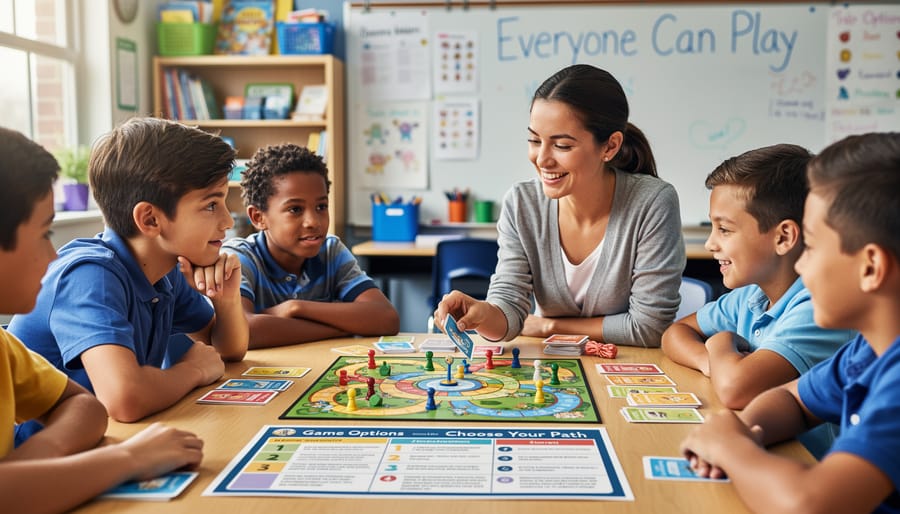
The right educational games genuinely transform review sessions from something students tolerate into activities they actually look forward to. When teenagers are racing against the clock in a trivia challenge or strategizing during a vocabulary relay, they’re learning without even realizing it. That’s the magic you’re creating in your classroom.
Don’t hesitate to experiment with different game formats to discover what resonates with your students. Some classes thrive on competitive team challenges, while others prefer collaborative puzzles. The beauty of customizable templates is that you can test various approaches without spending hours on preparation. Simply adjust the questions, swap the format, and you’re ready to go.
Remember, the time you invest in making learning enjoyable creates ripples that extend far beyond a single class period. Students retain information better when they’re engaged, and they develop positive associations with learning that last a lifetime. By incorporating educational games into your teaching toolkit, you’re not just covering curriculum requirements—you’re building excitement around knowledge and showing your students that education can be genuinely fun. Start small, stay flexible, and watch your classroom energy transform.