
Why Your Game Assessments Might Be Lying to You (And How to Fix It)
Picture this: Your students ace your Jeopardy-style review game, but then bomb the unit test. Sound familiar? This frustrating disconnect happens when classroom assessments lack validity (measuring what you think they measure) and reliability (producing consistent results). The good news? You don’t need a PhD in psychometrics to fix it.
When you create game-based assessments, you’re making critical decisions about student learning. If your trivia questions only test memorization while your standards require analysis, that’s a validity problem. If student scores swing wildly based on which team they’re randomly assigned to, that’s a reliability issue.
Understanding these two concepts transforms your classroom games from fun time-fillers into powerful diagnostic tools. You’ll spot learning gaps faster, adjust instruction more effectively, and give students feedback they can actually use. Whether you’re designing quiz bowl questions, creating escape room challenges, or building interactive review games, validity and reliability determine whether your assessment data helps or misleads you.
Let’s break down these essential concepts into practical strategies you can apply to any classroom game today.
What Makes a Classroom Game Assessment Actually Work?
Picture this: You’ve just wrapped up a fun trivia game with your students, and everyone’s buzzing with excitement. But now comes the big question – what did this game actually tell you about what your students know?
For a classroom game to work as a real assessment tool, it needs to give you reliable information you can trust. Think of it like checking the temperature with a thermometer. You need to know it’s measuring what you think it’s measuring (are students really demonstrating their knowledge of fractions, or just good guessing skills?), and that it gives you consistent results you can count on.
When game-based assessments work well, they help you make confident decisions about where to go next with your teaching. You can identify which students need extra support, which concepts need more practice time, and when your class is ready to move forward. Without these qualities, even the most engaging game is just entertainment – fun, but not particularly useful for planning instruction.
The good news? You don’t need a degree in psychometrics to create effective game assessments. Understanding two key concepts – validity and reliability – will transform how you use games in your classroom. These ideas might sound technical, but they’re actually pretty straightforward once you see them in action with real classroom examples. Let’s break down what makes your game assessments truly worth the time you invest in them.
Validity: Is Your Game Actually Measuring What You Think It Is?
The Different Faces of Validity in Game-Based Learning
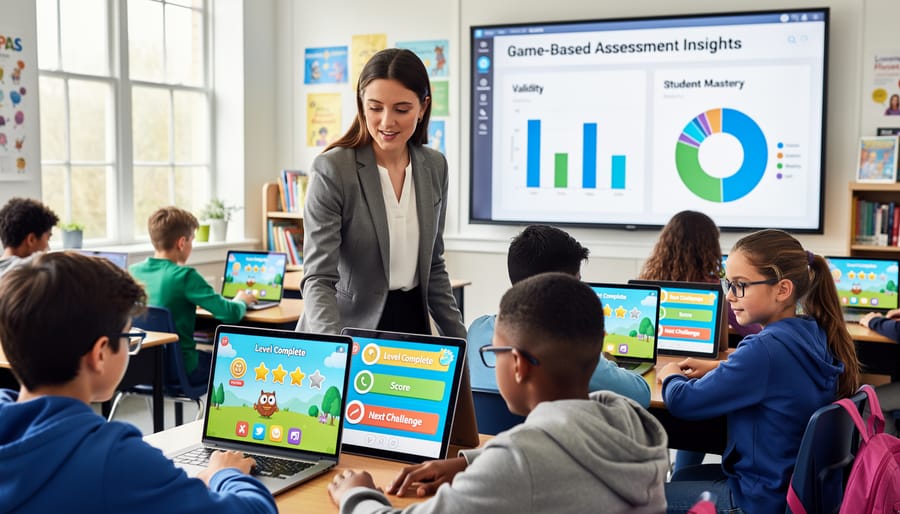
Let’s break down the three main types of validity you’ll encounter when creating game-based assessments. Don’t worry – understanding these concepts will help you create better learning experiences without getting bogged down in technical terminology!
Content validity is all about whether your game actually covers what you’ve been teaching. Think of a trivia game reviewing the water cycle. If your questions only focus on evaporation and condensation but skip precipitation and collection, you’re missing key content. Your game might be fun, but it’s not giving you the full picture of student understanding. A quick fix? Create a simple checklist of learning objectives before designing your game questions to ensure you’re hitting all the important points.
Construct validity asks whether your game measures the thinking skills you intend to assess. Imagine you want students to demonstrate critical thinking about historical events, but your review competition only requires them to memorize dates. That’s a mismatch! Instead, design puzzle challenges where students must analyze cause and effect or compare different perspectives. The game format should match the learning goal.
Face validity is the simplest to grasp – does your assessment look like it measures what it claims to measure? If you’re testing math problem-solving skills through a word scramble game focused on vocabulary, students and parents might question the connection. While face validity isn’t as academically rigorous as the other types, it matters because buy-in from students increases engagement and effort.
The good news? You can customize most classroom games to strengthen all three validity types simultaneously. Start with clear learning objectives, match your game mechanics to those goals, and make the connection obvious to everyone involved.
Red Flags That Your Game Isn’t Measuring Learning
Let’s talk about some warning signs that your awesome classroom game might not be giving you the accurate picture of student learning you’re hoping for.
First up: the speed trap. You know that student who always slams the buzzer first? Speed doesn’t equal understanding. If your game rewards lightning-fast responses above all else, you might be measuring reflexes instead of real learning. A student could be guessing wildly and getting lucky, while a thoughtful learner who needs a few extra seconds to process gets left behind. If you notice the same speedy students dominating every round regardless of the topic, that’s your red flag waving.
Next, watch out for the team dynamics shuffle. Group games can be fantastic for engagement, but they’re tricky for assessment. When teams work together, it’s nearly impossible to know who actually knows the material. That one super-prepared student might be carrying the whole group, while others coast along for the ride. If you can’t confidently say what each individual student learned after the game ends, you’ve got a validity problem.
Here’s the big one: entertainment overwhelm. Yes, we want games to be fun and motivating, but if students leave your classroom buzzing about the game’s bells and whistles instead of the content, something’s off. When the excitement about winning overshadows actual learning, or when students remember the silly team names but not the concepts you taught, your assessment has become pure entertainment.
The good news? Recognizing these red flags is the first step toward creating games that are both engaging and genuinely informative about student understanding.
Reliability: Can You Trust Your Game Results Every Time?
What Reliability Looks Like in Your Classroom Games
Reliability is all about consistency, and here’s what that means for your classroom games. Imagine running a vocabulary quiz game on Monday and then again on Wednesday with similar words. If your students score roughly the same both times, that’s reliability in action! You’re seeing consistent results that truly reflect their vocabulary knowledge, not just a lucky day.
Let’s look at practical examples. When you create multiple rounds of your trivia game, reliable assessment means students who mastered the material perform well regardless of which specific questions appear. Similarly, if you split your class into two groups playing the same game simultaneously, you should see comparable performance patterns across both groups.
Here’s the thing though: inconsistency happens, and it’s often fixable! Maybe Sarah aces the first round but struggles with the second because the questions suddenly got way harder. That’s an issue with question balance. Or perhaps Team A crushes the competition while Team B flounders, but it’s just because one team got easier prompts. That’s unreliable assessment.
You’ll know your game assessment is reliable when students demonstrate similar performance levels across different sessions, when question difficulty stays balanced throughout the game, and when all students face comparable challenges. Think of it as creating a level playing field where student knowledge, not random factors, determines success. The beauty of customizable game templates is you can tweak and adjust until you achieve that sweet consistency!
Why Your Game Results Might Be All Over the Place
Have you ever noticed that students score wildly different from game to game, even when testing the same material? You’re not alone! This inconsistency happens more often than you’d think, and it usually comes down to a few common culprits that affect reliability.
One major issue is inconsistent question difficulty. Imagine playing a trivia game where the first round asks basic addition questions, but the next round suddenly jumps to complex word problems. Students might ace one session and struggle through another, not because their understanding changed, but because the questions weren’t balanced. This makes it super tricky to know what they’ve actually learned.
Random team assignments can also throw results off track. When you pair your strongest reader with students who need more support, their team might dominate. But switch up those teams next time, and suddenly the results look completely different. The game becomes more about who’s on which team rather than what individual students know.
Varying game mechanics create another headache. If you change the rules between sessions, like switching from individual answers to group discussions, or adjusting time limits, you’re essentially playing a different game each time. Students might perform differently simply because they’re navigating new formats, not because their knowledge has shifted.
Finally, unclear instructions can send everything sideways. When students aren’t sure how to earn points, what counts as a correct answer, or how much time they have, they’re guessing at more than just the content. One student might rush through thinking speed matters, while another takes their time believing accuracy is key.
The good news? Once you spot these reliability issues, they’re totally fixable with a few simple tweaks to your game setup!
Bias: The Sneaky Problem Hiding in Your Game Assessments
Common Types of Bias in Classroom Review Games
Even the most exciting review games can accidentally favor certain students over others, which affects whether you’re truly measuring what students know. Let’s look at some common pitfalls to watch for.
Cultural bias sneaks in when questions assume knowledge from specific backgrounds. For instance, a game question about snow sports might disadvantage students from warmer climates, even if you’re testing math skills. Keep your questions inclusive and relevant to all students in your classroom.
Speed-based games naturally advantage quick thinkers, but fast doesn’t always mean accurate or deep understanding. Students who process information thoughtfully might know the material better but lose points in rapid-fire formats. Mix up your game styles to give everyone a fair shot at showing what they know.
Team games often spotlight extroverted students while quieter ones fade into the background. You might miss discovering that your introvert actually mastered the content. Try incorporating individual response systems or roles within teams so every voice counts.
Technology access creates another hurdle. If your game requires smartphones or home internet access, students without these resources start at a disadvantage. This doesn’t reflect their knowledge, just their access to tools.
The good news? Recognizing these biases helps you design games that accommodate different learning styles and backgrounds. When you customize your games with equity in mind, you get clearer, more accurate pictures of what your students actually understand. Small adjustments make big differences in fairness and assessment quality.
Spotting Bias Before It Skews Your Data
Before you hit “launch” on that trivia game, take a moment to scan for hidden bias that could skew your results. Start by reviewing your questions through different lenses. Do they assume specific cultural knowledge or life experiences? For example, questions about “typical family dinners” or “common household pets” might unintentionally favor certain backgrounds over others.
Check your language carefully. Are questions written at an appropriate reading level for all students? Sometimes we accidentally create barriers when we’re just trying to assess science or math understanding. If vocabulary is tripping students up, you’re measuring reading skills instead of content knowledge.
Look at your answer choices too. Do correct answers follow predictable patterns? Are they consistently longer or use specific keywords? Students might spot these patterns and guess correctly without actually knowing the material.
Here’s a quick trick: Have a colleague or teaching partner review your game template with fresh eyes. They’ll often catch assumptions you didn’t realize you were making. Better yet, pilot the game with a small group first and ask students if any questions felt confusing or unfair. Their feedback is gold for catching bias before it affects your whole class’s data.
Simple Strategies to Boost Validity and Reliability in Your Games
Before the Game: Setting Up for Success
Think of game setup like preparing for a big party – a little planning goes a long way! Before launching your assessment game, take time to set yourself up for success.
Start by making sure you align questions with learning objectives. Every question should directly connect to what students need to know. If you’re teaching fractions, your trivia questions should focus on fraction concepts, not random math facts. This keeps your assessment focused and meaningful.
Next, balance your difficulty levels. Mix easier questions with more challenging ones to give all students a chance to shine while still stretching their thinking. Think of it like a video game – you want players engaged, not frustrated or bored.
Create a clear scoring rubric before you start. Decide what counts as correct, partially correct, or incorrect. When students understand exactly how they’ll be evaluated, they can focus on demonstrating their knowledge instead of guessing what you want.
Here’s a game-changer: test your game format first! Run through it yourself or with a colleague. Does the timing work? Are instructions clear? Can students navigate it easily? A quick trial run helps you catch confusing elements before students encounter them.
Remember, the more prepared you are upfront, the more reliable and valid your results will be. Plus, you’ll save yourself headaches during game time!
During and After: Getting the Most Reliable Data
Getting reliable data from your game-based assessments doesn’t stop once you’ve designed them well. How you use these tools makes all the difference!
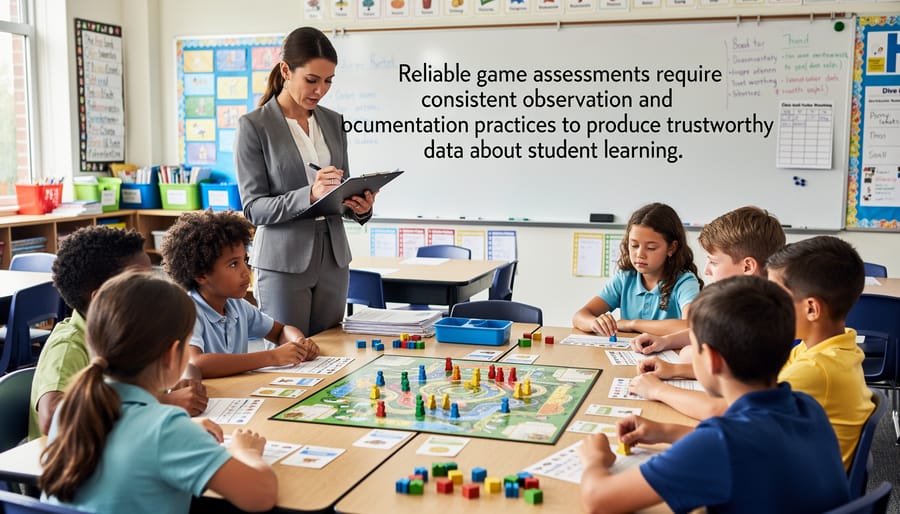
First, keep things consistent. When students play assessment games, try to maintain similar conditions each time. This means using the same time limits, instructions, and setup procedures. Think of it like a science experiment – if you change too many variables, it’s hard to know what the results really mean. When every student gets the same experience, you can trust that differences in their scores reflect actual learning differences, not just varying game conditions.
Here’s an exciting tip: don’t rely on game data alone! Combine your game results with other assessment methods like exit tickets, observations, or quick writing tasks. This gives you a fuller picture of what students actually know. If a student aces your vocabulary game but struggles to use those same words in writing, that’s valuable information you might miss with just one data source.
The real magic happens when you start tracking patterns over time. Play similar games throughout a unit and watch for trends. Is Emma consistently strong in multiplication but struggling with word problems? Does the whole class show growth after your new teaching strategy? These patterns tell stories that single snapshots can’t reveal, helping you make smarter instructional decisions and celebrate genuine student progress along the way.
When Good Enough Is Actually Good Enough
Here’s the truth: your classroom Jeopardy game doesn’t need to undergo the same rigorous testing as a state standardized exam. And that’s perfectly okay!
When you’re using games for formative assessment, you’re gathering snapshots of student understanding to guide your teaching tomorrow, not making life-altering decisions about student placement or graduation. This means you can relax a bit on the scientific perfectionism.
Think of it this way: if your quiz game helps you realize that half the class is confused about fractions, it’s done its job, even if the questions aren’t psychometrically validated. You noticed the gap, and now you can reteach. Mission accomplished!
The key is matching your assessment rigor to the stakes involved. High-stakes tests determining student advancement? Yes, those need serious validity and reliability measures. Your Friday review game checking if students remember this week’s vocabulary? A quick check that questions align with your learning goals is probably sufficient.
This doesn’t mean throwing quality out the window. You still want clear questions, consistent scoring, and alignment with what you taught. But you don’t need to lose sleep over whether every game reaches research-grade standards.
Focus your energy on making assessments helpful and actionable rather than perfect. Your students will learn more from a good-enough game you actually use than a flawless assessment you never have time to create.
Here’s the great news: being mindful of validity, reliability, and bias doesn’t mean your game-based assessments need to become boring or stressful for students. In fact, when you make small, thoughtful improvements to your assessment games, you’re actually making them more effective tools for learning while keeping all the fun intact. Think of it as fine-tuning your favorite activities so they give you better insights into what your students truly know.
Start small. Maybe you’ll adjust one question in your next quiz game to reduce confusion, or you’ll create a quick scoring guide for your team challenge. These tiny tweaks add up to more accurate data about student progress, which means you can better support every learner in your classroom. Remember, the goal isn’t perfection from day one. It’s about being intentional with your design choices and continuously improving your assessment practices. Your students will still enjoy the excitement and engagement of game-based learning, but now you’ll have more confidence that the results are showing you the real picture of their understanding. That’s a win-win for everyone in your classroom.