
Why Your 3rd Graders Keep Confusing Hydrogen-3 with Regular Hydrogen
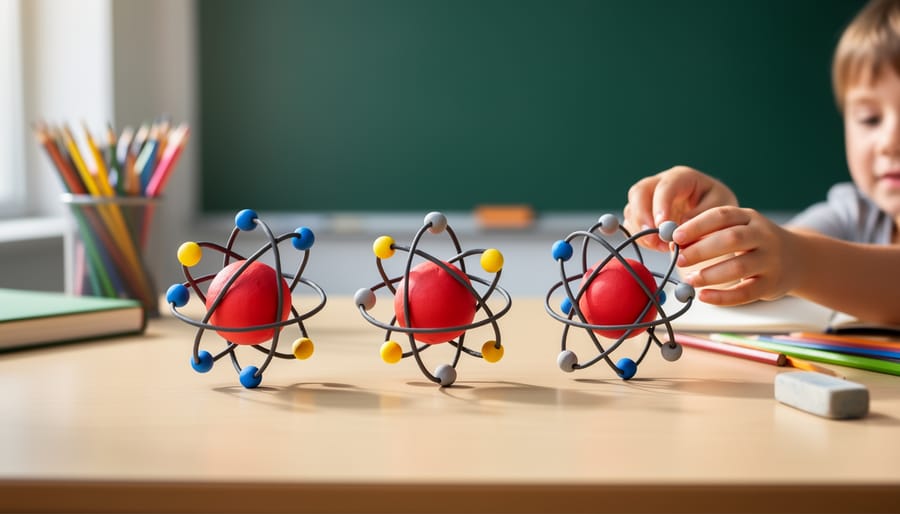
Transform hydrogen-3 into an exciting classroom adventure by comparing isotopes to siblings in a family—they share the same last name (hydrogen) but have different characteristics. Create a simple visual aid showing three hydrogen siblings: hydrogen-1 (protium), hydrogen-2 (deuterium), and hydrogen-3 (tritium), with each having the same single proton but different numbers of neutrons. Use colorful balls or clay to let students build atom models, making the abstract concept tangible for young hands.
Gamify the learning experience by turning isotope identification into a matching activity where students sort element cards by their proton numbers while discovering that different neutron counts create isotope variations. This hands-on approach makes teaching science standards about atomic structure feel less intimidating and more memorable.
Connect the concept to real-world applications by explaining that tritium glows in exit signs and watch dials, giving students a practical reason to care about this special hydrogen isotope. Keep explanations simple: hydrogen-3 is just regular hydrogen with extra neutrons packed inside, making it heavier and slightly different—like adding extra toppings to your favorite pizza without changing what makes it pizza.
What Makes H-3 Different from Regular Hydrogen?
The Building Block Basics
Think of atoms like tiny LEGO structures! Every atom has three main building blocks that snap together in different ways. Let’s break it down so your students can picture it clearly.
Protons are like the red LEGO bricks in the center – they’re positive and sit in the middle part called the nucleus. You can think of them as the team captain that tells you what element you have. Hydrogen always has just one proton, no matter what!
Neutrons are the neutral buddies – imagine yellow LEGO bricks right next to the red ones in that center pile. They don’t have a charge (not positive or negative), but they add weight and stability. Here’s the cool part: atoms can have different numbers of neutrons, which is what makes isotopes special. Regular hydrogen has zero neutrons, but hydrogen-3 has two extra ones!
Electrons are like tiny blue LEGO pieces zooming around the outside in invisible race tracks. They’re negative and super light. For hydrogen, there’s always one electron dancing around that nucleus.
This simple building block approach helps students visualize how atoms work before diving into the exciting world of isotopes. Once they grasp these basics, explaining hydrogen-3 becomes much easier and way more fun!
Why Scientists Care About H-3
Scientists find hydrogen-3 super fascinating because it helps us in amazing ways! This special element glows in the dark without needing batteries, making it perfect for emergency exit signs and watch dials that glow at night. Scientists also use H-3 to track how water moves through our environment, like following a secret path through rivers and oceans. It helps researchers study climate change and understand our planet better. In medicine, doctors use tiny amounts to create important treatments and diagnose health problems. Even though hydrogen-3 is radioactive, scientists handle it safely in laboratories. When you teach your students about H-3, you’re introducing them to real science that makes a difference in our everyday lives, from keeping us safe in emergencies to protecting our environment!
Teaching H-3 Without Losing Your Students
The Cookie Analogy That Actually Works
Here’s a classroom favorite that makes hydrogen-3 crystal clear! Grab three types of cookies: plain sugar cookies (hydrogen-1), cookies with one chocolate chip (hydrogen-2), and cookies with two chocolate chips (hydrogen-3). The cookie itself represents the proton, while the chocolate chips are neutrons.
Show your students how all three are still cookies, just like all hydrogen isotopes are still hydrogen. The difference? Extra neutrons, just like extra chocolate chips! This simple comparison helps young learners visualize that isotopes have the same basic identity but different “extras” inside.
You can extend this into hands-on learning activities by having students create their own isotope cookies using playdough and small objects like beads or buttons. Let them build hydrogen-1, hydrogen-2, and hydrogen-3 models side-by-side. This tactile experience reinforces the concept that the number of neutrons changes while the element stays the same.
Pro tip: Take photos of their creations and create a classroom display labeled “Our Isotope Bakery” to celebrate their understanding!

Quick Activities That Stick
Ready to make H-3 learning come alive? These engaging science activities require minimal prep and maximum student participation.
Start with the Isotope Identity Dance. Assign each student a role: protons, neutrons, or electrons. Call out different hydrogen isotopes and watch students group together to form the correct atomic structure. For H-3, one proton buddy joins with two neutron friends while one electron orbits around them. This kinetic activity helps students physically understand how isotopes differ.
Next, try the Neutron Number Line. Create a floor number line using tape, marking spots for zero, one, and two neutrons. Students jump to the correct position when you call out H-1, H-2, or H-3. Add challenge by calling out “heavy hydrogen” or “tritium” to keep them thinking. You can even time students for an energetic review session.
Finally, use the Half-Life Hot Potato game. Students pass a soft ball around a circle while music plays. When it stops, that student sits down, representing H-3 decay. Continue until half the class sits, demonstrating the half-life concept visually. Restart and see if the second round takes about the same time.
These quick activities transform abstract isotope concepts into memorable, movement-based learning experiences your students will actually remember during assessment time.
Common Misconceptions to Address
Young learners often think isotopes are completely different elements rather than variations of the same element. Gently remind students that hydrogen-3 is still hydrogen because it has one proton—that’s what makes it hydrogen! The extra neutrons just make it heavier, like adding more sprinkles to the same cupcake.
Another common confusion is believing that all hydrogen atoms are identical. Use this as a wonderful teaching moment! Explain that nature loves variety, and atoms come in different versions. Think of isotopes like different flavors of the same ice cream—they’re all ice cream, just with slight differences.
Students might also worry that radioactive sounds scary. Keep the tone light and factual. Explain that many natural things around us are slightly radioactive, including bananas and even our own bodies. Hydrogen-3’s radioactivity is actually useful for scientists and doctors, making it pretty amazing! Encourage curiosity rather than fear, and celebrate their questions as signs of great scientific thinking.
Turn H-3 Learning Into a Game
Game Ideas for Isotope Review
Ready to make isotope review exciting? Let’s explore some fantastic game formats that transform atomic structure concepts into engaging learning experiences!
Isotope Bingo is a classroom favorite that you can easily customize. Create bingo cards featuring different isotopes, including hydrogen-1, hydrogen-2, and hydrogen-3. Call out atomic characteristics like “has 2 neutrons” or “tritium” and watch students mark their cards. This simple format helps reinforce the relationship between isotope names and their atomic structures.
Try Atomic Structure Relay Races for active learners. Set up stations where teams race to build correct isotope models using craft materials. One student adds protons, another adds neutrons, and a third adds electrons. This hands-on competition reinforces that isotopes have different neutron counts while keeping the same number of protons.
Isotope Matching Games work wonderfully too. Students pair isotope names with their properties or match atomic diagrams to written descriptions. You can create these as digital activities or physical card games, making them perfect for centers or whole-class review.
Don’t forget about digital classroom review games that let you customize content specifically for hydrogen isotopes. These platforms allow students to compete in quiz-show formats while reviewing proton, neutron, and electron configurations.
Mix and match these formats based on your students’ energy levels and learning preferences. The key is keeping it fun while reinforcing those essential isotope concepts through repetition and engagement!

Making It Stick with Team Competitions
Once your students have grasped the basics of hydrogen-3 and isotopes, turn up the excitement with team competitions! Dividing your class into small groups creates a supportive environment where students can share ideas and learn from each other while reviewing what they’ve learned.
Set up a quick quiz game where teams answer questions about neutrons, protons, and the differences between hydrogen isotopes. You can use a simple scoreboard on your whiteboard or smartboard to track points as teams correctly identify which hydrogen version has extra neutrons or explain why tritium is special. The friendly competition keeps energy high and helps reinforce key concepts.
Consider mixing up your teams periodically so students work with different classmates. This approach helps everyone stay engaged and gives quieter students chances to shine. You might award bonus points for teams that can create their own isotope questions or come up with creative ways to remember the differences between hydrogen-1, hydrogen-2, and hydrogen-3.
The best part? Students often remember concepts better when they’ve discussed them with teammates and worked through challenges together. Plus, the fun factor makes even tricky science topics feel approachable!
Assessment Tips That Show Real Understanding
Here’s the exciting part – knowing if your students really get it! Instead of asking them to simply define tritium, try these fun checks that reveal true understanding.
Start with the comparison challenge. Give students three atomic diagrams and ask them to identify which one shows hydrogen-3 and explain why. This shows they understand the neutron difference, not just memorized definitions. You can make this even more engaging by having them create their own isotope drawings and swap with partners for identification.
Try the real-world connection activity. Ask students to explain why scientists might use tritium in glow-in-the-dark signs using only their own words. If they can connect the concept to practical applications, they’ve moved beyond memorization into genuine comprehension.
Use quick think-pair-share moments throughout your lesson. Pose questions like “How is H-3 like having different flavors of ice cream but still being ice cream?” Let students discuss with partners before sharing. Listen for analogies that show they grasp the same-element-different-mass concept.
Create simple exit tickets with scenario-based questions. For example: “A scientist finds an atom with one proton and two neutrons. What element is it? How do you know?” This requires students to apply their knowledge rather than recall facts.
Remember, the goal is understanding over memorization. When students can explain concepts in their own words, make comparisons, and apply knowledge to new situations, you’ll know they’ve truly mastered the material. Celebrate those aha moments – they’re pure teaching gold!
You’ve got this! Teaching about hydrogen-3 and isotopes to your elementary students might have seemed daunting at first, but remember that complex science topics absolutely belong in elementary classrooms when we present them the right way. Your young learners are naturally curious about how the world works, and with the strategies we’ve explored, you’re ready to make this topic come alive for them.
The beauty of teaching isotopes at this level is that you’re not aiming for college-level understanding. Instead, you’re planting seeds of scientific curiosity and building foundational knowledge that will grow with your students over the years. Those building block analogies, simple models, and hands-on activities transform abstract concepts into concrete learning experiences that stick.
Start small if you need to. Maybe try just one visual model during your next science lesson, or introduce a quick comparison game during review time. Notice how your students respond and build from there. Customize these activities to fit your classroom’s unique needs and your teaching style. The goal isn’t perfection but progress and engagement.
Your enthusiasm matters more than anything else. When you approach hydrogen-3 with curiosity and excitement rather than anxiety, your students will mirror that energy. They’ll see science as an adventure rather than a challenge, and that mindset shift is invaluable.
So take a deep breath, grab those building blocks or marshmallows, and dive in. Your students are ready to explore the tiny world of atoms, and you’re equipped to guide them there.