
Why the 1-3 Grading Scale Makes Elementary Science Less Stressful for Everyone
Simplify your elementary grading with the 1-3 scale by defining clear, observable criteria for each level: Level 1 shows beginning understanding with significant support needed, Level 2 demonstrates developing skills with some independence, and Level 3 reflects mastery where students apply concepts confidently on their own. Focus your assessment on specific learning targets rather than trying to grade every assignment, which saves precious time while providing meaningful feedback to students and parents.
Transform this scale into a growth tool by using formative assessments throughout your units to track progress before final evaluations. Quick checks like exit tickets, observation checklists, and interactive activities help you identify exactly where each student stands without overwhelming your grading load. When students score at Level 1, provide targeted small-group instruction and additional practice opportunities; Level 2 learners benefit from guided practice with gradual release of responsibility; Level 3 students are ready for enrichment and extension challenges.
Communicate the scale effectively to parents by sharing specific examples of student work at each level during conferences and in take-home portfolios. Replace vague comments with clear next steps: “Marcus is at Level 2 in measuring—he can use a ruler independently but needs practice choosing appropriate tools for different objects.” This concrete language helps families understand exactly where their child excels and where focused support will make the biggest difference.
What the 1-3 Grading Scale Really Means
Breaking Down Each Level
Let’s look at what student work actually looks like at each level! Understanding these distinctions will help you grade more consistently and communicate progress clearly to students and families.
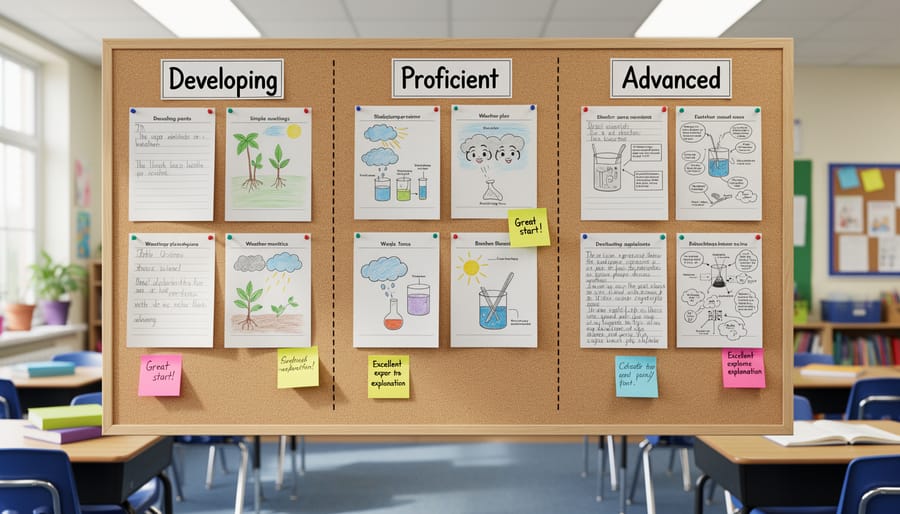
Level 1 shows that students are just beginning to grasp the concept. For a science experiment about plant growth, a Level 1 student might draw a picture but struggle to label the parts correctly or explain what happened. They’re trying, but they need significant support to understand the basic ideas. You’ll often see incomplete work, missing key vocabulary, or answers that show confusion about the topic.
Level 2 means students are developing their understanding and meeting grade-level expectations. Using that same plant experiment, a Level 2 student correctly labels most plant parts, describes what they observed, and uses some science vocabulary appropriately. Their work is solid and shows they’re right where they should be. Think of this as your target zone—students demonstrate they understand the main concepts and can apply them with occasional minor errors.
Level 3 represents students who exceed expectations and show deeper thinking. These students go beyond the assignment requirements. They might connect the plant experiment to what they learned about ecosystems, use advanced vocabulary correctly, or ask thoughtful questions that extend their learning. A Level 3 student doesn’t just complete the work—they show curiosity and make connections you didn’t explicitly teach.
Remember, most of your students will be working at Level 2, and that’s exactly what you want to see!
How It’s Different from Letter Grades
Traditional letter grades can feel like a final judgment, creating anxiety for young learners who are just beginning their academic journey. The 1-3 scale flips this script completely! Instead of chasing an A, students focus on where they are right now and where they’re headed next. A score of 2 doesn’t mean average or mediocre—it means you’re right on track and making solid progress. This approach celebrates growth over perfection, reducing the pressure that comes with letter grades while keeping expectations clear.
Here’s the key difference: letter grades often feel permanent, while the 1-3 scale communicates that learning is ongoing. When a student receives a 1, it’s not failing—it’s an invitation for more practice and support. A 3 shows mastery, but it’s presented as an achievable goal rather than an exclusive club. This shift helps students develop a growth mindset, where effort and improvement matter more than being perfect the first time. Parents appreciate this too, as it opens up more meaningful conversations about their child’s learning journey rather than just focusing on a grade.
Making Grading Faster and More Consistent
Simple Rubrics That Actually Work
Let’s dive into some practical rubrics you can start using tomorrow! These ready-to-use examples will save you time and make your expectations crystal clear for students.
For science observations and data collection, try this straightforward approach. A score of 3 means students recorded detailed observations using multiple senses, included specific measurements or quantities, and organized their data neatly. A 2 shows they made observations and recorded most information, but might be missing some details or measurements. A 1 indicates they attempted the observation but recorded minimal information or left sections incomplete.
When grading lab reports or science experiments, here’s what works well. Give a 3 when students clearly identify the question, materials, steps, and results with supporting evidence. A 2 means most sections are complete but might lack detail in one area, like forgetting to explain what they learned. A 1 shows they included some parts but the report is mostly incomplete or unclear.
For science presentations or posters, this rubric keeps things simple. Students earn a 3 by including accurate information, clear visuals or diagrams, and organized content that’s easy to follow. A 2 means the presentation has good information but might be missing visuals or feels a bit disorganized. A 1 indicates minimal effort with little information or very unclear organization.
The beauty of these rubrics is their flexibility. You can easily customize them for different topics while keeping the same basic structure. Print them on half-sheets to attach to student work, or display them during activities so everyone knows exactly what success looks like. When students understand the targets, they’re more motivated to hit them!
Quick Assessment Tips
Grading during hands-on activities doesn’t have to slow you down! Keep a clipboard handy with a simple class roster where you can quickly jot down numbers as you observe students in action. This real-time assessment captures learning as it happens, giving you authentic snapshots of understanding.
Try the “sticky note strategy” for fast feedback. Use three different colored sticky notes to represent each level: green for 3, yellow for 2, and pink for 1. As you circulate, place a sticky note on student work or in your grade book. It’s visual, quick, and easy to transfer to your official records later.
Focus on one or two key skills per activity rather than trying to assess everything at once. This targeted approach keeps grading manageable and gives students clearer expectations. For example, during a science experiment, you might only assess their ability to make predictions and record observations.
Create simple checklists that align with your 1-3 criteria for common activities. Laminate these and keep them on your clipboard for quick reference. You’ll develop consistency in your grading while speeding up the process. Remember, the 1-3 scale works best when assessment feels seamless and natural within your classroom flow!
Explaining the Scale to Students and Parents
Student-Friendly Language
The words we choose when talking about grades can make all the difference in keeping our young learners motivated and excited about their progress. Instead of using numbers alone, try pairing them with encouraging language that focuses on growth.
When students earn a 3, celebrate their mastery with phrases like “You’ve got it!” or “You’re teaching-ready!” This helps them see themselves as experts who could share their knowledge with classmates.
For students at level 2, emphasize their journey with positive language: “You’re making great progress!” or “You’re almost there!” This keeps them moving forward without feeling stuck or discouraged. Remind them that level 2 means they’re developing their skills, which is exactly what learning looks like.
Level 1 students need the most encouragement. Use growth-focused phrases like “You’re just getting started” or “We’re building your foundation together.” Avoid words that suggest failure. Instead, frame it as the beginning of their learning adventure.
Create a classroom culture where every level is celebrated as part of the learning process. Display anchor charts with kid-friendly descriptions that students can reference. When students understand that grades show where they are on their learning path, not their worth as learners, they’ll stay motivated to keep growing and improving their skills.

Parent Communication Templates
Communicating your 1-3 grading approach helps parents understand their child’s progress and supports learning at home. Here are practical templates to make those conversations easier and more productive.
For newsletters, try this friendly opening: “We’re excited to share how we celebrate learning in our classroom! Instead of traditional letter grades, we use a simple 1-3 scale that shows exactly where your child is on their learning journey. A 3 means they’ve mastered the skill, a 2 shows they’re developing and making progress, and a 1 means they’re just beginning to explore the concept. This approach lets us focus on growth rather than comparing students to each other.”
During parent conferences, address common concerns with clear talking points. When parents ask “Why not use letter grades?” explain that the 1-3 scale provides more specific feedback about skill mastery. If they worry about a score of 1 or 2, reassure them by saying, “A 2 simply means your child is right where they should be in the learning process. They’re actively developing this skill, and here’s how we’re supporting them.”
Include concrete examples in your communications. Share a quick chart showing what each level looks like for a specific standard, like identifying plant parts or understanding the water cycle. Add a positive spin by highlighting that students can move between levels as they grow, making learning feel like an adventure rather than a test.
Keep your messages warm and encouraging, emphasizing partnership in supporting each child’s unique learning path.
Using Review Games to Support 1-3 Learning Goals

Aligning Game Questions to Each Level
Creating questions that match each performance level helps you assess understanding accurately while keeping students engaged. Here’s how to craft game questions for each level on the 1-3 scale.
For Level 1 (Developing), design questions that focus on basic recall and foundational concepts. Think multiple-choice questions with obvious distractors or simple fill-in-the-blank prompts. These questions help students build confidence while you identify knowledge gaps. For example, “What is the center of our solar system?” with clear answer choices.
Level 2 (Proficient) questions should require application and understanding. Use scenario-based questions where students must apply their knowledge to new situations. Try questions like “If a plant isn’t getting enough sunlight, what might happen to its leaves?” These encourage critical thinking while staying grade-appropriate.
Level 3 (Advanced) questions challenge students to analyze, evaluate, or create. Ask open-ended questions during science review games that require deeper reasoning: “Why do some animals migrate while others hibernate? Explain your thinking.”
Mix difficulty levels throughout your games to keep all learners engaged. Start with Level 1 questions as warm-ups, progress to Level 2 for the majority of gameplay, and sprinkle in Level 3 questions as bonus challenges. This approach ensures every student experiences success while stretching their thinking.
Making Formative Assessment Fun
Game-based reviews are perfect for checking student understanding before you assign formal grades on the 1-3 scale. Try quick digital review games where students answer questions individually, giving you real-time data on who’s mastered the concept (3), who’s getting there (2), and who needs extra support (1). These formative assessment strategies take the pressure off while providing valuable insights.
Make it exciting by creating customized games that match your current science unit. Students love the competitive element and immediate feedback, while you gather evidence of learning without the stress of formal testing. Plus, you can easily identify misconceptions and adjust your teaching before moving forward. Use these fun check-ins regularly to track progress and ensure students are genuinely ready for that summative assessment. The best part? Kids don’t even realize they’re being assessed because they’re having too much fun learning.
Common Challenges and Simple Fixes
When Students Get Stuck at Level 1
When a student consistently scores at Level 1, it’s time to shift gears with targeted support. First, break down the learning goal into smaller, manageable chunks. Instead of expecting mastery of the whole concept, celebrate progress on individual parts.
Try these quick wins: Use visual aids and hands-on activities to make abstract concepts concrete. Pair struggling students with buddies who can model the skill. Consider whether the student needs more time, different materials, or a fresh approach entirely.
Game-based review tools work wonders here! They provide low-pressure practice while giving you real-time data on what’s clicking and what’s not. Students often shine when they can learn through play.
Don’t forget to check if reading difficulties are masking science understanding. Sometimes students know the content but struggle to show it. Explore intervention strategies that address foundational skills.
Remember: Level 1 isn’t failure—it’s your starting point for personalized support. With consistent, differentiated instruction, you’ll see those students climbing toward Level 2 and beyond.
Motivating Already-Proficient Students
Students who consistently demonstrate proficiency at level 2 are ready for enrichment that deepens their understanding rather than just piling on more work. Think of it as building up, not out!
Challenge these learners with extension activities that ask them to apply concepts in new situations. Have them design their own experiments, create teaching materials for classmates, or solve real-world problems using what they’ve learned. You might ask a student who masters the water cycle to research how climate affects it differently across regions, or have them build a model showing multiple cycles working together.
Incorporate student choice whenever possible. Let proficient learners select from a menu of extension options, like conducting independent research projects, creating digital presentations, or mentoring peers who need extra support. This customization keeps them engaged and invested.
Remember, advancing to level 3 means going beyond the standard. Encourage higher-order thinking by asking “what if” questions, prompting predictions, and inviting connections across different science topics. The goal is stretching their thinking while maintaining that enthusiasm for learning that keeps science exciting!
Switching to a 1-3 grading scale can feel like a big change, but the benefits are absolutely worth it! This streamlined approach reduces grading stress for you while giving students clearer feedback on their learning journey. You’ll spend less time agonizing over whether something deserves an 82 or 85, and more time actually teaching and connecting with your students.
The beauty of the 1-3 scale is that it shifts everyone’s focus toward growth and mastery rather than chasing points. Students understand exactly where they stand and what they need to work on next. Parents appreciate the straightforward communication about their child’s progress. And you’ll find yourself with more energy to create engaging lessons and meaningful learning experiences.
Ready to give it a try? Start small! Pick one subject or one unit to experiment with the 1-3 scale. See what works for your classroom, adjust the criteria as needed, and don’t be afraid to tweak your approach. Remember, there’s no perfect system, just the one that helps your students learn best. You’ve got this! Your willingness to try something new shows your commitment to putting student growth first, and that’s what makes you an amazing educator.