
Turn Any Review Into a Game With This Simple 3-2-1 Organizer
Transform reflection into an engaging classroom game by using the 3-2-1 graphic organizer as your secret weapon for assessment and fun. This simple framework asks students to identify three key concepts, two interesting details, and one remaining question about any lesson—turning routine check-ins into interactive challenges that students actually enjoy.
Turn the organizer into a timed competition where teams race to complete their responses with the most thoughtful answers winning bonus points. Create station rotations where students move through different subject areas, filling out a new 3-2-1 organizer at each stop while competing for accuracy and creativity. Design a gallery walk game where students post their completed organizers around the room, then earn points by adding meaningful comments to classmates’ work.
The beauty of this tool lies in its flexibility—customize the numbers to fit your needs (try 4-3-2 for older students or 2-1-1 for quick checks), adjust the prompts to match your content, and adapt the game format to suit your classroom energy. Whether you’re wrapping up a science unit, processing a read-aloud, or reviewing math concepts, the 3-2-1 organizer turns passive listening into active participation. Students get immediate feedback, you gain valuable insight into their understanding, and everyone benefits from the energizing game atmosphere that makes learning memorable.
What Is a 3-2-1 Graphic Organizer?
The 3-2-1 reflection template is a simple yet powerful learning tool that helps students process and reflect on what they’ve just learned. Here’s how it works: students identify 3 things they learned, 2 interesting facts that caught their attention, and 1 question they still have. It’s that straightforward!
What makes this organizer so special is its flexibility. As a learning tool, it encourages students to actively engage with content rather than passively absorbing information. They need to think critically about what resonated with them and what they’re still curious about. This metacognitive process strengthens understanding and retention.
But here’s where it gets exciting for your classroom: the 3-2-1 format transforms beautifully into game components. You can turn student responses into trivia questions, create team challenges where groups compare their findings, or build scavenger hunt activities around the format. The structure naturally creates talking points and discussion opportunities that make games more meaningful.
Teachers love it because it’s quick to implement and easy for students to understand, regardless of grade level. There’s no complicated setup or lengthy explanations needed. Students love it because it gives them choice in what they share and doesn’t feel like a traditional worksheet. Plus, when you gamify the process, learning becomes an adventure rather than an assignment. Whether you’re reviewing yesterday’s lesson or wrapping up a unit, this organizer keeps everyone engaged and thinking.

Why This Organizer Works as a Game Component
The 3-2-1 organizer isn’t just a reflection tool—it’s a brilliant game component that transforms review sessions into games students genuinely enjoy. Here’s why it works so well in gameplay settings.
First, the structure naturally encourages thoughtful reflection without feeling overwhelming. Students can’t just breeze through with surface-level answers because they need to prioritize and select their most important points. This built-in thinking process makes every game round meaningful.
The format also creates friendly competition that keeps everyone engaged. When students share their 3 things, 2 insights, and 1 question, classmates can challenge responses, award points for creativity, or vote on the best answers. This peer interaction adds excitement while reinforcing learning.
Scoring is incredibly straightforward, which means you can focus on facilitating rather than wrestling with complicated point systems. Whether you award points per item, bonus points for unique answers, or group points for collaboration, the three-tier structure keeps scoring simple and transparent.
The real magic? This organizer works across every subject and grade level. Elementary students can identify 3 vocabulary words, 2 examples, and 1 question about insects, while high schoolers might analyze 3 causes of historical events, 2 effects, and 1 lingering debate. You can customize the categories to fit any content area—math, science, literature, social studies, or even art and music.
Plus, the organizer is flexible enough for individual play, partner challenges, or team competitions. Whether you have ten minutes or a full class period, the 3-2-1 format adapts to your schedule and classroom dynamics, making it a reliable go-to game component that grows with your students.
Print-and-Play Game Ideas Using 3-2-1 Organizers
Team Relay Challenge
Ready to amp up the energy in your classroom? The Team Relay Challenge transforms the 3-2-1 organizer into an exciting competition that gets everyone moving and thinking!
Here’s how it works: Divide your class into teams of 3-4 students. Each team receives a stack of 3-2-1 organizers related to your current lesson. Position teams at the back of the classroom with answer stations at the front.
When you say “Go!” one student from each team races to the front, completes one line of the organizer, then races back to tag the next teammate. The relay continues until the entire organizer is finished. Teams earn points for both speed and accuracy—maybe 10 points for finishing first, 5 for second, but an additional 15 points if all answers are correct!
Mix it up by having different topics at each station or requiring teams to complete multiple organizers. You can even add challenge cards where students must explain their answers to earn bonus points.
This game works beautifully for review sessions or as a formative assessment that doesn’t feel like a test. Your students will love the movement and friendly competition while you get valuable insight into their understanding!
Bingo Battle
Ready to level up your 3-2-1 review sessions? Bingo Battle transforms traditional reflection into an exciting competition that gets everyone engaged! Here’s how it works: Create bingo cards where each square contains a different 3-2-1 prompt. Students move around the room completing various prompts from their cards, marking off squares as they go.
The beauty of this game is its flexibility. You can customize prompts to match any subject or skill level. One square might ask for “3 vocabulary words from today’s lesson,” while another requests “2 questions you still have” or “1 real-world connection.” Students can work independently or interview classmates to fill their cards, adding a collaborative element.
To play, set a timer for 15-20 minutes and let students tackle prompts in any order. First person to complete a line (horizontal, vertical, or diagonal) shouts “Bingo!” and shares their responses with the class. For longer sessions, play blackout bingo where students aim to complete the entire card.
This format works wonderfully as a unit review, station rotation activity, or end-of-week recap. Plus, the game structure naturally encourages students to think deeper about content without feeling like traditional assessment.
Gallery Walk Showdown
Turn your classroom into an art gallery with this exciting peer-review game! After students complete their 3-2-1 organizers, have them post their work around the room at designated stations. Each student gets sticky dots or colorful voting cards to place on organizers that catch their eye.
Set clear voting categories to make it more engaging: Most Creative, Deepest Thinking, Best Connections, or Funniest Takeaway. Students walk around gallery-style, reading what their classmates wrote and placing their votes. You can even play soft music to create that gallery atmosphere!
This activity works beautifully because it encourages students to take pride in their work and learn from each other’s perspectives. They’ll notice different ways to interpret the same content, sparking valuable discussions. Plus, it gets everyone moving and talking, which breaks up sedentary learning time.
At the end, tally votes together and celebrate the winners. Consider displaying top organizers on a bulletin board or taking photos to share with families. The competitive element motivates students to put extra thought into their responses, while the gallery format makes assessment feel like celebration rather than evaluation.
Quick-Fire 3-2-1
Ready to add some friendly competition to your classroom? Quick-Fire 3-2-1 transforms the graphic organizer into an exciting timed challenge that gets students energized about summarizing their learning.
Here’s how it works: Set a timer for 3-5 minutes and challenge students to complete their 3-2-1 organizers with thoughtful, quality responses. You can run this as an individual race against the clock or pair students up for a partner challenge. The goal isn’t just speed—it’s producing well-crafted answers quickly.
What makes this game so effective is the balance between time pressure and quality thinking. Students learn to process information efficiently while still maintaining depth in their responses. It’s perfect for reviewing lesson content or wrapping up a unit with energy.
Try these variations to keep things fresh: rotate partners after each round, create team relay races where students pass the organizer after completing each section, or establish different time limits based on content complexity. You can even award points for creativity alongside completion time.
Display the organizers on your board afterward to celebrate quick thinking and quality work. Students love seeing their responses recognized, and it creates wonderful discussion opportunities. This quick-paced format works brilliantly for all grade levels—just adjust your timing and content difficulty accordingly.
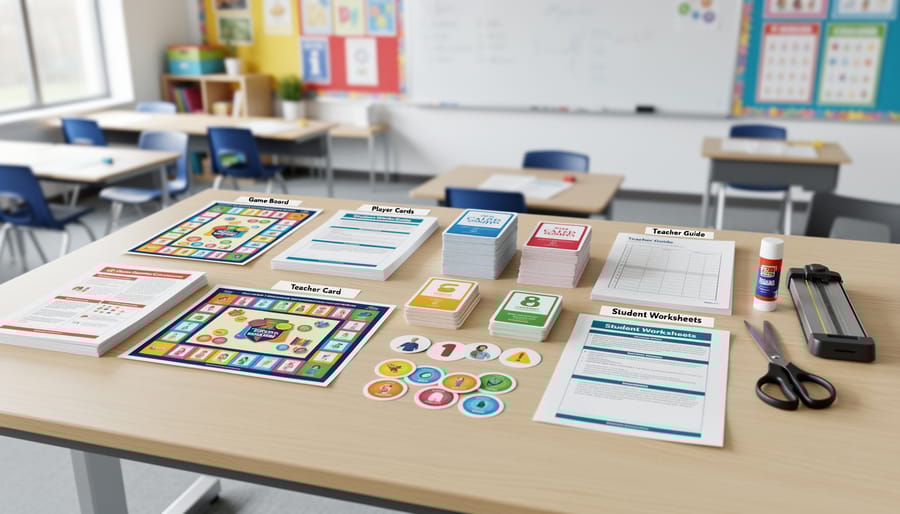
How to Create Your Print-and-Play 3-2-1 Game Kit
Creating your own print-and-play games with the 3-2-1 organizer is easier than you think! Let’s build a game kit you can use right away.
Start by printing enough 3-2-1 organizer templates for each student or team. Regular paper works perfectly fine, but cardstock makes them more durable for repeated use. Next, decide on your scoring system. The simplest approach awards 3 points for each item in the top section, 2 points for the middle, and 1 point for the bottom. You can also add bonus points for creativity or depth of thinking.
Now for the game rules! Keep them straightforward so students can jump right in. Set a clear time limit, usually 5-10 minutes works well. Explain what students should write in each section based on your lesson content. For example, after a science unit, they might list 3 facts they learned, 2 questions they still have, and 1 way to apply the concept.
Add some excitement by creating challenge cards with specific prompts or categories. Laminate these if possible so you can reuse them throughout the year. Include a simple instruction sheet that explains the rules in kid-friendly language.
Store everything in a labeled folder or envelope for quick access. You might even create different themed kits for various subjects or grade levels. The beauty of this approach is how easily you can customize it. Change the categories, adjust the point values, or add collaborative elements where teams combine their answers.
Keep your game kit accessible and ready to grab whenever you need a quick review activity that actually engages students!
Customization Tips for Different Subjects and Grade Levels
The beauty of the 3-2-1 graphic organizer is how easily you can tweak it to fit any subject or age group! Let’s explore some practical ways to make it shine across your curriculum.
For elementary students, keep prompts simple and concrete. In math, try “3 shapes you found, 2 ways to make 10, 1 math word you learned.” For reading, use “3 characters, 2 events, 1 favorite part.” Young learners love visual elements, so encourage drawings alongside written responses.
Middle schoolers thrive with slightly more challenge. In science, prompt them with “3 observations from the experiment, 2 hypotheses, 1 question for further research.” Social studies works great with “3 causes of the event, 2 effects on society, 1 modern connection.” This age group enjoys competitive elements, so incorporate team challenges where groups compare answers.
High school students can handle abstract thinking. Try “3 literary devices, 2 thematic elements, 1 critical analysis question” for English, or “3 mathematical concepts applied, 2 alternative solution methods, 1 real-world application” for advanced math.
Subject-specific tips: Math benefits from “show your work” variations. Science loves the “observe-hypothesize-question” model. ELA shines with “quote-analyze-connect” formats. Social studies works beautifully with “fact-interpretation-opinion” structures.
Remember, modifications should work for all learners in your classroom. Adjust complexity, add visual supports, or allow verbal responses as needed. The framework stays consistent while the content flexes to meet your students exactly where they are.
Ready to transform your classroom review sessions? The 3-2-1 graphic organizer game approach is one of the easiest strategies you can implement tomorrow. There’s no complicated setup, no expensive materials, and no lengthy training required. Just print, play, and watch your students engage with content in fresh ways.
The beauty of this approach lies in its flexibility. Whether you choose the board game format, bingo variation, or card-based version, you’re giving students a fun framework to demonstrate their learning while building critical thinking skills. Plus, the customization options mean you can adapt these games to any subject, grade level, or learning objective.
Don’t stop here! Your platform offers countless other print-and-play game components that work alongside the 3-2-1 format. Mix and match elements to create unique classroom experiences that keep students motivated and excited about learning. Start with one game format this week, see how your students respond, and build from there. Your classroom game toolkit is just getting started!