

These Four Critical Thinking Skills Transform How Students Solve Real Problems
Teach your students to question assumptions by having them identify what information they’re taking for granted in everyday scenarios—from analyzing advertisements to solving math word problems. Build their analytical muscles by breaking complex topics into smaller parts, then asking them to examine how each piece connects to create the whole picture. Practice evaluation skills through activities where students compare multiple sources, rate the strength of different arguments, or judge the reliability of information they encounter online. Strengthen inference abilities by presenting incomplete information and challenging students to draw logical conclusions based on available evidence, whether they’re predicting story outcomes or interpreting scientific data.
These four competencies—analysis, interpretation, evaluation, and inference—form the foundation of effective thinking. When you understand that critical thinking is a skill, you can intentionally design lessons that target each area. The best part? You don’t need elaborate materials or complicated lesson plans. Simple classroom discussions, quick review games, and everyday problem-solving activities give students the practice they need to become sharper, more confident thinkers who can tackle challenges both inside and outside your classroom.
Analysis: Breaking Down Complex Problems Into Bite-Sized Pieces

What Analysis Looks Like in Your Classroom
Analysis looks different across subjects and grade levels, but the core skill remains the same: breaking information into parts to understand the whole.
In elementary science, students analyzing a plant diagram might identify roots, stems, and leaves, then explain how each part helps the plant survive. They’re not just labeling—they’re connecting structure to function.
Middle school history students analyzing primary sources might examine a historical letter by identifying the author’s perspective, the intended audience, and the context of the time period. This helps them understand why the document matters beyond just reading words on a page.
High school math students working through word problems demonstrate analysis by identifying given information, determining what’s missing, and choosing the right formula. They’re dissecting the problem before solving it.
In literature classes, students analyze characters by examining their actions, dialogue, and relationships to understand motivations and themes. This connects directly to metacognition skills as students reflect on how authors create meaning.
The key is giving students opportunities to pull things apart systematically rather than just accepting information at face value.
Games That Build Analytical Thinking
Interactive games transform analytical thinking from an abstract concept into an exciting hands-on experience. When students play review games, they naturally practice breaking down complex information into manageable pieces without even realizing they’re building critical skills.
Think about classic classroom favorites like sorting games or pattern recognition activities. These seemingly simple exercises require students to examine information carefully, identify what’s important, and group related concepts together. When you turn vocabulary review into a matching game or historical events into a timeline challenge, you’re creating opportunities for students to analyze relationships and connections.
Digital quiz platforms take this even further by letting you customize questions that specifically target analytical skills. You can design multiple-choice questions where students must identify the key component in a scientific process, or create true-false statements that require breaking down complex sentences into their essential parts.
Puzzle-based games are particularly effective because they mirror real analytical thinking. Whether students are solving riddles, completing logic puzzles, or playing mystery-solving games, they’re practicing the same skills they’ll use when analyzing literature or scientific data. The key is that these activities feel like fun rather than work.
The beauty of game-based learning is the immediate feedback loop. Students quickly see whether their analysis was correct, allowing them to adjust their thinking in real-time. This instant reinforcement helps solidify analytical strategies much faster than traditional worksheets.
Don’t forget team-based competitions either! When students work together to analyze information during relay races or group challenges, they verbalize their thinking process, learn from peers, and develop stronger analytical approaches through collaboration. The competitive element keeps energy high while the teamwork ensures deeper learning.
Evaluation: Weighing Evidence and Making Sound Judgments
Teaching Students to Question and Verify
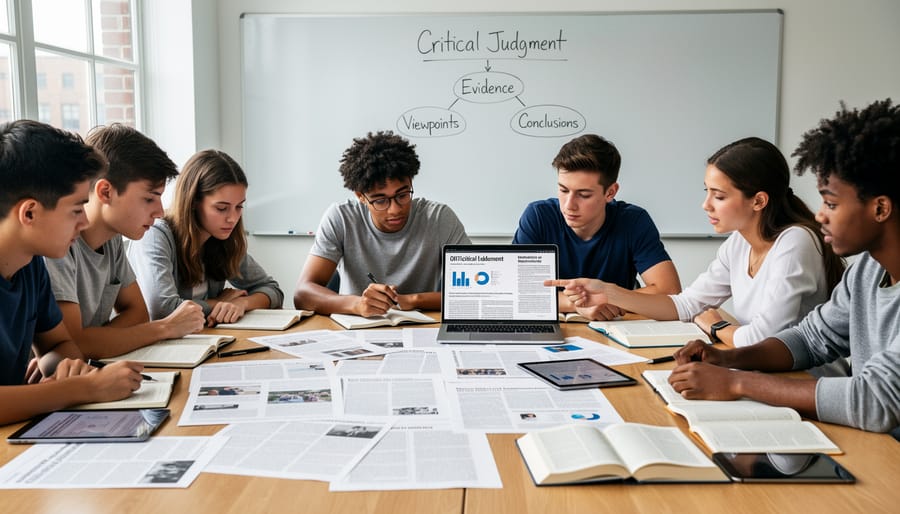
Help your students become smart information consumers by teaching them to question what they encounter. Start simple by creating a classroom culture where asking “How do you know that?” is celebrated, not seen as challenging. Model this behavior yourself by thinking aloud when you evaluate sources during lessons.
Introduce the CRAP test (Currency, Reliability, Authority, Purpose) as a memorable framework for source evaluation. Make it interactive by having students practice on real-world examples like social media posts, advertisements, or news headlines. You can turn this into an engaging game where teams compete to identify red flags in questionable sources.
Teach students to cross-reference information by checking multiple sources before accepting claims as facts. Create scavenger hunts where they must verify a statement using at least three different credible sources. This builds the habit of not taking things at face value.
Encourage students to identify bias by examining who created the information and why. Have them compare how different news outlets cover the same story or analyze the language used in persuasive texts. Regular practice with these verification strategies transforms students from passive information receivers into critical thinkers who naturally question and investigate before believing.
Using Review Games to Practice Evaluation
Review games transform your classroom into an energetic space where critical thinking happens naturally through play and competition. When students participate in game-based learning, they’re constantly evaluating their options, defending their answers, and reconsidering their reasoning—all essential components of strong critical thinking.
The beauty of using games for evaluation practice lies in the immediate feedback loop they create. Students must quickly assess multiple answer choices, eliminate incorrect options, and justify why their selection is the strongest. This rapid-fire decision-making mirrors real-world critical thinking, where we often need to evaluate information efficiently and confidently.
Competition adds another layer of motivation. When teams face off in a review game, students become invested in thoroughly analyzing each question. They’ll debate with teammates, challenge assumptions, and weigh evidence before committing to an answer. This collaborative evaluation process helps students articulate their thinking and consider perspectives they might have missed independently.
You can maximize the critical thinking benefits by customizing your review games to include questions that require genuine evaluation rather than simple recall. Include scenarios where students must compare and contrast options, identify the best solution among several viable choices, or explain why one answer is superior to another that seems similar.
Try incorporating question formats that mirror standardized tests but with engaging delivery methods. Students practice the same evaluation skills they’ll need for assessments while enjoying the game atmosphere. The competitive element keeps energy high, and the interactive format means students stay engaged longer than traditional review methods.
The key is making evaluation fun rather than intimidating. When students associate critical analysis with enjoyable game experiences, they develop confidence in their ability to think critically across all subjects.
Inference: Reading Between the Lines
From Clues to Conclusions
Inferential thinking shows up in exciting ways across every grade level! In elementary classrooms, young students practice inference when they predict what might happen next in a story based on character clues or determine why a plant grew taller in one spot versus another during science experiments. They’re learning to connect the dots between what they observe and what it means.
Middle school students take it further by analyzing historical documents to infer the motivations behind important events or examining data patterns in math to predict future outcomes. When they’re studying ecosystems, they might infer how removing one species could impact the entire food chain.
High school learners use inference to tackle complex challenges like interpreting symbolism in literature, drawing conclusions from statistical evidence in research projects, or predicting chemical reactions based on molecular properties. They’re constantly asking “what does this evidence tell us that isn’t directly stated?”
The beauty of inferential thinking is that it’s naturally engaging because students become detectives in their own learning. You can strengthen these skills through regular practice with open-ended questions, collaborative discussions, and interactive activities that challenge students to support their conclusions with evidence. When students see how their inferences connect to real-world problem-solving, they become more confident critical thinkers ready to tackle any subject area.
Game-Based Practice for Inference Skills
Getting students to make logical leaps and connect the dots doesn’t have to mean endless worksheets. Puzzle-style games and interactive challenges turn inference practice into something students actually look forward to!
Think of inference as detective work. Students gather clues, look for patterns, and draw conclusions based on evidence. Games naturally mirror this process. When students play mystery-solving games, they’re constantly asking themselves: What do these clues tell me? What’s missing? What can I figure out from what I already know?
Digital puzzle games work wonderfully because they offer immediate feedback. Students make an inference, test it out, and instantly see if their reasoning holds up. This trial-and-error approach builds confidence and helps them understand that inference is a skill they can practice and improve.
You can customize game-based activities to match your students’ levels and your lesson objectives. Start with simple picture-based inference games for younger learners where they guess what happens next in a story sequence. For older students, try mystery scenarios where they piece together evidence or text-based puzzles that require reading between the lines.
The beauty of using games is that students naturally want to keep trying. When they get stumped, they’re motivated to look more carefully at the details and think deeper. They learn that good inferences come from paying attention to all available information, not just making wild guesses.
Interactive challenges also work great for group activities. Team-based puzzle games encourage students to explain their thinking to each other, which reinforces their inference skills and builds collaborative problem-solving abilities. Plus, when students hear how classmates arrived at different conclusions, they learn to consider multiple perspectives and strengthen their reasoning process.
Creative Problem-Solving: Thinking Outside the Box
Why Creativity Matters in Critical Thinking
Here’s a surprise: great critical thinkers are also creative thinkers! Many people assume that critical thinking is all about logic and analysis, but that’s only half the story. The truth is, creativity plays a huge role in effective critical thinking and problem-solving.
When students think creatively, they generate multiple solutions to problems, consider unusual perspectives, and make unexpected connections between ideas. This imaginative thinking helps them move beyond obvious answers and discover innovative approaches. In your classroom, you’ve probably noticed that the most engaged learners are those who ask “what if” questions and explore different possibilities.
The magic happens when creativity and logic work together. Creative thinking generates fresh ideas and possibilities, while analytical thinking evaluates and refines them. Encourage your students to brainstorm wild ideas before analyzing their merit. You’ll be amazed at how this combination strengthens their overall thinking skills and leads to deeper understanding. When students feel free to think creatively, they become more confident critical thinkers who aren’t afraid to tackle challenging problems.

Interactive Tools That Spark Creative Solutions
Here’s the exciting part: you don’t need fancy equipment or expensive programs to help students develop critical thinking skills. Customizable classroom games offer a brilliant way to practice these competencies in an environment where students feel comfortable taking risks and exploring new ideas.
Think about it. When students are engaged in a game, the pressure of being wrong disappears. Instead, they’re motivated to analyze problems, evaluate options, and create solutions because they’re having fun. This low-stakes atmosphere is perfect for encouraging creative thinking alongside those essential critical thinking skills you’ve been teaching.
The beauty of customizable review games is that you can tailor them to match exactly what your students are learning. Studying the scientific method? Create a game where students must identify flawed reasoning in experimental designs. Working on historical analysis? Build questions that require students to compare different perspectives on the same event. The customization options let you target specific skills while keeping engagement high.
What makes these tools especially valuable is how they naturally encourage collaboration. Students bounce ideas off each other, defend their reasoning, and reconsider their positions based on peer feedback. This social aspect mirrors real-world problem-solving, where critical thinking rarely happens in isolation.
You’ll also notice that games create natural opportunities for reflection. After each round, you can pause and ask students to explain their thought process. Why did they choose that answer? What clues led them to their conclusion? These metacognitive moments help students understand not just what they’re learning, but how they’re thinking.
Best of all, you can use the same game template throughout the year, simply updating the content as you move through your curriculum. It’s efficient, effective, and genuinely enjoyable for everyone involved.
When these four critical thinking skills work together, something amazing happens in your classroom. Analysis, evaluation, inference, and problem-solving don’t exist in isolation. They build on each other, creating independent thinkers who approach challenges with confidence and curiosity.
The best part? You don’t need complicated lesson plans to teach these skills. Interactive review games, group discussions, and hands-on activities make critical thinking engaging and accessible for every student. By weaving these opportunities into your regular teaching practice, you’re giving students tools they’ll use far beyond your classroom walls.
Remember, developing critical thinkers takes time and consistent practice. Every question you encourage them to ask, every problem they work through, and every solution they evaluate strengthens their ability to think deeply and independently. You’re not just teaching content, you’re shaping how students approach the world around them. That’s the kind of impact that lasts a lifetime, and it starts with the engaging, thoughtful experiences you create in your classroom today.