
Keep Your Fast Finishers Engaged Without the Chaos
Create a clearly labeled Early Finishers station in your classroom stocked with self-directed activities students can access independently without asking permission. This simple system eliminates the constant “I’m done, what do I do now?” interruptions while keeping fast workers productively engaged.
Establish a three-tier choice board system where students select activities based on their energy level and learning preference. Tier one includes quiet individual tasks like puzzle games or reading, tier two offers partner challenges, and tier three provides creative extensions of the day’s lesson. Rotate options weekly to maintain novelty and excitement.
Teach students the difference between “finished” and “done well” by implementing a quality checklist they review before moving to enrichment activities. This self-assessment habit reduces rushed work while building metacognitive skills, ensuring early finishers aren’t simply racing through assignments carelessly.
Design activities that genuinely extend learning rather than serving as busy work. Quick brain teasers, subject-specific challenge cards, and student-choice passion projects transform waiting time into opportunities for deeper exploration. The key is making these activities so engaging that students actually look forward to finishing their work efficiently.
The reality is that mixed-ability classrooms will always have pace differences. Rather than viewing early finishers as a classroom management problem, reframe this as an opportunity to foster independence, honor different working speeds, and provide meaningful differentiation. With the right systems in place, those extra minutes become valuable learning time instead of potential disruption.
Why Early Finisher Routines Matter More Than You Think
You know that moment when half your class is still working diligently while a few students are looking around for something to do? Without a plan, those early finishers can quickly become classroom distractions, and let’s be honest—nobody wants that domino effect of off-task behavior spreading through the room.
Here’s the thing: early finisher routines aren’t just about keeping kids busy. They’re about creating a classroom culture where every student can work at their own pace without disrupting the learning flow. When you establish clear systems, your speedy workers know exactly what to do next, and you can continue supporting students who need more time without constant interruptions.
But there’s an even bigger benefit that makes these routines absolutely essential. Early finishers aren’t just passing time—they’re getting valuable opportunities to extend their learning, explore topics more deeply, and challenge themselves in new ways. Think of it as differentiation that happens naturally, without you having to create entirely separate lesson plans for different ability levels.
The best part? Once you set up your early finisher system, it practically runs itself. Students develop independence and self-direction, two skills they’ll carry with them far beyond your classroom. They learn to manage their time, make choices about their learning, and take ownership of those extra minutes.
And let’s talk about your sanity for a second. When early finishers have engaging options ready to go, you can breathe easier. You’re free to work with small groups, help struggling students, or handle those inevitable classroom moments that need your attention. It’s a win-win situation that transforms potential chaos into productive learning time for everyone.
Setting Up Your Early Finisher System for Success
Creating Clear Visual Cues
The secret to successful early finisher activities? Making sure your students actually know they exist! Visual cues eliminate confusion and create independence, so you’re not answering “What do I do now?” twenty times a day.
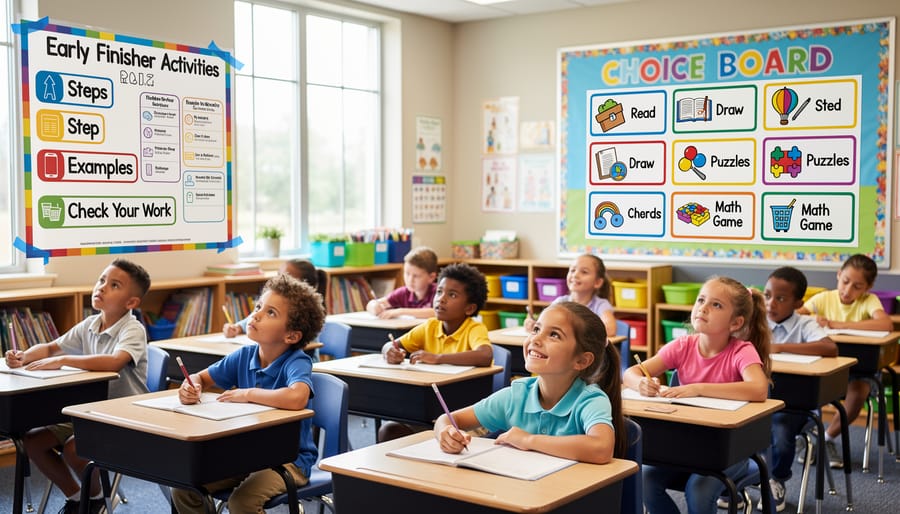
Start with an anchor chart posted in a visible spot. Keep it simple and colorful with clear icons or pictures next to each activity option. Think: a book emoji for independent reading, puzzle pieces for brain teasers, or art supplies for creative projects. Students should be able to glance at the chart and immediately see their choices without needing to interrupt you.
Choice boards are game-changers for visual learners. Create a grid with nine squares, each featuring a different activity option. You can customize these by subject, skill level, or even student interest. Laminate your boards and use dry-erase markers so students can check off completed activities throughout the week. This adds an element of fun while helping kids track their progress.
Don’t forget the power of simple visual reminders! A colorful “I’m Done, Now What?” poster near the pencil sharpener catches students right at that transition moment. Traffic light systems work wonderfully too—green means “Ask your teacher,” yellow means “Check your work,” and red means “Choose an early finisher activity.”
The best part? Once these visual systems are in place, they practically run themselves. Your early finishers become self-directed learners who know exactly where to look and what to do, giving you precious time to support students who need extra help.
Teaching the Routine (Not Just Assigning It)
Here’s the truth: your students won’t magically know what to do when they finish early. You need to teach this routine just like you’d teach any other classroom procedure, and it’s worth spending the time upfront to get it right.
Start during the first week of school by dedicating 10-15 minutes to explicitly modeling your early finisher system. Show students exactly where materials are located, how to transition quietly, and what activities are available. Walk through each step yourself, then have a student demonstrate while classmates watch.
Practice makes perfect, so build in opportunities for your class to rehearse the routine. You might even have students intentionally finish an assignment early to practice the transition. Give specific feedback: “I love how Maya went straight to the choice board without interrupting anyone” or “Notice how this table is working silently on their puzzles.”
Create visual reminders that support independence. A simple poster listing the steps or a numbered chart showing activity choices helps students reference the routine without asking you. Consider customizing these visuals with student input so they feel ownership over the system.
Don’t forget ongoing reinforcement throughout the year. When procedures get sloppy around October or after winter break, pause for a quick refresher. A five-minute re-teach is way better than constant redirections. Celebrate students who follow the routine well, and adjust your system if something isn’t working. The goal is creating a smooth, self-running system that gives you back precious teaching time.
Engaging Early Finisher Activities That Actually Work
Brain-Boosting Games and Puzzles
Give your students’ brains a workout with puzzles and games that make thinking fun! These activities are perfect for early finishers because they’re self-contained, engaging, and require zero teacher supervision once you’ve set them up.
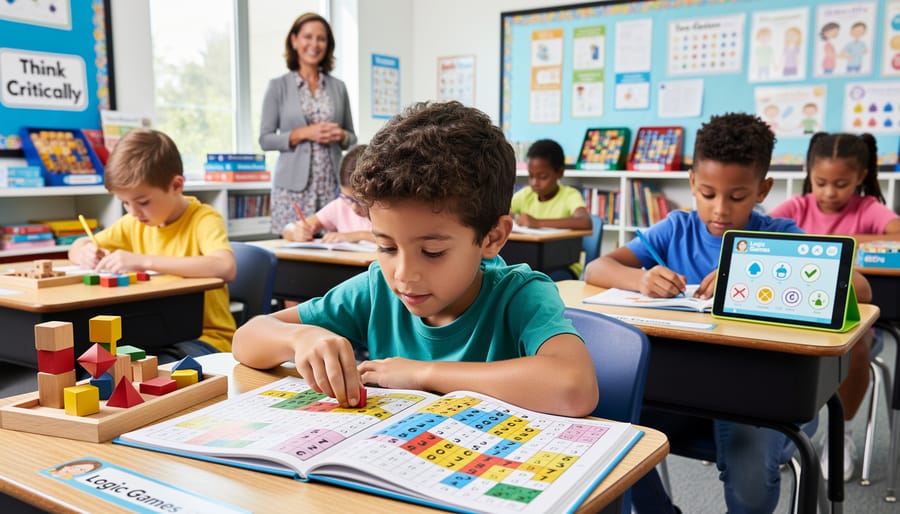
Start with classic logic puzzles that challenge students to think critically. Sudoku works wonderfully for different skill levels—simply provide easier 4×4 grids for younger students and traditional 9×9 puzzles for older ones. Keep a folder or basket filled with various difficulty levels so students can choose what matches their comfort zone.
Crossword puzzles are another fantastic option that builds vocabulary while keeping minds active. You can customize these to match your current curriculum topics, turning review time into an enjoyable challenge. Many free online tools let you create subject-specific crosswords in minutes.
Brain teasers and riddles add a playful twist to problem-solving. Create a “riddle of the week” display where students can submit their answers, or keep a collection of brain teaser cards that rotate regularly to maintain interest.
Don’t overlook educational board games! Classics like chess, checkers, or strategy games provide rich learning experiences. Set up a designated game station with clear rules posted nearby, and teach students how to reset games for the next player.
The beauty of these activities is their flexibility. Once you’ve established the routine and expectations, students can dive right in without disrupting your work with other learners. Plus, they’re building essential skills while having a blast!
Review Games That Reinforce Learning
Review games are absolute game-changers for early finishers because they turn extra time into meaningful practice. Instead of students asking “What do I do now?” they can dive into interactive activities that reinforce what they’ve already learned.
PowerPoint review games work wonderfully because they’re visual, engaging, and easy to navigate independently. Students can work through digital quiz games, matching activities, or interactive challenges at their own pace. The best part? You can customize these games to match whatever skills your class is currently working on, whether that’s math facts, vocabulary words, or science concepts.
Self-checking tasks are essential for early finisher activities because they eliminate the need for you to stop teaching and check answers. Digital activities with built-in answer keys let students verify their work immediately, giving them instant feedback and keeping them accountable. This independence builds confidence and helps students learn from their mistakes right away.
Consider creating a rotation of different game types so students don’t get bored. Mix up your offerings with trivia-style games, digital scavenger hunts, and interactive sorting activities. Keep these resources organized in a dedicated folder on classroom devices or as printed QR codes students can scan.
The beauty of review games is their flexibility. They work perfectly for individual students or small groups of early finishers working together. Plus, when students genuinely enjoy these activities, they’ll be motivated to work efficiently so they can earn that coveted game time.
Creative Extension Projects
When students finish early, it’s the perfect opportunity to tap into their creativity and curiosity! Creative extension projects give kids the freedom to explore their interests while developing critical thinking skills.
Start with open-ended writing prompts that spark imagination. Questions like “If you could invent a new holiday, what would it be?” or “Write a letter to your future self” encourage students to think beyond the worksheet. Keep a rotation of fresh prompts displayed on a bulletin board or posted digitally so there’s always something new to explore.
Drawing challenges work wonderfully across grade levels. Try “design your dream classroom,” “create a new animal species,” or “illustrate a scene from today’s lesson.” These activities reinforce learning while letting artistic students shine. The best part? There’s no single right answer, which takes pressure off perfectionists.
Research mini-projects let curious minds dive deeper into topics that fascinate them. Provide a list of intriguing questions related to your current units, or let students propose their own research topics. They can create simple presentations, posters, or fact sheets to share what they’ve learned.
Consider setting up passion project time where students work on longer-term creative endeavors. Whether it’s writing a story chapter-by-chapter, building something with recyclables, or learning about space exploration, these ongoing projects give early finishers something meaningful to return to. Just establish clear expectations about materials, noise levels, and cleanup to keep things running smoothly. The goal is fostering independence while celebrating each student’s unique interests and talents!
Quick Wins for Every Subject
The best early finisher activities are the ones that keep learning going without creating extra work for you! Here’s how to align meaningful tasks with what you’re already teaching in each subject area.
For math, give students access to number puzzles, logic games, or challenge problems that extend current concepts. If you’re working on multiplication, early finishers can explore arrays or create their own word problems. Math fact practice games are perfect quick wins that build fluency while others catch up.
Reading activities should feel like a treat, not a chore. Set up a cozy reading corner where students can dive into independent reading, or create book recommendation cards where they share their favorite stories with classmates. Vocabulary practice games that connect to your current unit keep skills sharp without feeling like busywork.
Writing prompts work beautifully for early finishers when they’re open-ended and creative. Keep a jar of “what if” questions or story starters related to your current themes. Students can write quietly in journals or create illustrated mini-books to share later.
Science lovers can explore observation journals, drawing and labeling diagrams, or researching questions that came up during class discussions. These activities extend curiosity naturally.
For social studies, try map activities, timeline challenges, or research cards about historical figures you’re studying. The key is making these activities feel like exciting privileges rather than additional assignments. When early finisher work connects directly to classroom learning, everyone wins!
Making Early Finisher Activities Work on Busy Days
Let’s be honest—on those packed days when you’re juggling a million things, even the best early finisher system can feel like one more thing to manage. But here’s the good news: with a few smart strategies, your early finisher activities can practically run themselves, even when you’re stretched thin.
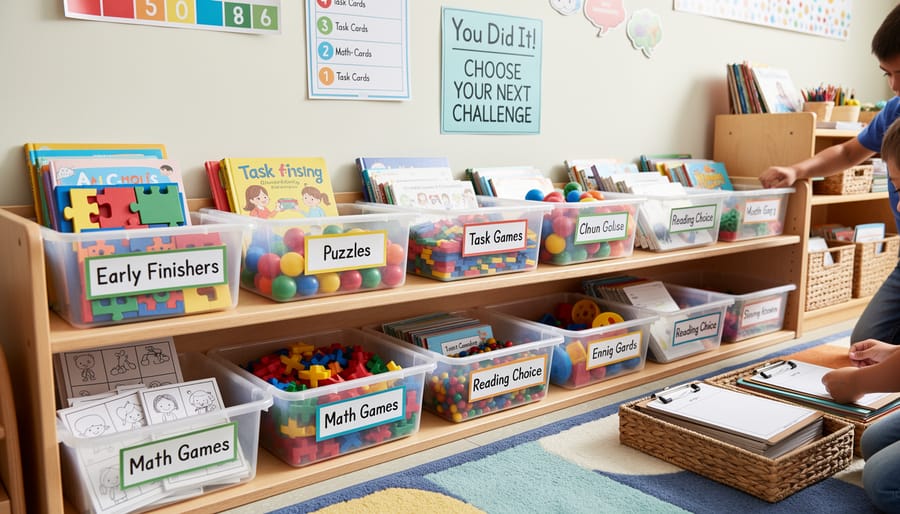
Start by creating a “grab-and-go” station that requires zero prep on busy days. Stock a designated shelf or bin with evergreen materials like puzzle books, brain teasers, coloring sheets, or reading materials. The key is choosing activities that students can access independently without needing your explanation or assistance. Once you set it up initially, it’s there whenever you need it.
Digital activities are your secret weapon for no-prep options. Educational games, typing practice, and online learning platforms require nothing from you except making them available. Students can simply log in and get started. This works beautifully when you haven’t had time to prep physical materials.
Keep your most successful activities on rotation rather than constantly creating new ones. Students actually appreciate familiar choices because they can dive right in without instructions. Think of it as your greatest hits collection—why reinvent the wheel when certain activities already work perfectly?
Use simple visual systems that students can follow without your input. A choice board with pictures, a menu posted on the wall, or color-coded bins all help students select activities independently. When everything has a clear place and purpose, your early finishers know exactly what to do without asking.
Remember, the goal isn’t perfection—it’s progress. Some days, your early finisher system might just be students reading quietly or working on a designated ongoing project. That’s completely okay! Having even basic options available prevents disruptions and keeps everyone engaged. The system doesn’t need to be elaborate to be effective; it just needs to be accessible and consistent.
Avoiding Common Early Finisher Pitfalls
Let’s be honest—even the best early finisher systems can go sideways if we’re not careful! The good news? Most pitfalls are easy to fix once you know what to watch for.
The biggest trap teachers fall into is accidentally creating a race-to-finish mentality. When students see early finisher activities as rewards, they’ll rush through their work just to get there. The fix? Frame these activities as learning extensions, not prizes. Try saying “When you’ve done your best work” instead of “When you’re done.” This subtle shift emphasizes quality over speed.
Another common mistake is offering activities that are too fun compared to regular work. If early finisher time feels like recess while everyone else is grinding away, you’ve got a problem. Keep activities engaging but academically valuable. Think brain teasers, creative writing prompts, or skill-building games rather than free drawing time or non-educational games.
Watch out for the “same kids, same activities” rut too. Some students finish early every single day and might default to their favorite activity repeatedly. While choice is great, gently encourage variety by creating exploration challenges or rotating certain options weekly. This keeps learning fresh and prevents boredom.
Also avoid making early finisher activities feel like extra homework. If students perceive them as punishment for working efficiently, they’ll actually slow down to avoid them! Keep activities optional or give meaningful choices so students feel empowered.
Finally, don’t forget to check in periodically. Are students actually engaged, or just killing time? A quick observation can help you adjust activities that aren’t working and celebrate the ones that truly extend learning. Remember, the goal is meaningful engagement, not just quiet busy work.
You don’t need to overhaul your entire classroom management system overnight! Start small by choosing just one or two reliable early finisher activities that feel right for your teaching style and classroom needs. Maybe it’s a simple choice board or a designated game station. The key is consistency. When you establish clear routines around these activities, your students will know exactly what to do when they finish early, and you’ll feel less stressed trying to keep everyone engaged. Once these routines become second nature, you can always add more variety and options. Remember, even a simple system is better than no system at all. Your future self will thank you when those fast finishers know exactly where to go and what to do, leaving you free to support students who need extra help. You’ve got this!