High School Science Sub Plans, Emergency Sub Binder, Grades 9-12, 9 No Prep Activities

$5.99

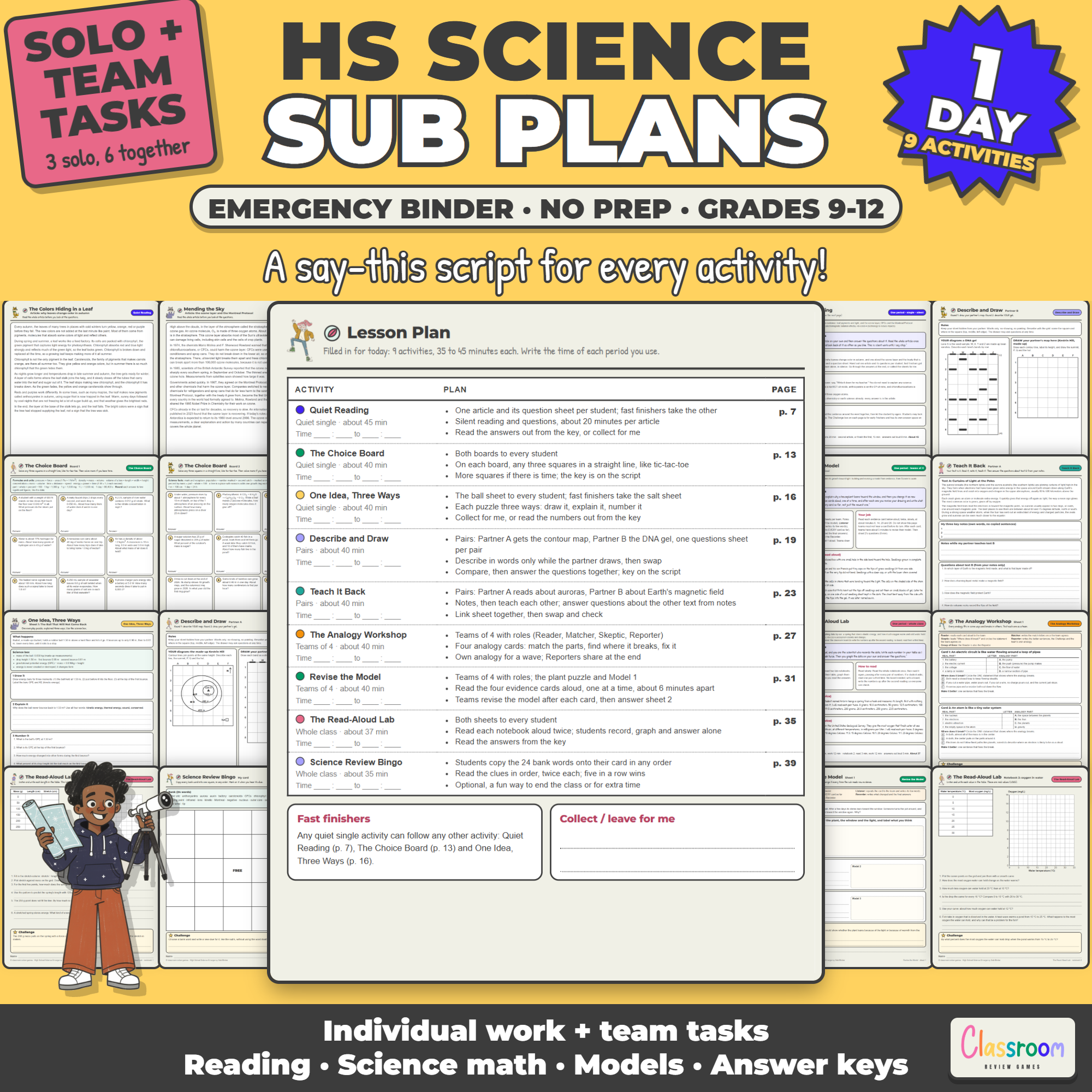
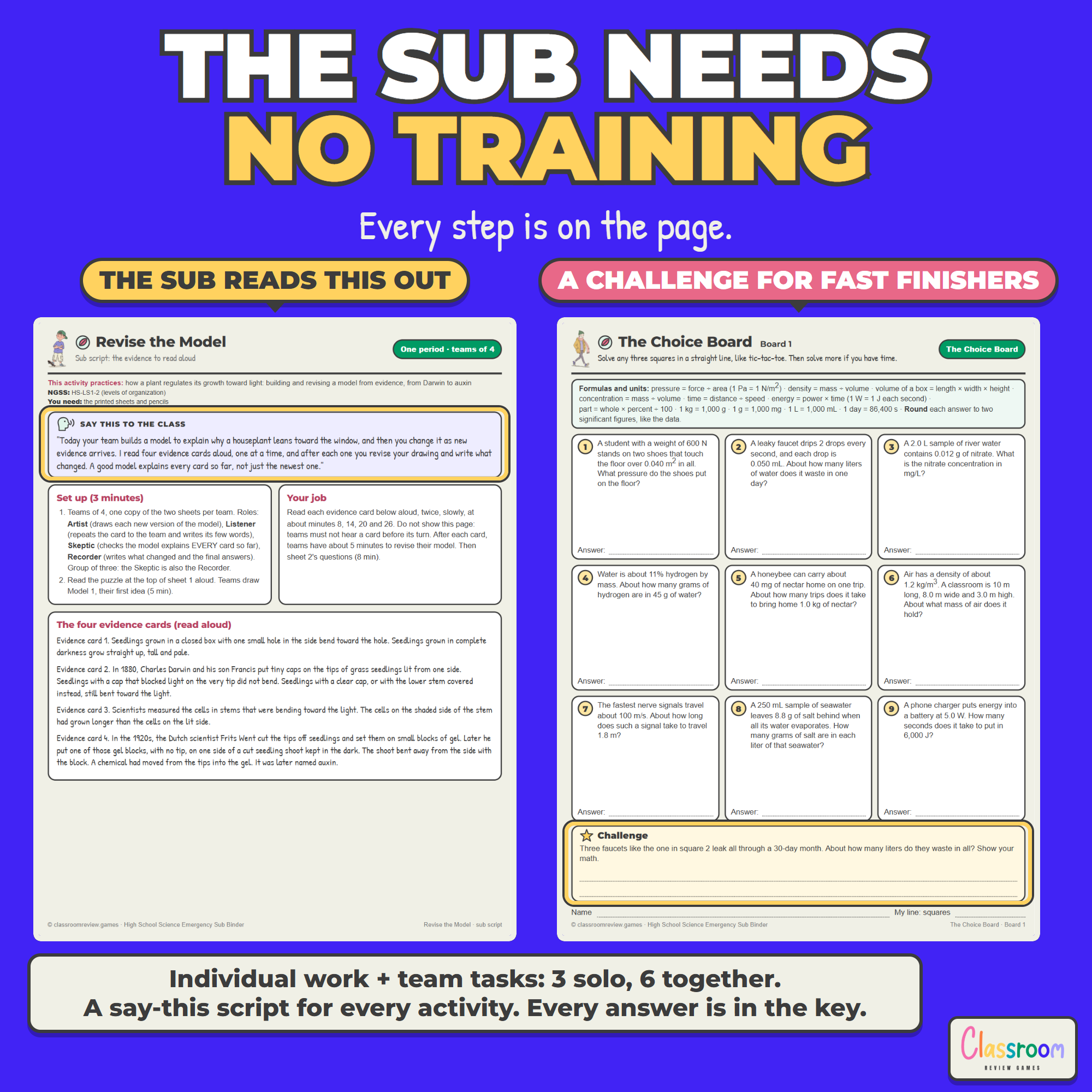
Autumn leaves, the ozone hole, auroras and a leaning houseplant, in one day. These no prep emergency sub plans give grades 9-12 a paper and pencil science review day for high school biology, chemistry, physics or earth science. Your students get both individual work and team tasks: 3 activities they do on their own (a quiet reading with two articles, a choice board of science problems and one idea explained three ways) and 6 with others (describe and draw and teach it back in pairs, an analogy workshop and a model revision in teams of 4, a read-aloud lab and an optional review bingo for the whole class). Every activity starts with a Say this to the class box, every student sheet has a star challenge for early finishers, and every answer is in the key, so the sub needs no science background. 8 of the 9 activities also list their NGSS performance expectations on the sub script. Everything is paper and pencil, with no lab supplies, no chemicals and nothing to taste or touch, and climate science and evolution are stated plainly as science. No tech and no prep for you: print it once and keep it ready.

Mix and match: add any 3 or more resources to your cart and 20% comes off at checkout, automatically.

30-Day Money-Back Guarantee

If this resource does not work for your class, email me and I refund you. No questions asked. How it works

Download the free preview (PDF)

Look through the sample pages before you buy.

Perfect For

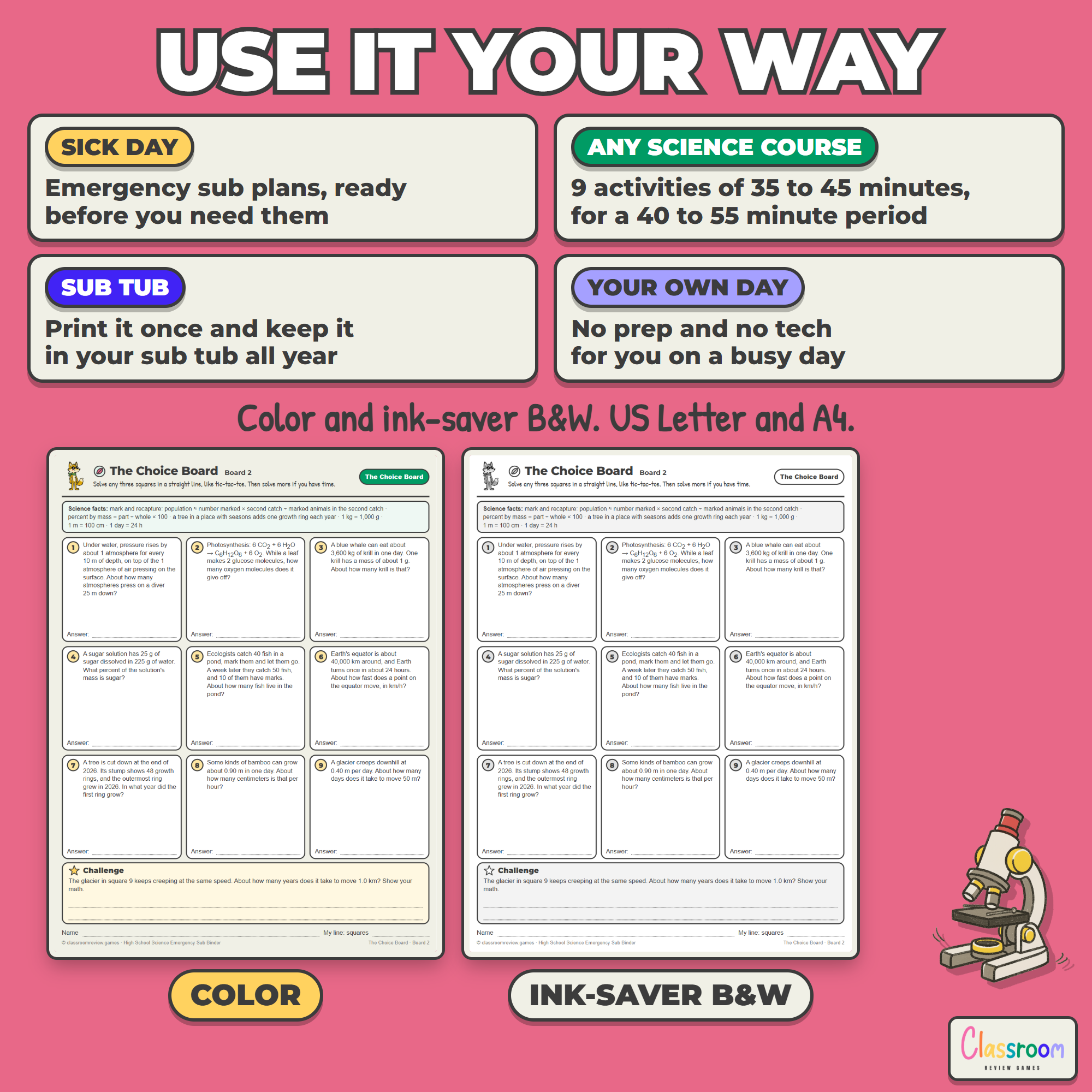
  • A sudden sick day: emergency sub plans that are ready before you need them
  • A sub who is not a science teacher: the script, the steps and every answer are on the page
  • Any high school science course, grades 9 to 12 (biology, chemistry, physics, earth and space science or integrated science), with a 40 to 55 minute period: run one activity per period, or the same one all day
  • Your sub tub or emergency sub folder, printed once for the whole year
  • Your own no prep day, a review day before a test, or a planned absence like a conference or a field trip day

How It Works

  1. Print the binder one-sided and leave it on your desk. The lesson plan on page 4 is already filled in: every activity with its page, its minutes and three short steps.
  2. Each activity starts with a sub script: a Say this to the class box the sub reads aloud, how to set it up, the timing, and the answer key.
  3. Every activity fits one class period (35 to 45 minutes), so the sub can run a different one each period or the same one all day. They all stand alone, and all the science a student needs is on the sheet, so the binder works in any science course.
  4. It is all paper and pencil work at the desks: no lab supplies, no tech, no logins and no textbook needed.
  5. 8 of the 9 activities list the NGSS high school performance expectations they practice on the sub script, for you and not the students. The optional Science Review Bingo does not list any. An activity practices part of a performance expectation: it is review and practice, not a full assessment of it.
  6. Every student sheet has a star challenge for early finishers. The bingo game is optional, a fun way to end a class or to fill extra time, never a prize for behavior.
  7. Every answer is in the key on the script or on the page right after it, and the open questions come with models, so the sub can check work or simply collect it for you.

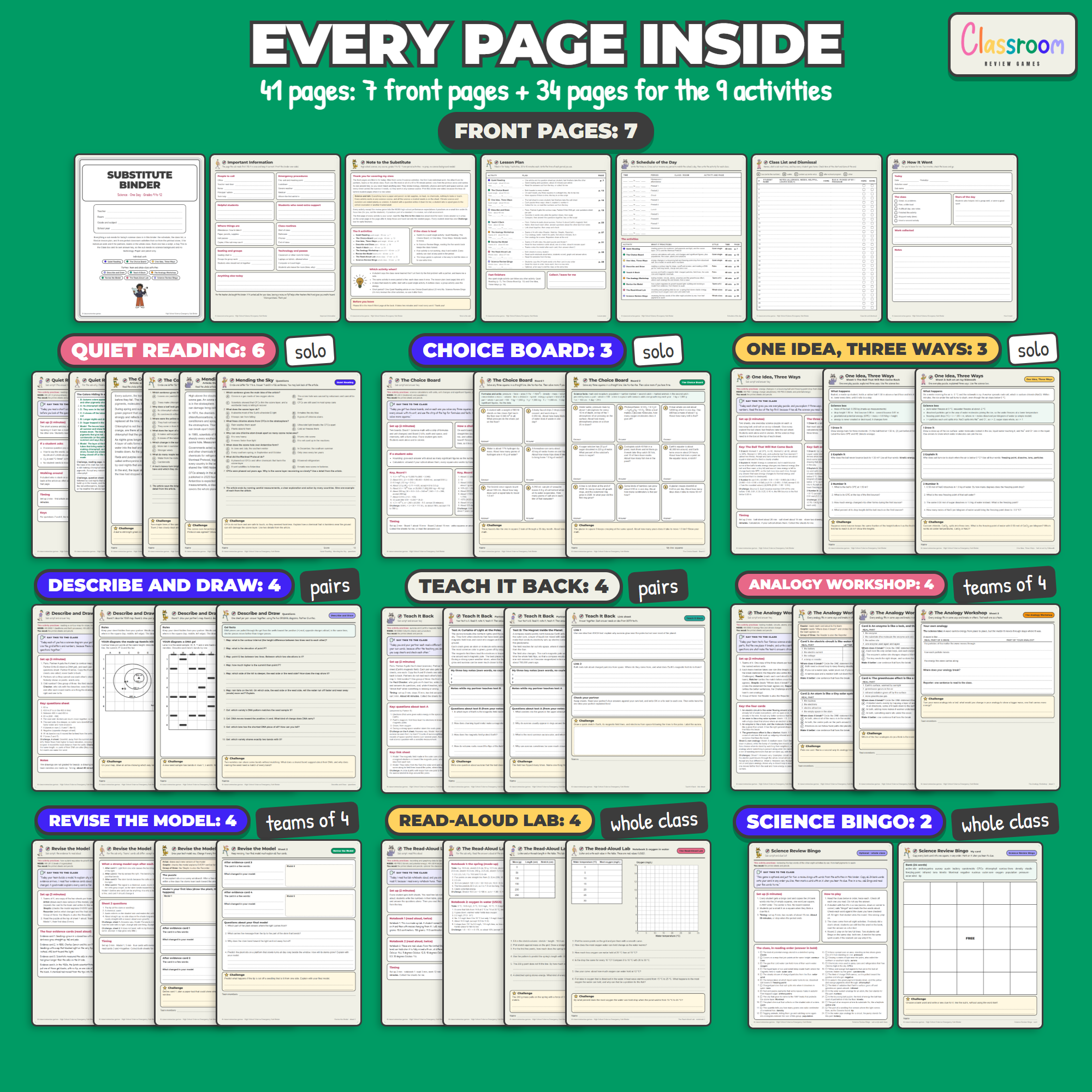
What’s Inside: 41 Pages

  • 7 front pages: a binder cover, important information, a note to the substitute, the lesson plan already filled in, a schedule of the day, a class list and dismissal sheet, and a "how it went" sheet for the sub
  • Quiet Reading (individual, 45 min): Two short science articles: why leaves change color in autumn, and how the ozone layer is being repaired. Focus: reading science for evidence: leaf pigments and light, and the ozone layer, CFCs and the Montreal Protocol. NGSS: HS-LS1-5 (photosynthesis), HS-PS4-4 (electromagnetic radiation effects), HS-ESS3-4 (technology to reduce impacts).
  • The Choice Board (individual, 40 min): Two tic-tac-toe choice boards: science math with units, then life, earth and chemistry reasoning; students solve three in a line. Focus: science calculations with units, unit changes and significant figures, plus populations, the ocean, plants and solutions. NGSS: HS-LS2-2 (biodiversity and populations).
  • One Idea, Three Ways (individual, 40 min): One everyday puzzle per sheet, explained with a drawing, with words and with numbers: a bouncing ball and salt on ice. Focus: energy changes in a bouncing ball and freezing point drop from dissolved salt, as a model, in words and in numbers. NGSS: HS-PS3-1 (energy change calculations), HS-PS3-2 (kinetic and potential energy).
  • Describe and Draw (pairs, 40 min): Partners describe a hidden contour map and a hidden DNA gel in words while the other draws, then read both diagrams together. Focus: reading a contour map for slope, runoff and erosion, and reading a DNA gel for matching bands, charge and piece size. NGSS: HS-ESS2-1 (landforms and Earth processes), HS-LS3-1 (DNA, chromosomes and traits).
  • Teach It Back (pairs, 40 min): Partners each read a different short text, on auroras or on Earth’s magnetic field, teach it to each other and link the two. Focus: auroras and Earth’s magnetic field: charged particles, field lines, the outer core and magnetic reversals. NGSS: HS-ESS2-3 (Earth’s interior and convection).
  • The Analogy Workshop (teams of 4, 40 min): Teams test four famous science analogies, find where each one breaks, fix it, and build their own analogy for a wave. Focus: testing models: circuits, atoms, enzymes and the greenhouse effect, where each analogy fits and breaks, then a wave. NGSS: HS-ESS2-4 (energy flow and climate change).
  • Revise the Model (teams of 4, 40 min): Teams model why a houseplant leans toward a window, then revise the model after each of four real pieces of evidence. Focus: how a plant regulates its growth toward light: building and revising a model from evidence, from Darwin to auxin. NGSS: HS-LS1-2 (levels of organization).
  • The Read-Aloud Lab (whole class, 37 min): The sub reads two lab notebooks aloud; students record the data by ear, graph it and answer questions: a spring and oxygen in water. Focus: recording and graphing data by ear: a spring that stores elastic energy, and how much oxygen warm and cold water hold. NGSS: HS-PS3-2 (kinetic and potential energy), HS-LS2-6 (ecosystem stability and change).
  • Science Review Bingo (whole class, optional, 35 min): Optional: a whole-class bingo game whose 24 clues review the other eight activities. Focus: reviewing the key words of the other eight activities by ear, from leaf pigments to auxin. No standards listed.
  • A sub script for every activity, with the answer keys or models printed on it or right after it (12 pages), and 22 student pages

Here is a quick look at the binder:

Description

What’s Included

  • 41 pages: 7 front pages, 12 sub script and key pages, 22 student pages
  • Color and ink-saver black and white versions
  • US Letter and A4
  • Answer keys printed for the sub, plus models for the open questions

Helpful Details

Written for high school science, grades 9 to 12, for biology, chemistry, physics, earth and space science and integrated science classes. 9 activities for one day, 35 to 45 minutes each, each with its own sub script and student pages: 3 for students working on their own and 6 with a partner, a team or the whole class. The topics are review: why leaves change color in autumn and how the ozone layer is being repaired, science math with units and significant figures (pressure, density, concentration, mark and recapture, growth rings), the energy in a bouncing ball and why salt melts ice, a contour map and a DNA gel described in words, auroras and Earth’s magnetic field, four famous science analogies (a circuit, an atom, an enzyme and the greenhouse effect) and where each one breaks, a model of why a houseplant leans toward the window revised with evidence from Darwin to auxin, and two lab notebooks read aloud for students to record and graph: a made-up spring and real data on how much oxygen water holds at each temperature. The harder items are in the challenges. Climate science and evolution are stated plainly as science, and made-up places, people and data are labeled made-up. The note to the sub says what to do if a student has a question (write it down for me) or is upset (the school counselor or another trusted adult). Supplies are copies and pencils; a classroom board helps with one activity, and it says what to do without it. No lab supplies, no tech, no logins, no prep.

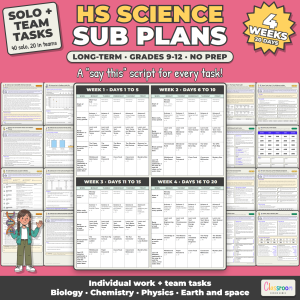
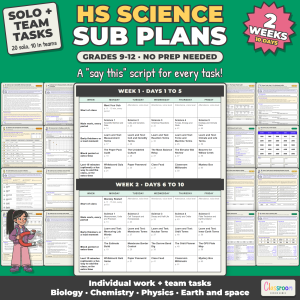
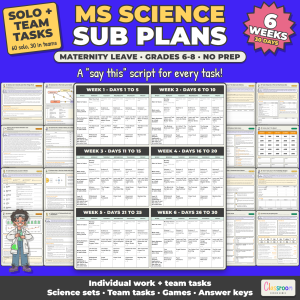
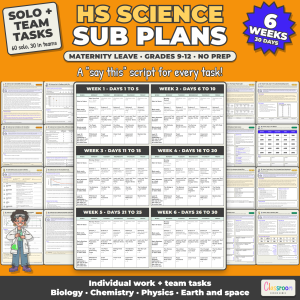
Need more than one day? My High School Science Sub Plans also come as 2 Weeks, 4 Weeks (long term) and 6 Weeks (maternity leave) of full science days, and my High School Science Sub Plans Review Game is a quiz game in Google Slides and PowerPoint to go with them.

Please Note

This is a print resource. There are no slides and no editable file, so what you see in the preview is exactly what you print.

Works With

Any printer. No student devices, logins, or prep required.
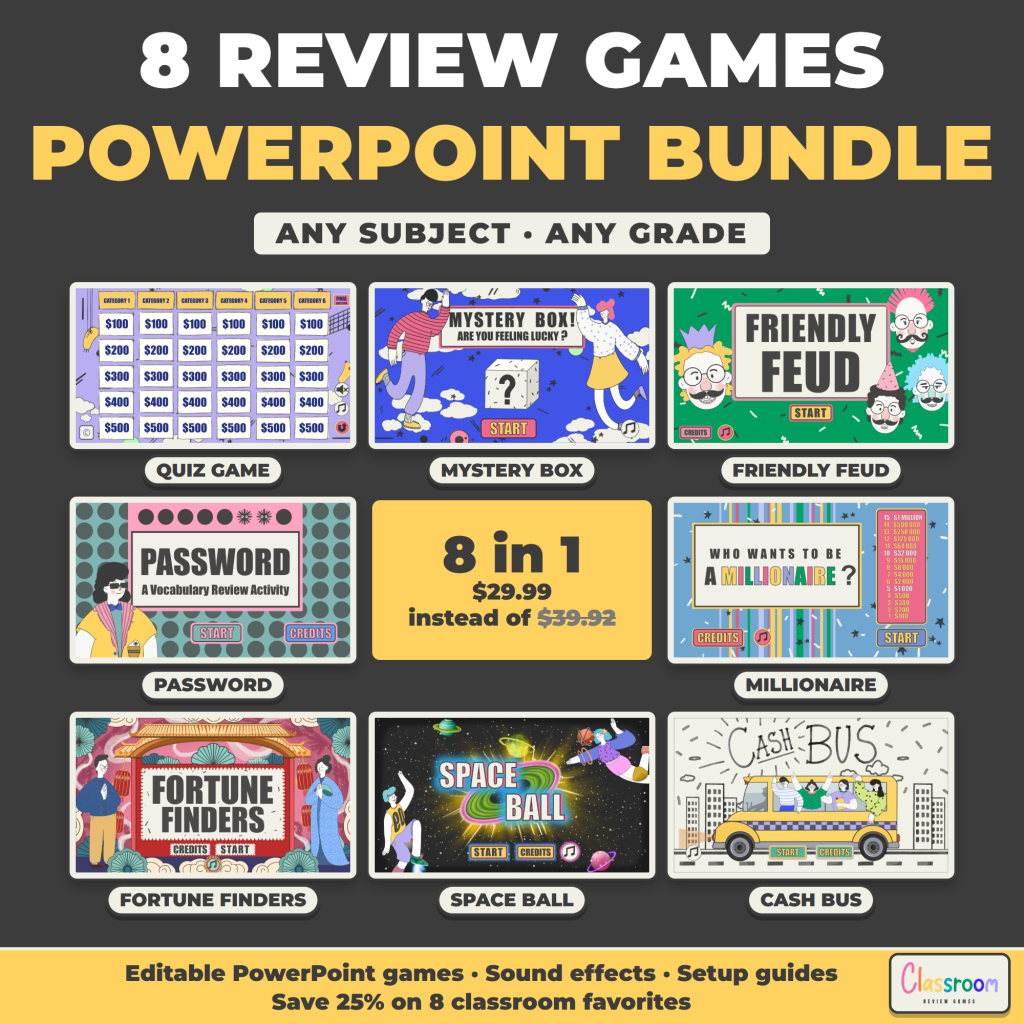
PowerPoint Review Games Bundle, 8 editable game show templates

Help

Email me any time with questions or requests. Thank you for supporting a small teacher-run shop.

Carolin

carolin@classroomreview.games
Reviews

There are no reviews yet.

Be the first to review “High School Science Sub Plans, Emergency Sub Binder, Grades 9-12, 9 No Prep Activities”

Your email address will not be published. Required fields are marked *