High School US History Sub Plans, Emergency Sub Binder, Grades 9-12, 9 No Prep Activities

$5.99

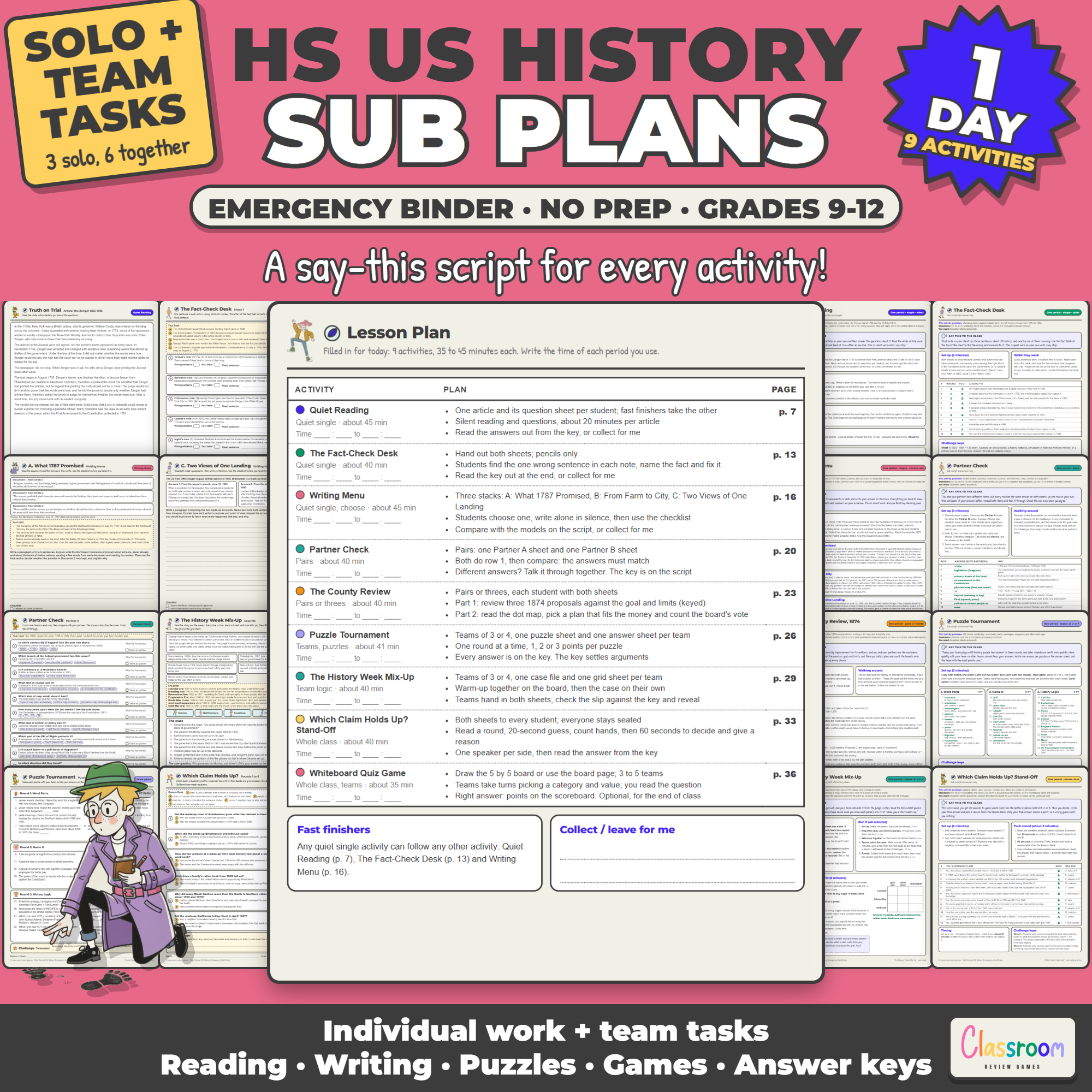
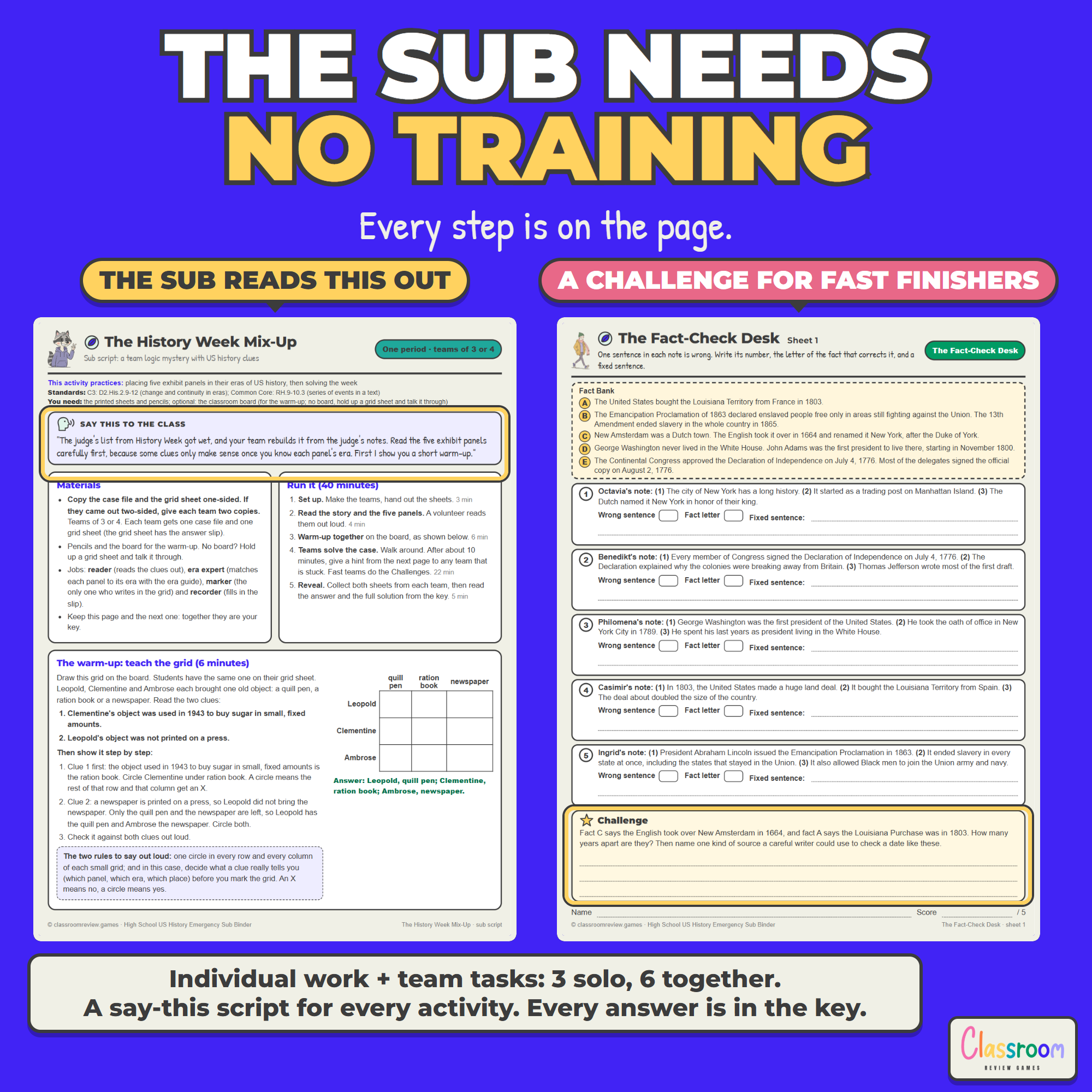
Zenger’s trial, an 1874 county vote, ten fact checks: a whole day, planned. These emergency sub plans give high school American history, grades 9-12, a paper and pencil, no prep US history review day. Your students get both individual work and team tasks: 3 activities they do on their own (a quiet reading with two articles, a fact-check desk with ten student notes and a writing menu) and 6 with others (a partner check, a county review in pairs or threes, a puzzle tournament and a History Week logic mystery in teams, a claims stand-off and an optional quiz game for the whole class). Every activity starts with a Say this to the class box, early finishers get star challenges, and every answer is in the key, so the sub needs no history background. 8 of the 9 activities also list their C3 Framework or Common Core standards on the sub script. Hard history is told accurately and without graphic detail, and nothing takes a side in today’s politics. No tech and no prep for you: print it once and keep it ready.

Mix and match: add any 3 or more resources to your cart and 20% comes off at checkout, automatically.

30-Day Money-Back Guarantee

If this resource does not work for your class, email me and I refund you. No questions asked. How it works

Download the free preview (PDF)

Look through the sample pages before you buy.

Perfect For

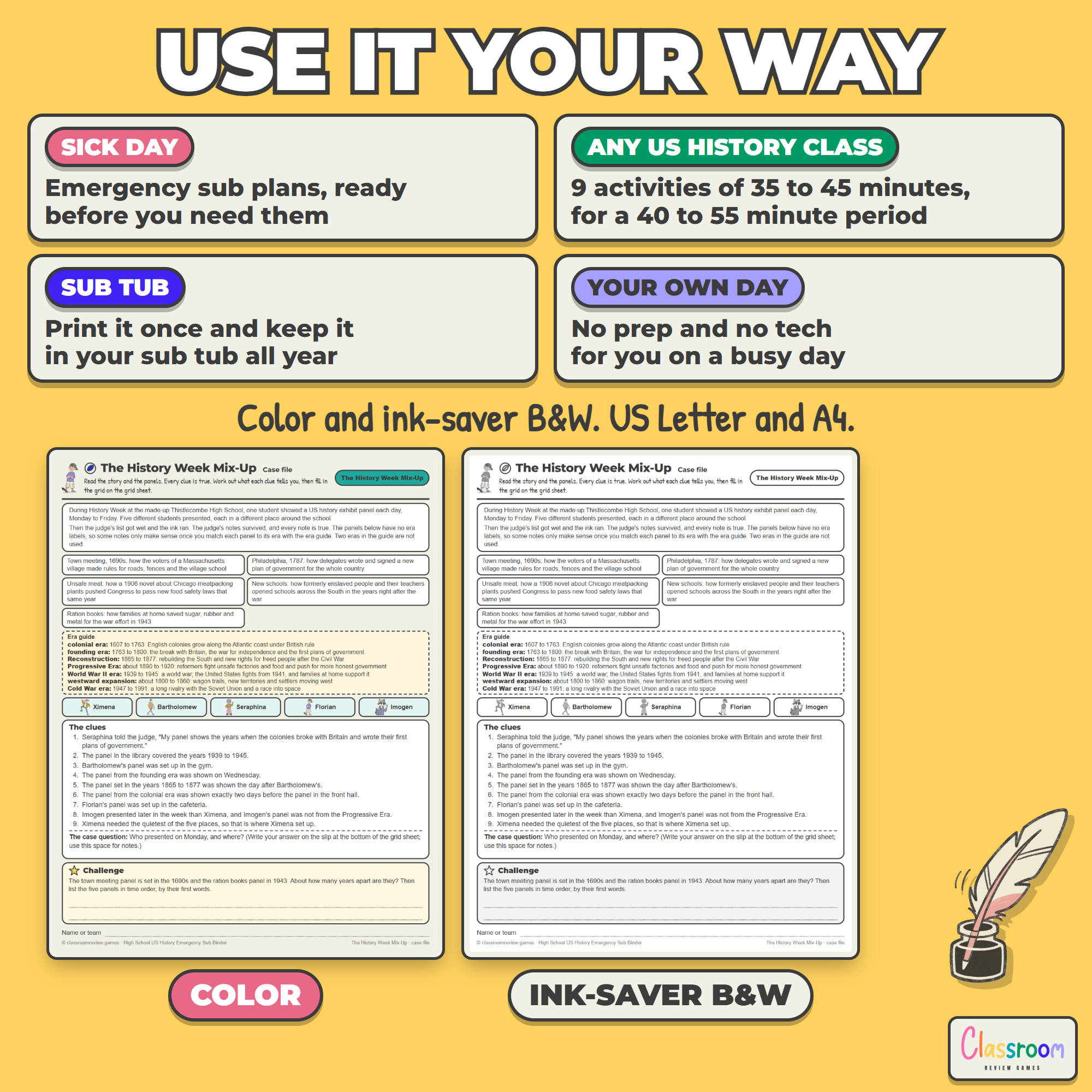
  • A sudden sick day: emergency sub plans that are ready before you need them
  • A sub who is not a history teacher: the script, the steps and every answer are on the page
  • Any high school US history or American history class, grades 9 to 12, with a 40 to 55 minute period: run one activity per period, or the same one all day
  • Your sub tub or emergency sub folder, printed once for the whole year
  • Your own no prep day, a review day before a test, or a planned absence like a conference or a field trip day

How It Works

  1. Print the binder one-sided and leave it on your desk. The lesson plan on page 4 is already filled in: every activity with its page, its minutes and three short steps.
  2. Each activity starts with a sub script: a Say this to the class box the sub reads aloud, how to set it up, the timing, and the answer key.
  3. Every activity fits one class period (35 to 45 minutes), so the sub can run a different one each period or the same one all day. They all stand alone and review US history from the colonial era to the Cold War.
  4. It is all paper and pencil work at the desks: no tech, no logins and no textbook needed.
  5. 8 of the 9 activities list the C3 Framework or Common Core (literacy in history, grades 9-10) standards they practice on the sub script, for you and not the students. The optional Whiteboard Quiz Game does not list any. An activity practices part of a standard: it is review and practice, not a full assessment of it.
  6. Every student sheet except the quiz board has a star challenge for early finishers. The quiz game is optional, a fun way to end a class or to fill extra time, never a prize for behavior.
  7. Every answer is in the key on the script or on the page right after it, and the open writing tasks come with checklists and models, so the sub can check work or simply collect it for you.

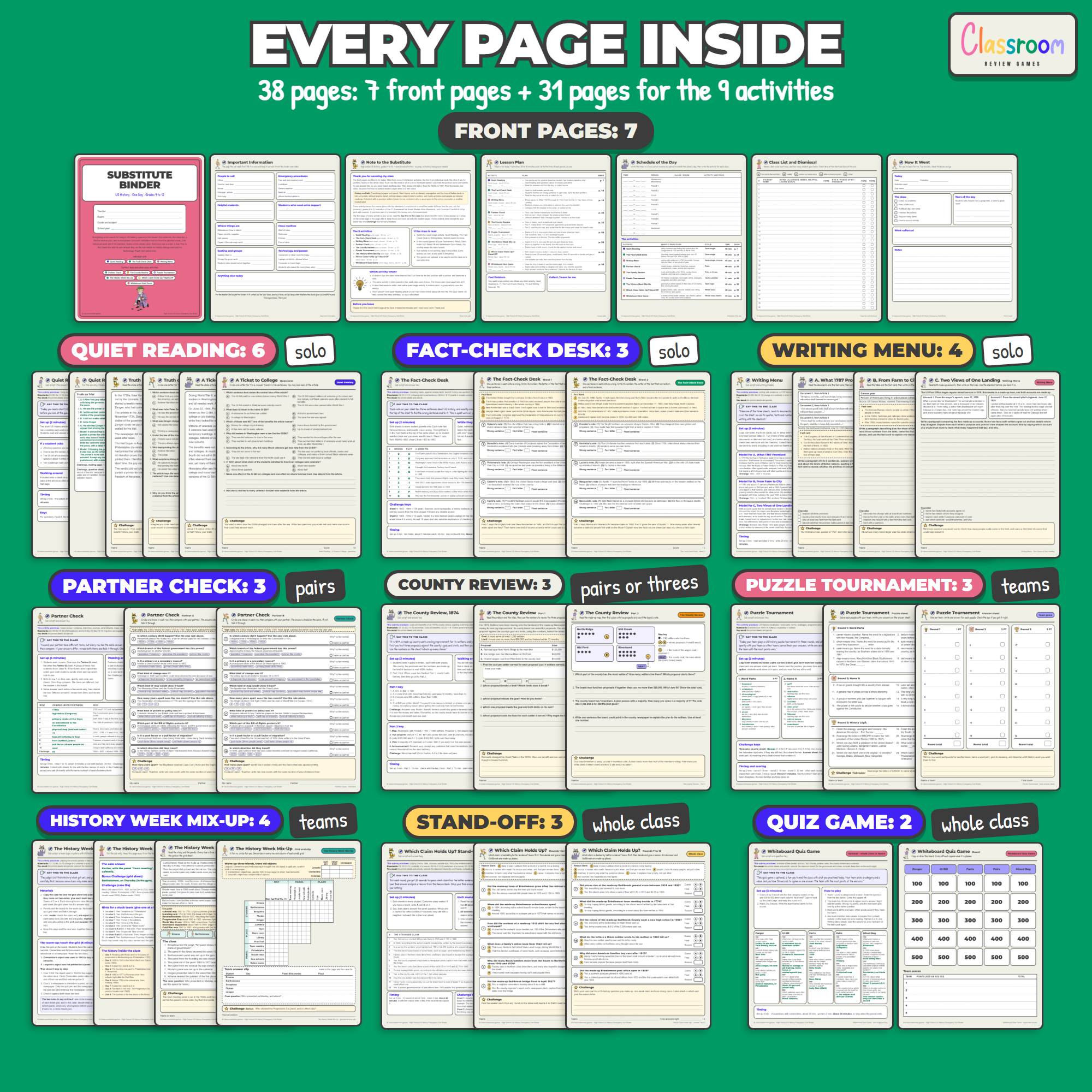
What’s Inside: 38 Pages

  • 7 front pages: a binder cover, important information, a note to the substitute, the lesson plan already filled in, a schedule of the day, a class list and dismissal sheet, and a "how it went" sheet for the sub
  • Quiet Reading (individual, 45 min): Two short US history articles: the Zenger trial of 1735 and the GI Bill of 1944. It practices citing evidence and finding the central idea: the Zenger trial of 1735 and the GI Bill of 1944. Standards: C3: D2.His.1.9-12 (events in broader context); Common Core: RH.9-10.1 (citing evidence, date and origin), RH.9-10.2 (central ideas of a source).
  • The Fact-Check Desk (individual, 40 min): Ten student notes from 1664 to 1983, one wrong sentence each: find it, name the fact and fix it. It practices checking claims against reliable facts: ten US history mix-ups from 1664 to 1983. Standards: C3: D4.4.9-12 (critiquing claims and evidence), D2.His.1.9-12 (events in broader context).
  • Writing Menu (individual, 45 min): Choose one: three lines of the Northwest Ordinance, real Census data on cities, or two accounts of one day. It practices writing with evidence: a 1787 document, Census data on cities, or two points of view. Standards: C3: D2.His.2.9-12 (change and continuity in eras); Common Core: RH.9-10.6 (comparing authors’ points of view), RH.9-10.7 (charts and data with text).
  • Partner Check (pairs, 40 min): Partner A and Partner B read different US history items with the same answers and check each other. It practices mixed review: centuries, branches, sources, amendments, maps, protest and migration. Standards: C3: D2.Civ.4.9-12 (US Constitution and its limits), D2.Geo.7.9-12 (migration and population), D2.His.1.9-12 (events in broader context).
  • The County Review (pairs or threes, 40 min): Review three proposals for a made-up 1870s county against its goal and limits, read a dot map and count the board’s vote. It practices costs and benefits of an 1870s county choice, reading a dot map and a majority vote. Standards: C3: D2.Eco.1.9-12 (incentives, costs and benefits), D2.Civ.11.9-12 (how governments make decisions), D2.Geo.2.9-12 (maps, places and regions).
  • Puzzle Tournament (teams, 41 min): 24 puzzles in 3 rounds: US history word parts, naming the term and history logic. It practices US history vocabulary: word parts, terms, analogies, anagrams and other word logic. Standards: Common Core: RH.9-10.4 (history vocabulary in context).
  • The History Week Mix-Up (teams, 40 min): A logic mystery with US history clues: match each exhibit panel to its era, then rebuild the week. It practices placing five exhibit panels in their eras of US history, then solving the week. Standards: C3: D2.His.2.9-12 (change and continuity in eras); Common Core: RH.9-10.3 (series of events in a text).
  • Which Claim Holds Up? Stand-Off (whole class, 40 min): Twelve pairs of claims: guess which one has the better evidence behind it, then prove it. It practices judging claims: data, sources, sample size, fitting the evidence and causes. Standards: C3: D3.2.9-12 (credibility of a source), D2.His.11.9-12 (usefulness of a source), D4.4.9-12 (critiquing claims and evidence).
  • Whiteboard Quiz Game (whole class in teams, optional, 35 min): An optional board quiz game on the US history in this binder. It is a review of this binder: articles, fact checks, partner rows, the county review and evidence. No standards listed.
  • A sub script for every activity, with the answer keys or writing models printed on it or right after it (11 pages), and 20 student pages

Here is a quick look at the binder:

Description

What’s Included

  • 38 pages: 7 front pages, 11 sub script and key pages, 20 student pages
  • Color and ink-saver black and white versions
  • US Letter and A4
  • Answer keys printed for the sub, plus checklists and models for the open writing tasks

Helpful Details

Written for high school US history, grades 9 to 12, for US history and American history classes. 9 activities for one day, 35 to 45 minutes each, each with its own sub script and student pages: 3 for students working on their own and 6 with a partner, a team or the whole class. The topics are review: the Zenger trial of 1735 and freedom of the press, the GI Bill of 1944, ten fact checks from New Amsterdam in 1664 to 1983, the Northwest Ordinance of 1787, Census data on the move from farm to city, two accounts of one event, centuries, branches of government, primary and secondary sources, amendments, maps, protest and migration, the costs and benefits of a made-up 1870s county’s choice with a dot map and a vote, history vocabulary, the eras of US history from the colonial era to the Cold War, and judging which claim has the better evidence, with the harder items in the challenges. Hard history such as slavery, segregation and the loss of Native lands is told accurately, without graphic detail; nothing takes a side in today’s politics, and made-up towns and people are labeled made-up. The note to the sub says what to do if a student has a question (write it down for me) or is upset (the school counselor or another trusted adult). Supplies are copies and pencils; a classroom board helps with three activities, and each one says what to do without it. No tech, no logins, no prep.

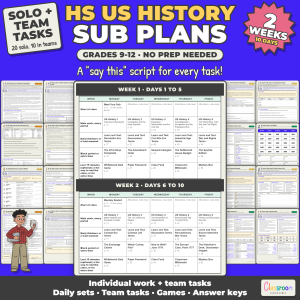
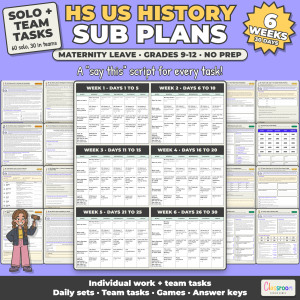
Need more than one day? My High School US History Sub Plans also come as 2, 4 and 6 weeks of full history days.

Please Note

This is a print resource. There are no slides and no editable file, so what you see in the preview is exactly what you print.

Works With

Any printer. No student devices, logins, or prep required.
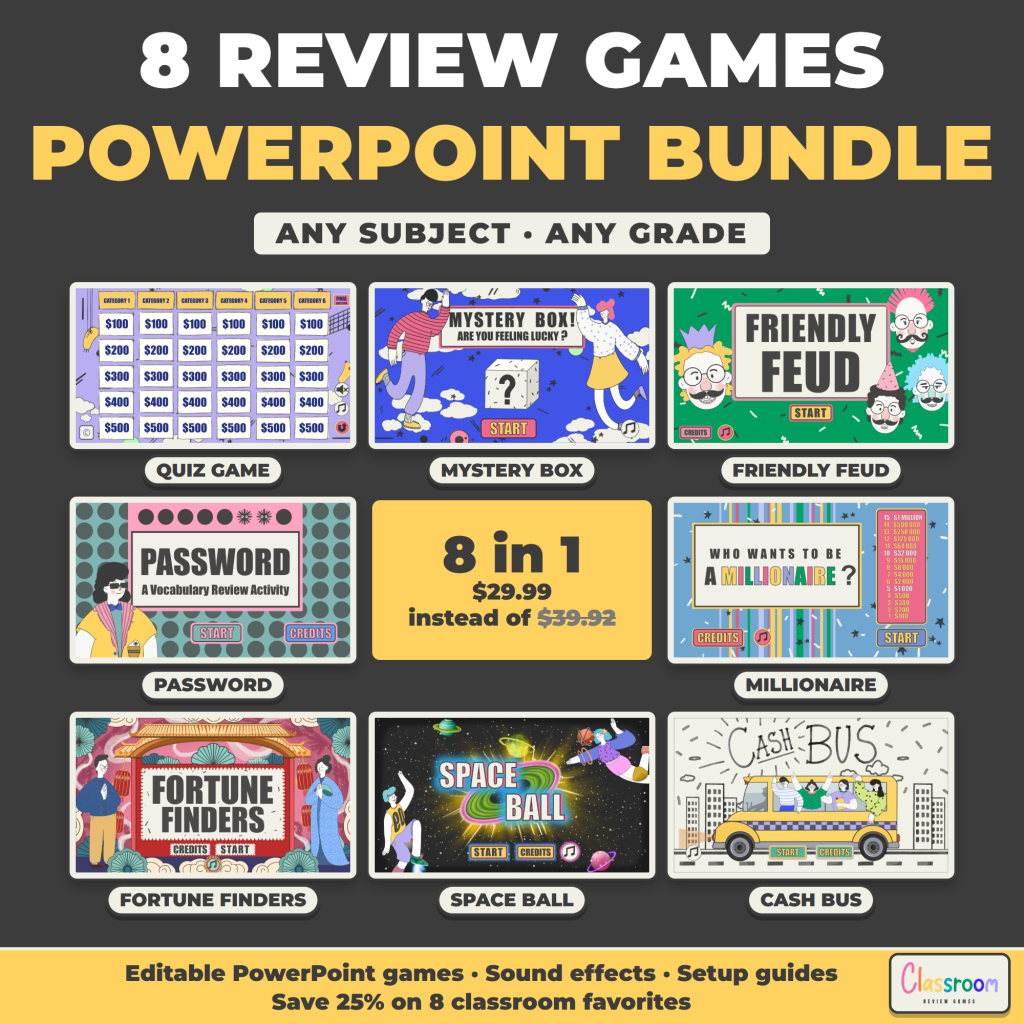
PowerPoint Review Games Bundle, 8 editable game show templates

Help

Email me any time with questions or requests. Thank you for supporting a small teacher-run shop.

Carolin

carolin@classroomreview.games
Reviews

There are no reviews yet.

Be the first to review “High School US History Sub Plans, Emergency Sub Binder, Grades 9-12, 9 No Prep Activities”

Your email address will not be published. Required fields are marked *