
What Are Gamification Systems (and How Do They Work in Your Classroom)?
A gamification system is a structured framework that applies game design elements like points, levels, badges, and leaderboards to non-game environments to increase engagement and motivation. In your classroom, it transforms routine review sessions and learning activities into interactive experiences that tap into students’ natural desire for achievement and competition.
The reason gamification works so well in education is simple: it makes learning feel less like work and more like play. When students earn points for correct answers, unlock new levels as they master concepts, or see their progress visualized through achievement badges, they’re more likely to stay focused and put in extra effort. These systems don’t just make activities more fun. They provide immediate feedback, create clear goals, and give students a sense of control over their learning journey.
If you’ve been using game-based review tools in your classroom, you’ve probably wondered whether your current setup is actually working as well as it could be. That’s where analytics and A/B testing come in. By tracking how students interact with your gamification system and experimenting with different configurations (like adjusting point values or changing reward structures), you can fine-tune the experience to maximize engagement and learning outcomes for your specific group of students.
This guide breaks down exactly how gamification systems function, what components make them effective, and how you can use data-driven methods to optimize them for your classroom. Whether you’re just getting started or looking to improve an existing system, you’ll learn practical strategies to create more engaging, effective learning experiences.
What Gamification Systems Mean for Your Classroom
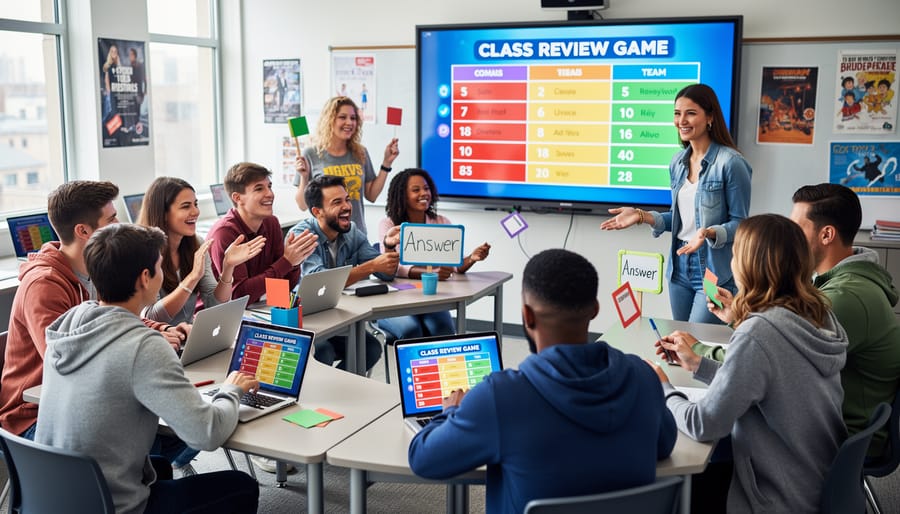
Gamification systems are the structured frameworks that transform everyday classroom activities into experiences that feel and function like games. Think of them as the invisible architecture behind your favorite review activities, the rules, rewards, and mechanics that make students lean forward in their seats instead of checking the clock.
At its heart, a gamification system takes something educational (like vocabulary practice or math review) and layers on game elements that make students want to participate. When you divide your class into teams, display scores on the board, and celebrate correct answers with sound effects, you’re using a gamification system. The “system” part means these elements work together intentionally, not randomly, each piece reinforces the others to keep students engaged and motivated.
Here are the key terms that make up classroom gamification systems:
- Points
- Numerical values awarded for correct answers, participation, or completed tasks that give students measurable progress.
- Badges or Rewards
- Visual symbols of achievement earned for hitting milestones, demonstrating skills, or completing challenges.
- Leaderboards
- Ranked displays showing how students or teams compare, creating friendly competition and visible status.
- Levels
- Progressive stages that unlock as students advance, providing clear pathways from beginner to mastery.
- Challenges
- Specific goals or obstacles students tackle, often with varying difficulty to match skill levels.
In your classroom, these systems show up in review games where teams answer questions for points, in reading programs where students earn badges for books completed, or in interactive presentations where correct responses trigger celebration animations. The beauty of customizable systems is that you control which elements to emphasize, whether that’s collaborative team challenges or individual achievement tracking, based on what fires up your particular students.
How Gamification Systems Work in Educational Settings
The Motivation Engine
Game mechanics work because they activate two powerful motivational forces simultaneously. When students see their team score climb on the board or hear celebratory sounds after a correct answer, they’re experiencing extrinsic motivation, those external rewards that signal achievement. The points matter because everyone can see them. The applause feels good because it’s immediate and public.
But here’s where effective gamification systems go deeper: they also kindle intrinsic motivation, the internal drive that keeps students wanting to participate even after the game ends. When a student masters a tough concept to help their team, they’re not just chasing points, they’re experiencing genuine competency and pride. When teammates high-five after a round, the social connection becomes its own reward.
The real power happens when these motivations feed each other. A student drawn in by the scoreboard (extrinsic) discovers they actually enjoy the challenge of recall (intrinsic). Another motivated by helping teammates (intrinsic) gets an extra boost from the visible points (extrinsic). This dual-engine approach explains why gamified review sessions often generate more sustained engagement than traditional worksheets or verbal quizzes. Students stay invested because they’re getting rewards that satisfy different psychological needs at once.
Creating Immediate Feedback Loops
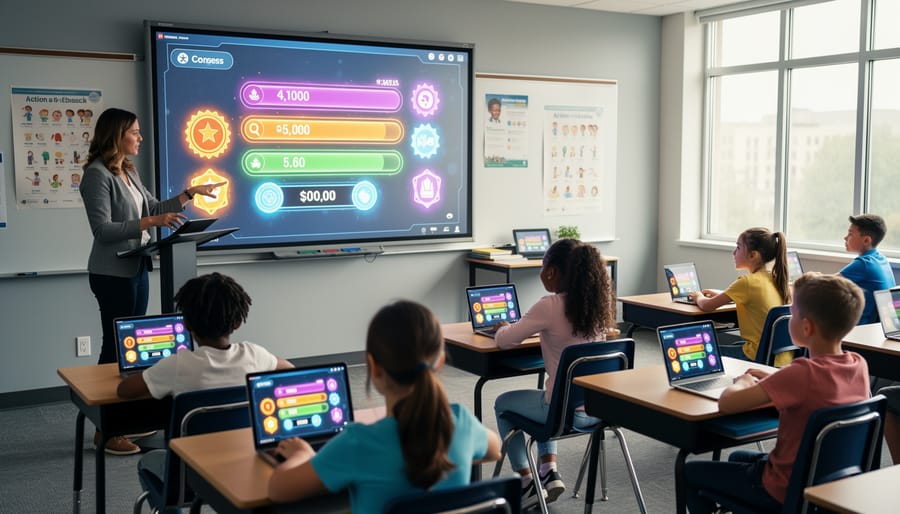
In traditional classroom activities, students might wait days to get quiz results back. That delay kills momentum. Gamification systems flip this script by showing students exactly how they’re doing the moment they answer.
When a team buzzes in with the correct response and immediately sees their score jump on the screen, something powerful happens. Their brains get an instant dopamine hit that reinforces the learning behavior. They want to feel that success again, so they stay locked in for the next question.
This feedback loop doesn’t require complex technology. A simple scoreboard that updates after each round gives students the immediate validation they crave. Add sound effects, a triumphant chime for correct answers, a playful buzz for incorrect ones, and you’ve created sensory markers that students remember. Visual celebrations matter too. When a team’s name flashes across the screen or their score changes color as they take the lead, these small moments create anticipation and excitement that keeps energy high throughout the entire review session.
The faster students see results, the more engaged they stay. That’s why effective classroom gamification systems prioritize immediate, visible feedback over delayed evaluation. Your students aren’t checking out between questions, they’re already strategizing for the next one.
Core Components of Classroom Gamification Systems
Point Systems and Scoreboards
Point systems transform abstract learning into tangible progress students can see and feel. When you assign clear point values to correct answers, bonus challenges, or quick responses, students immediately understand their performance relative to their peers and their own past efforts.
The real power emerges when you display these points on a visible scoreboard. Whether it’s a digital leaderboard projected on your screen or a simple tally on the whiteboard, that public display creates healthy competition. Students naturally push themselves harder when they can see their team is just 50 points behind the leaders or when they’re climbing from fourth place to second.
Effective scoring isn’t about complexity, it’s about clarity and fairness. Simple systems work best: 100 points per correct answer, 50-point bonuses for speed, maybe double points for the final round. Students grasp these rules instantly and focus on learning rather than decoding your point structure. The scoreboard becomes their progress bar, showing exactly how close they are to victory.
Visual and Audio Rewards
Sound effects and animations aren’t just decorative flourishes in classroom gamification systems, they’re powerful tools for positive reinforcement that signal success and celebrate achievement in the moment. When students answer correctly and hear a cheerful ding or watch confetti burst across the screen, their brains register that win immediately. These sensory rewards create emotional connections to learning milestones, making students want to experience that feeling again.
The best gamification examples for the classroom layer multiple reward types: a point pop-up appears first, followed by a sound effect, then perhaps a team mascot animation. This multi-sensory approach accommodates different learners and amplifies the celebration without requiring teacher intervention. You can customize these elements to match your classroom culture, swap triumphant trumpets for gentle chimes if your students respond better to calm affirmation. The key is consistency: students learn to associate specific sounds and visuals with specific achievements, building anticipation and motivation throughout your review game.
Team-Based Features
Team-based features flip the script from individual achievement to shared success. When students work together toward a common score, they naturally start coaching each other, celebrating wins as a group, and pooling their knowledge to answer questions.
The magic happens when one student’s correct answer boosts the entire team’s total. Suddenly, the quieter kid who knows the answer becomes valuable to their teammates, not just competing alone. Teams develop quick strategies, who should answer what type of question, how to use their collective strengths.
Group leaderboards create friendly rivalry between tables or rows without singling out individuals. Even students who typically avoid participation get pulled in by team spirit. They don’t want to let their group down, so they engage when they might have checked out in individual competition.
The collaborative dynamic also means students learn from each other’s explanations in real-time, making review sessions more interactive than lecture-based prep.
How Gamification Systems Are Used Across Grade Levels
Gamification systems work differently depending on your students’ ages and what you’re teaching. Elementary teachers often use these systems for math fact practice and vocabulary review, where bright colors, silly sound effects, and simple point counting match younger students’ developmental needs. A second-grade class might buzz with excitement over a basic team challenge where every correct answer earns a star, while the teacher tracks which students need extra support based on participation patterns.
Middle school classrooms benefit from more complex gamification structures that tap into pre-teens’ growing social awareness and competitive spirit. Science teachers use these systems for concept review before tests, letting teams collaborate on multi-step problems while scoreboards drive friendly rivalry. Social studies instructors find that gamified review sessions help students retain dates, events, and key figures better than traditional study methods, especially when they combine tutoring sessions with game-based practice for struggling learners.
High school applications shift toward test prep and college readiness, where gamification systems help break the monotony of standardized test practice. Juniors preparing for SATs engage more deeply when vocabulary drills become team challenges with real-time scoring. AP teachers use these systems to make comprehensive review manageable, turning overwhelming content into digestible game rounds that students actually want to participate in.
The beauty of modern gamification systems lies in their flexibility. You can adjust the same basic game template to work for Spanish verb conjugations with freshmen, physics formulas with sophomores, or literature analysis with seniors. The core mechanics stay consistent, but you customize the content, complexity, and competitive intensity to match your specific students and learning goals. Teachers who experiment across different subjects and grade levels discover which combinations of points, teams, and rewards generate the most authentic engagement for their unique classroom dynamics.
Using Analytics to Understand What’s Working

Simple Metrics Teachers Can Track
You don’t need expensive software to track what’s working in your classroom games. Start with participation rates: note who’s raising their hand, answering questions, or actively contributing versus sitting quietly. A simple tally during the game reveals which students engage with the format and which might need different approaches.
Team scores themselves tell a story beyond who won. Watch for patterns across multiple games, do certain teams consistently dominate, or does competition stay close? Lopsided scores might signal that your team assignments need adjusting or that some students understand the material better than others.
Time-on-task gives you another useful metric. Notice how long students stay focused during different game segments. If attention drifts after ten minutes, that’s your signal to add a quick format change or bonus round. Similarly, track how quickly teams answer questions, rushed responses might mean questions are too easy, while long silences could indicate they’re too hard.
Keep notes on your phone or a simple spreadsheet after each game session. These observations accumulate into patterns that show you exactly which elements keep your specific students engaged and learning.
Spotting Engagement Patterns
Watch your students closely during review games and you’ll start seeing clear patterns. Notice which rounds spark excited chatter and which ones bring groans or distracted fidgeting. Pay attention to the moments when hands shoot up fastest or when students lean forward in their seats, those reactions tell you which game elements are hitting the mark.
Keep a simple mental or written log after each game session. Did teams respond better to the buzzer sound effect or the animated confetti? Did participation drop when questions got too hard, or did challenge fuel more engagement? Track which point values made students fight harder for answers and which team sizes created the most energy.
The quieter students offer valuable signals too. If a typically reserved learner suddenly joins in during a specific round format, that mechanic is worth repeating. Similarly, if your usually enthusiastic class zones out during certain game phases, those elements need tweaking or removing.
You don’t need fancy analytics software for this, just consistent observation and brief notes. After three or four game sessions, clear favorites and duds will emerge, giving you the insights to double down on what works and drop what doesn’t.
A/B Testing Your Classroom Game Elements
You don’t need a research lab or statistical software to discover what works best in your classroom games. A/B testing simply means trying one approach with one class period, then trying something different with another, and comparing which generates more excitement and learning.
Start with one variable at a time. Maybe you’re wondering whether individual points or team points create better engagement. Run your review game with first period using individual scoring, then switch to team scoring for third period. Watch which format keeps more students actively participating throughout the entire game. Keep everything else identical, same questions, same timing, same classroom gaming fundamentals so you’re truly comparing just that one element.
Your testing can focus on practical elements you control. Try different point values: does awarding 100 points per correct answer feel more exciting than 10 points? Test different team sizes: do groups of three outperform pairs? Experiment with reward timing: is it better to celebrate after every question or save the fanfare for milestone scores?
Track simple observations rather than complex data. Notice which format produces more hands shooting up, fewer students checking phones, or louder cheers when teams score. Mental notes work fine, though jotting quick observations between classes helps you remember patterns across the week.
The beauty of classroom A/B testing is that you’re not committing to anything permanently. If individual scoring flops with second period, you haven’t ruined the whole semester, you’ve learned something valuable and can switch back immediately.
Give each variation a fair trial across at least two class periods before drawing conclusions. Sometimes a format needs a couple rounds before students catch on and warm up to it. Once you identify what clicks, you can confidently customize your review games knowing you’ve tested what actually works with your specific students, not just followed generic advice.
Common Questions About Gamification Systems
How long does it take to set up a gamification system in my classroom?
Most PowerPoint-based review games take 10-15 minutes to customize with your content once you’re familiar with the template. The initial learning curve might add another 20 minutes, but subsequent games go much faster since you’ll reuse the same framework.
Can I adjust the game mechanics to fit my teaching style?
Absolutely. Customizable templates let you control point values, team sizes, question difficulty, timer settings, and reward animations. You can make the system as competitive or collaborative as your students need.
What if some students get too competitive and others feel left behind?
Try rotating team compositions each game, awarding bonus points for helping teammates, or creating multiple scoring categories (accuracy, improvement, teamwork). You can also dial down the competitive elements by reducing scoreboard emphasis and increasing collaborative challenges.
Does gamification actually improve learning, or is it just entertainment?
When designed well, gamification reinforces learning through repetition, immediate feedback, and active participation. The key is ensuring the game mechanics support your learning objectives rather than overshadowing them.
Will gamification systems work for subjects beyond math and vocabulary?
Yes. Teachers successfully use game-based review for science concepts, historical events, reading comprehension, foreign languages, test prep, and even soft skills like critical thinking. The content adapts while the engagement mechanics remain consistent.
The beauty of gamification systems is their flexibility. Once you understand the core components, you can tweak individual elements based on what you observe in your classroom. Notice that one period responds better to team challenges while another thrives on individual achievement? Adjust accordingly. The system works for you, not the other way around.
Start simple with a basic point-and-scoreboard setup, then layer in additional features as you and your students get comfortable. Most teachers find their sweet spot after trying a game format three or four times with different classes.
Gamification systems shift your classroom from a space where students sit and listen to one where they actively compete, collaborate, and celebrate their learning. By turning review sessions into engaging experiences through points, teams, and instant feedback, you create an environment where participation becomes the norm, not the exception.
The beauty of these systems lies in their flexibility. Your students are unique, and what excites one class might fall flat with another. That’s why customization matters so much. Try different point structures, experiment with team formations, and adjust reward types based on what you observe. Pay attention to which elements spark genuine enthusiasm and which generate polite tolerance.
Simple analytics, even just noting participation rates or observing which rounds generate the most excitement, give you the insights to refine your approach. You don’t need complex tracking systems; your observations combined with basic metrics reveal what’s working.
Start with one PowerPoint review game format, watch how your students respond, make small adjustments, and iterate. The systems that transform your classroom won’t come from a manual, they’ll emerge from your willingness to experiment and adapt. Your students will show you what works; you just need to pay attention and keep adjusting until you find the perfect formula for your unique classroom dynamic.