Teachers Pay Teachers Alternatives: 9 Places Where Teachers Can Open Their Own Store (2026)
Teachers Pay Teachers is replacing its Premium membership with an “Exclusive Seller” tier on January 1, 2027. From then on, a seller who wants more than 55% of each sale has to promise to sell her digital resources nowhere else. That has a lot of teachers asking a question they had not asked in years: where else can I sell?
This is my answer. I only included places where a teacher can open her own store, set her own prices and get paid for each sale. Sites that just buy content from you, subscription libraries that pay from a shared pool, and marketplaces that are closed to new sellers are listed at the end so you do not waste an afternoon on them. I sell my own review games on TpT and on this website, so I have a stake in this, and I have tried to keep every number honest. Fees change; every figure below is what each platform published when I checked in October 2026, and the sources are at the bottom.
First, the one thing that matters more than fees
Who brings the buyers? TpT’s real product is not its upload form. It is the millions of teachers who type “fractions review game” into its search box every week. A marketplace like Amped Up Learning or Tes has some of that traffic. Your own shop on Payhip, Shopify or WordPress has none until you build it. So the right question is not “which site keeps the most of my $4.99?” It is “which mix gives me buyers I do not have to find myself, plus a shop that nobody can take away?”
For most teacher-sellers the answer in 2026 is a pair: one teacher marketplace for discovery, and one shop you own for your email list, your bundles and your repeat buyers. The list below is sorted that way.
The quick comparison
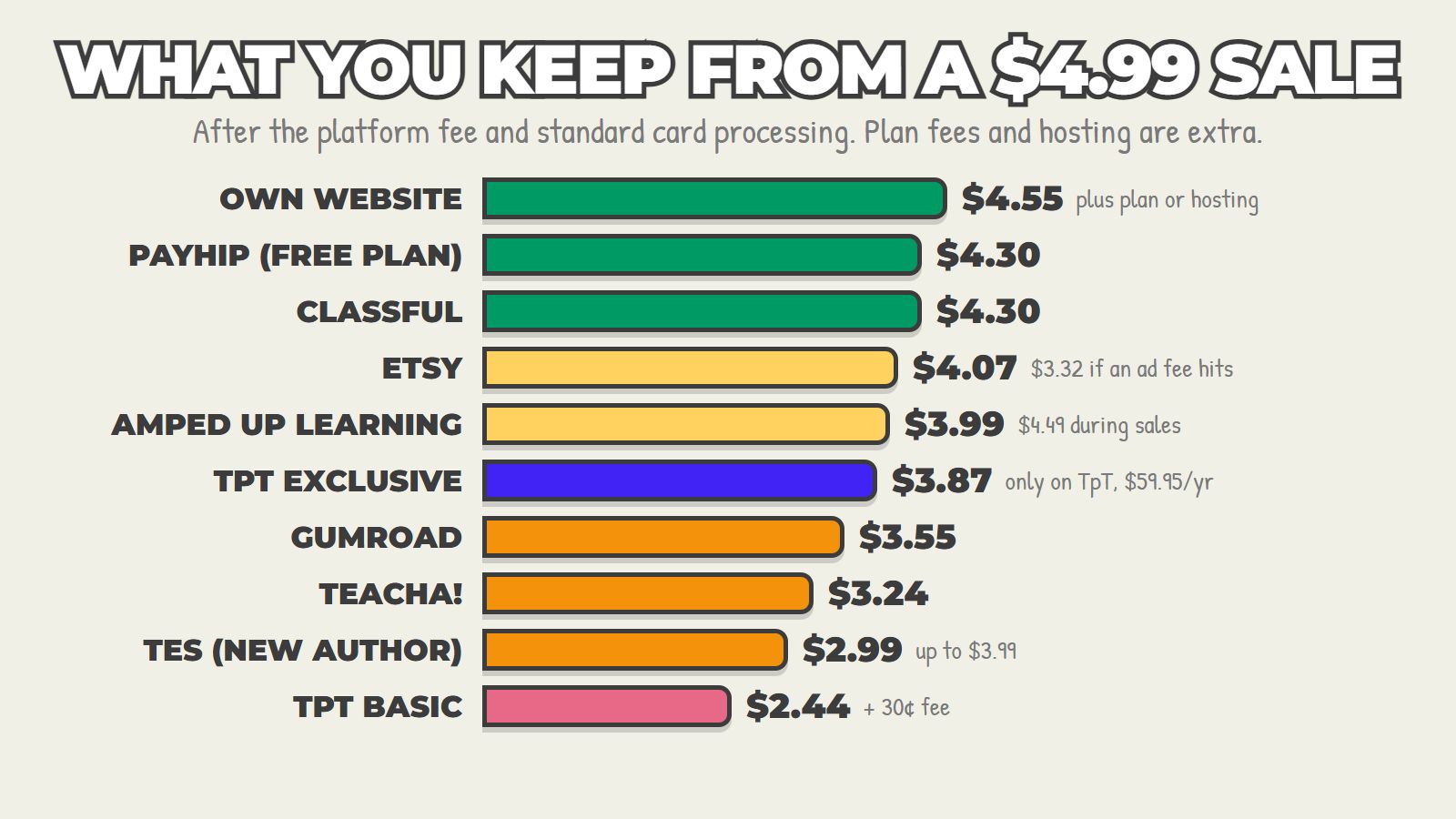
“You keep” is what lands in your account from one $4.99 sale, after the platform’s fee and standard card processing (about 2.9% + $0.30 where the platform does not include it). Monthly or yearly plan fees are listed separately because they depend on how much you sell.
| Platform | Type | Fees | You keep on $4.99 | Buyers built in? |
|---|---|---|---|---|
| TpT Basic (for comparison) | Marketplace | $29 once, 45% of each sale + $0.30 per resource | $2.44 | Yes, the most |
| TpT Exclusive (for comparison) | Marketplace | $59.95 a year, 22.5% of each sale; no selling elsewhere | $3.87 | Yes, the most |
| Amped Up Learning | Teacher marketplace | No fees; you keep 80% (90% during site sales); PayPal fee on payout | $3.99 to $4.49 | Some |
| Classful | Teacher marketplace | 5% + card processing | $4.30 | A little |
| Tes | Teacher marketplace (UK based, sells worldwide) | No fees; you keep 60%, rising to 70% and 80% with sales; 20p/20c fee on items under £3/$3 | $2.99 to $3.99 | Yes, strong in the UK |
| Teacha! | Teacher marketplace (South Africa based) | No fees; you keep 65% | $3.24 | Yes, in South Africa |
| Etsy | General marketplace | $0.20 per listing, 6.5% + 3% + $0.25 per sale; 12 to 15% more if an Etsy ad brought the buyer | $4.07 ($3.32 with an ad fee) | Yes, huge but not teacher-specific |
| Payhip | Your own shop | Free plan 5% + card processing; $29/month for 2%; $99/month for 0% | $4.30 | No |
| Gumroad | Your own shop | 10% + $0.50 + card processing; $100 minimum payout | $3.55 | Very little |
| Shopify | Your own shop | Basic plan $29/month paid yearly ($39 monthly) + 2.9% + $0.30 | $4.55 minus the plan | No |
| WordPress + WooCommerce | Your own website | Hosting (roughly $5 to $30/month) + card processing | $4.55 minus hosting | No, but Google can send them |
Teacher marketplaces: they bring some of the buyers
1. Amped Up Learning
A teacher-run marketplace in the US. Sellers keep 80% of every sale, 90% during site-wide sales, and pay no monthly or yearly fee. That is the old TpT Premium rate with no $59.95 attached. You can sell printables, digital lessons and games, Google resources, Boom Cards and even physical products, and there are coupon and BOGO tools. To open a store you email the team (askus@ampeduplearning.com), which tells you it is a small operation. Sellers I read describe traffic as modest and warn that a published resource cannot be edited afterward, so check your files before you hit publish. Seller page.
2. Classful
A free-to-join marketplace where sellers pay 5% per sale plus card processing (about 2.9% + $0.30 through Stripe). On a $4.99 resource you keep about $4.30, more than TpT ever paid. It is free to start and it lets you sell the same products elsewhere. The honest downside is traffic: of the sellers I found who list on several marketplaces, Classful was consistently the slowest earner. Treat it as a cheap extra shelf, not a replacement. Classful’s own seller pages have recently shifted toward its video-course product, so confirm the current resource-store terms when you sign up. Classful.
3. Tes
The big UK teacher marketplace, open to authors worldwide (age 18+, with some countries excluded by Stripe’s rules). No fee to join. New authors keep 60%, rising to 70% after £1,000 of sales in a rolling 12 months and 80% after £6,000. There is a 20p/20c fee only on items under £3/$3. You can price in GBP or USD, buyers can pay in six currencies, and withdrawals go straight to your bank once you pass £10/$10. Tes is strongest for UK curriculum content; US-style resources sell, but you will be a small fish in a different pond. Author FAQ.
4. Teacha!
South Africa’s teacher marketplace, run by the edtech company Snapplify. No registration or membership fees, and sellers keep 65%, paid every second month. It is worth a look if you make resources for South African or broader African curricula, or if you already have an audience there. For a US-focused seller the buyer pool is small. Become a seller.
5. Etsy
Not a teacher site, but a very large marketplace with a real digital-downloads section, and plenty of teachers already sell printables there. Fees: $0.20 to list an item (renews every four months or on each sale), 6.5% transaction fee, and 3% + $0.25 payment processing in the US. If a buyer arrives through one of Etsy’s offsite ads you pay another 12 to 15% on that sale. On a $4.99 item you keep about $4.07, or $3.32 if an ad fee hits. Etsy works best for things that look good in a photo: classroom decor, posters, planners, bulletin board kits. A quiz-show game or a grammar pack is a harder sell there. Etsy fee policy.
Your own shop: you bring the buyers, you keep the customer
None of these have a built-in teacher audience. What they give you is the thing TpT’s Exclusive rule takes away: the sale happens on your page, the email address is yours, and nobody can change your payout rate from 80% to 55% by email.
6. Payhip
The simplest own-shop option for digital files. The free plan charges 5% per sale plus the card fee; paid plans at $29/month (2%) and $99/month (0%) only reduce the fee, every feature is on every plan. You get a hosted storefront, instant file delivery, coupons, bundles, a mailing-list builder, an affiliate program, memberships and courses, and Payhip handles EU and UK digital VAT for you. Products can also be listed on Payhip’s small marketplace at no extra cost. If you want a shop this week with no technical setup, this is where I would start. Payhip.
7. Gumroad
Well known, but expensive for low-priced items. Gumroad charges 10% + $0.50 per sale on top of card processing, so a $4.99 resource leaves you about $3.55. Sales that come through Gumroad’s own Discover feed cost 30%. And in March 2026 Gumroad raised its minimum payout to $100, which is a long wait for a new seller. It is easy and reliable, but Payhip does the same job for less. Gumroad pricing.
8. Shopify
The full online-store route. The Basic plan is $29/month paid yearly, or $39 month to month, plus 2.9% + $0.30 per online card payment. You will also want a digital-downloads app (there are free ones). Shopify makes sense once you are selling a few hundred dollars a month and want a real brand, abandoned-cart emails, discount logic and a design you control. Below that, the plan fee eats the advantage. Shopify pricing.
9. Your own WordPress website with WooCommerce
This is what I do. WordPress and WooCommerce are free; you pay for hosting (anywhere from about $5 to $30 a month for a small store) and the usual card fee through Stripe or PayPal. There is no platform taking a percentage, your blog and your shop live at the same address, and over time Google starts sending teachers to you for free. The honest cost is time: setting up, keeping plugins updated, and writing the articles that bring the search traffic. If you already have a teacher blog, adding WooCommerce to it is the cheapest shop on this list.
Sites that are not on the list, and why
- Made By Teachers: a well-liked marketplace with up to 80% royalties, but its seller page currently says “Sorry, we’re not currently adding new sellers.” Check back; it may reopen.
- Teach Simple: a subscription library, not a store. Contributors are paid a share of a monthly royalty pool based on points, with no set price or payout per download. It can be a fine extra income stream, but you do not run a shop there.
- Boom Learning: you can sell Boom Cards there (and TpT Exclusive sellers are allowed to), but only Boom Cards.
- Twinkl, Education.com, Super Teacher Worksheets: subscription sites that create or buy their own content. No seller stores.
- TeachShare and other newcomers: there are several new marketplaces promising to import your TpT store. The ones I looked at had unclear fees and very little traffic yet. Worth watching, not worth moving to today.
A sensible plan
- Keep your TpT store open. Even at Basic rates, TpT sends buyers nobody else can. Just stop treating it as your only shop.
- Open one shop you own. Payhip if you want it done this week, WooCommerce if you already have a blog, Shopify if you are already doing real volume.
- Add one teacher marketplace. Amped Up Learning for US resources, Tes if your content fits the UK curriculum.
- Put the same prices everywhere so no platform can complain that you are undercutting it, and make sure no listing links out to a competitor.
- Start an email list on day one. It is the only sales channel on this page that no platform can change the terms of.
If you want the background on why this matters right now, read what the TpT Exclusive Seller change really means for teachers. And if you have experience selling on any of these platforms that contradicts what I found, tell me and I will update this list.