TpT Is Replacing Premium With an “Exclusive Seller” Membership. Here Is What It Really Means for Teachers Who Sell
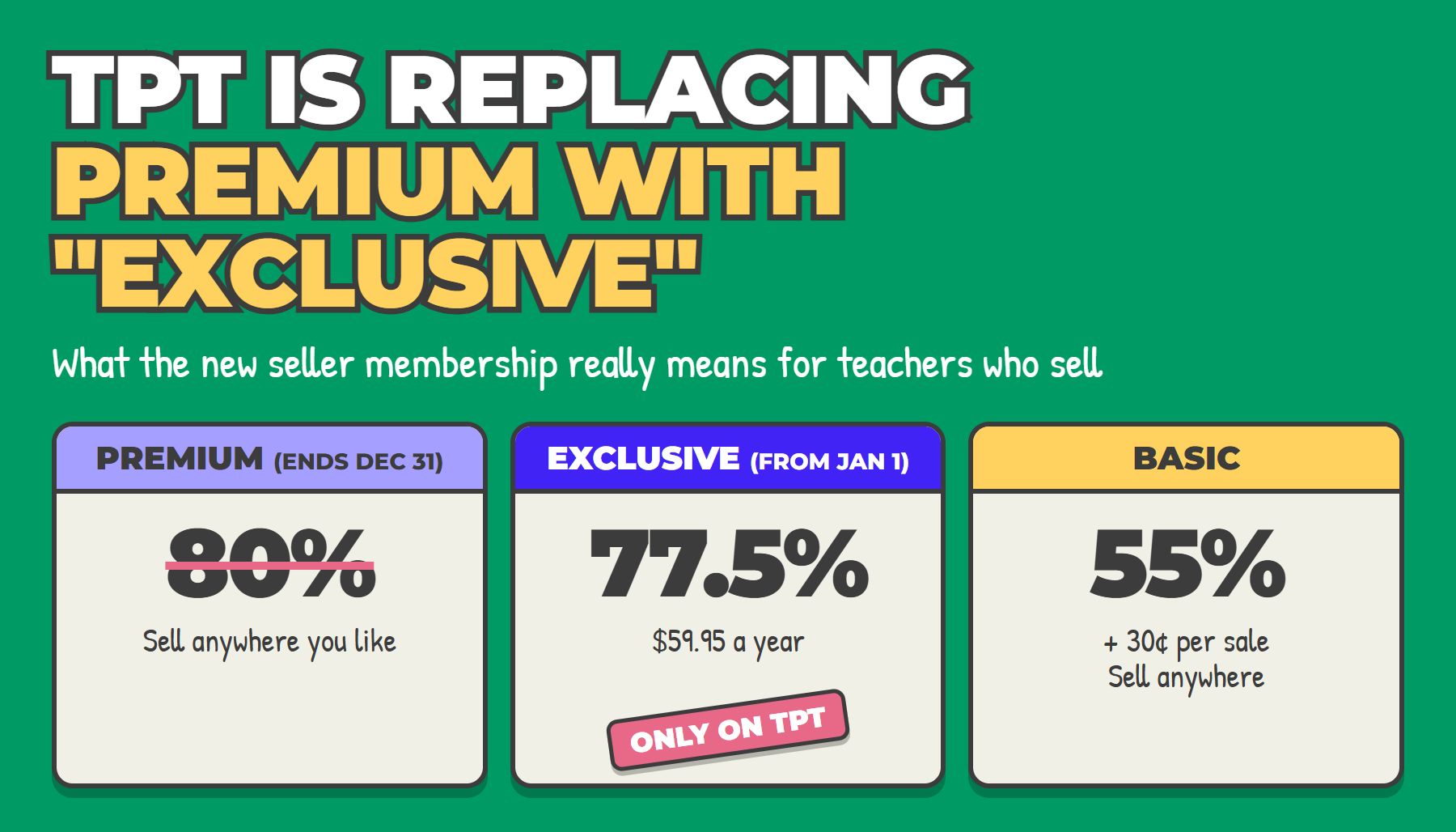
On October 1, 2026, Teachers Pay Teachers told its sellers that the Premium Seller membership is going away. From January 1, 2027 there will be two choices: a Basic Seller account that keeps 55% of each sale, or a new Exclusive Seller membership that keeps 77.5% but comes with one big condition. You promise to sell your digital teaching resources only on TpT. Not on your own website, not on Etsy, not through a membership, nowhere else.
I sell my review games on TpT and on this website, so this lands on my desk too. I have read TpT’s announcement, both of its FAQ pages, the Town Hall write-ups and a lot of what teacher-sellers have posted since. This article explains the change in plain words, shows what it does to a teacher’s income, collects what sellers are saying, and then says what I think. If you have already decided you want options, the companion piece is here: TpT alternatives where teachers can open their own store.
The short version
- Premium ends on December 31, 2026. Nobody new can buy it as of October 1, 2026. Existing Premium sellers keep their 80% rate until the end of the year.
- Exclusive replaces it from January 1, 2027. Same yearly fee as Premium ($59.95), a slightly lower payout (77.5% instead of 80%), and a new rule: your digital teaching resources may only be sold on TpT.
- Basic is the only non-exclusive option left. You keep 55% of each sale and pay $0.30 per resource sold. It is unchanged, but it is a 25-point drop from Premium.
- If you do nothing, you become Basic on January 1, 2027. TpT refunds unused Premium months at $5 each and waives the $29 Basic fee.
- Thousands of sellers are objecting. Two petitions, seller blogs, podcasts and a national education news site have all covered the backlash. Many sellers say the Town Hall on October 8 left more questions than answers.
Premium vs Exclusive vs Basic, side by side
Here is the whole change in one table. The Premium column is what sellers have today; the other two are the only options from January 1, 2027.
| Premium (ends Dec 31, 2026) | Exclusive (from Jan 1, 2027) | Basic | |
|---|---|---|---|
| Cost | $59.95 a year | $59.95 a year | $29 once |
| You keep | 80% of each sale | 77.5% of each sale (80% only until Dec 31, 2026 for new sign-ups) | 55% of each sale |
| Per-sale fee | $0.15 per resource, only on orders under $3 | Same as Premium | $0.30 per resource, on every order |
| Sell the same files on your own website? | Yes | No. Your site may show the product, but the “Buy” button has to send people to TpT | Yes |
| Sell on Etsy, Amped Up Learning, Classful, Tes, etc.? | Yes | No | Yes |
| Run a membership or subscription with your resources? | Yes | No | Yes |
| Sell school or district licenses directly? | Yes | No | Yes |
| Still allowed elsewhere | Everything | Physical products, courses and PD, Boom Cards on Boom, Kindle books, clip art, fonts, free resources | Everything |
| Extras | Search Analytics, Keyword Finder, marketing tools | Same, plus “possible inclusion” in TpT-funded marketing | None |
| Can you change your mind? | Cancel any time | You can leave, but you must wait one year before you can opt in again, and there is no refund on the yearly fee | Upgrade to Exclusive any time |
Sources for every cell are TpT’s own pages: the announcement on the TpT Seller Blog, the FAQ for existing Premium sellers, the FAQ for new and Basic sellers and the fee page.
What “exclusive” means in everyday words
TpT’s wording is: “while you can use other websites to highlight and market your resources, transactions must be routed to your TPT store.” Here is what that means in practice.
- Your own website turns into a brochure. You can keep it, write blog posts, show your products. But if a teacher wants to buy a worksheet or a game from you, your button has to send her to TpT. You do not get her email address, and TpT takes its 22.5%.
- Your Etsy shop has to stop selling teaching files. The same applies to Amped Up Learning, Classful, Tes, Payhip, Gumroad and every other marketplace. TpT has said the rule covers anything that could be sold on TpT, even if you never listed it there.
- No memberships, subscriptions or payment plans that include your teaching resources. An “all access pass” on your own site is out.
- No direct school or district licenses. Those have to go through TpT as well.
- Freebies are fine, on and off TpT. But anything you give away for free elsewhere cannot be sold on TpT.
- What you can still sell elsewhere: physical products, courses and professional development, Boom Cards on the Boom platform, Kindle books, and digital products that are not about teaching, such as clip art and fonts.
Two more details that matter. If you break the agreement, TpT says “penalties may apply” and has not said what they are. And the detailed guidance on what counts as a “digital educational resource” was still being written when the change was announced. At the October 8 Town Hall, TpT promised more guidance “later in October.” Sellers were asked to start deciding before the rules were finished.
The dates
- October 1, 2026: Announcement. Premium closed to new sign-ups. Basic and new sellers can opt in to Exclusive from this day, at 80% until the end of the year, with the exclusivity rule applying immediately.
- October 8, 2026: TpT Town Hall webinar.
- December 31, 2026, 11:59 pm ET: Deadline for existing Premium sellers to tick the “Yes, I want to become an Exclusive Seller” box in My Account. You can untick it any time before then.
- January 1, 2027: Premium ends. Payout rates switch to 77.5% (Exclusive) or 55% (Basic). Anyone who did not tick the box becomes Basic and receives $5 for every unused Premium month in their January payout.
- After January 1, 2027: You can still join Exclusive at any time, with the rule applying the moment you sign up. If you leave Exclusive, you wait a year to come back.
How it affects teachers who sell
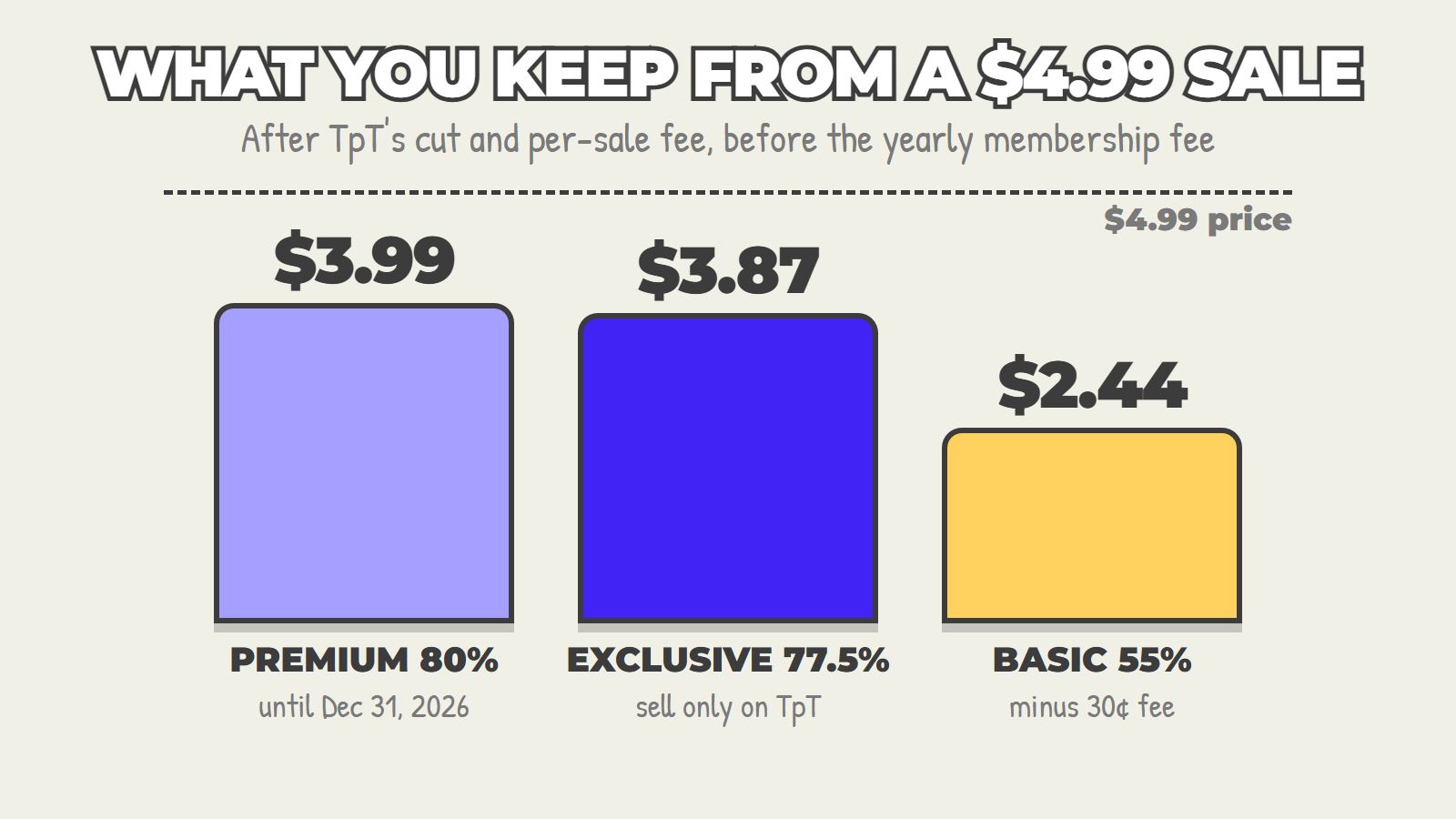
It depends on which kind of seller you are. Here is a $4.99 game and a $10 bundle under each option, after TpT’s cut and per-sale fee, before any yearly fee.
| Price | Premium (80%) | Exclusive (77.5%) | Basic (55% minus $0.30) |
|---|---|---|---|
| $4.99 game | $3.99 | $3.87 | $2.44 |
| $10.00 bundle | $8.00 | $7.75 | $5.20 |
| $1,000 in yearly sales | $800 | $775 | $550 minus fees |
If you only ever sold on TpT, this is a 2.5-point pay cut for the same $59.95 fee. On $1,000 of sales that is $25 a year. Annoying, not dramatic. You also gain nothing you did not have, apart from a vague promise of marketing.
If you also sell on your own website, Etsy or another marketplace, you have a hard choice. Either you shut those checkouts down and send everyone to TpT, or you drop to Basic and lose 25 points on every TpT sale. For a seller doing $5,000 a year on TpT, Basic costs about $1,250 a year compared with Premium. That is the real “price” of staying independent, and it is why so many sellers are angry.
If you are a new seller, there is no Premium to grow into. Your choice on day one is 55%, or 77.5% with exclusivity. You decide before you have any sales data at all.
If you are a buyer, nothing changes on January 1. But if sellers pull products, raise prices to cover a lower payout, or stop launching new resources, you will notice later.
What teachers who sell are saying
I went looking for sellers who have written about this publicly. There is a lot, and most of it is not happy.
Elizabeth W, a Canadian seller, started a Change.org petition asking TpT to reconsider the off-platform restrictions on the day of the announcement. It had about 1,400 signatures when I checked. Its core line: “The new terms could force sellers to make an unfair choice.” It points out that “these sellers have built their businesses based on the understanding that they could choose where and how to sell,” and asks TpT for plain-language rules, real notice before big changes, and a review of seller pay.
Josephine Myers, an elementary teacher and speech-language pathologist, started a second petition asking TpT to keep Premium. Her argument is that exclusivity “should be a third option, not the replacement for Premium,” and that if TpT wants exclusivity it should pay for it, with something closer to a 90% payout.
Sam, a high school teacher who writes at More Lessons Less Planning, published one of the sharpest reactions on October 2: “Teachers Pay Teachers Exclusive Seller Rules Punish Sellers for Selling Anywhere Else.” Sam describes the mood in the seller groups as running “from anger to grief,” calls Exclusive “a fee increase with a no-selling-elsewhere clause attached,” and asks the question that stuck with me: “So what keeps the next increase at 2.5 points instead of 5, or 10?” Sam also notes that “for a teacher running a side business, a 25 point drop in payout would come out of the household budget.”
Siân Namvihanh, who runs The SEO Teacher in Australia, attended the Town Hall and wrote that “many people came away feeling like they had more questions than answers.” The question she thinks every seller should sit with: “If TPT changed its terms again next year, how much would that affect my business?”
Lindsay Bowden, host of the Teacher Business School podcast, recorded an episode on the update the day after the announcement. Her advice: do not rush, keep uploading, wait for clearer rules, and in the meantime build the things TpT cannot take away, such as an email list and skills on other platforms.
Nicholas Ferroni, a New Jersey high school teacher with a large online following who has both bought and sold on TpT, told Chalkbeat the change is “a slap in the face for teachers” and that TpT is “just wanting to make more profit.”
A seller who also lists on Classful and Amped Up Learning updated her platform comparison post the day the news came out, and spelled out what Exclusive would mean for her: “disabling or deleting resources on other platforms, including Classful, AmpedUp Learning, and personal websites.”
Not everyone is leaving. Rebecca Vandemark of Caravan Sonnet Classroom wrote that she is “taking time to thoughtfully consider” the change and will stay on TpT. And one small telling detail: on the day I wrote this, TpT’s own FAQ page for Premium sellers showed that only 37 of 143 readers had marked it “helpful.”
TpT’s side of it
To be fair to TpT, here is its reasoning in its own words. The company says “TPT resources are being increasingly sold on sites outside of TPT,” that buyers who find a resource on TpT and then buy it elsewhere weaken the marketplace, and that exclusivity will create “a more unified marketplace.” It points to recent improvements it has paid for: new store and product pages, Search Analytics, the Keyword Finder, Seller Discounts and more marketing. It also stresses that Exclusive is optional and that Basic is unchanged.
TpT was founded in 2006 by a New York teacher, Paul Edelman, and has been owned by IXL Learning since 2023. It is by far the largest teacher marketplace, and that scale is exactly why this matters.
Why I think this is a bad move
- It is a pay cut dressed up as an upgrade. Sellers pay the same $59.95, keep 2.5 points less, and the “new benefit” is a restriction on their own business. The listed extras (analytics, keyword tools) are things Premium sellers already had.
- The middle option is gone on purpose. A 55% Basic rate next to a 77.5% Exclusive rate is not a free choice. It is a 25-point penalty for selling anywhere else. If TpT believed in the value of exclusivity, it would offer it as a third tier and let sellers choose, as both petitions ask.
- Once sellers are locked in, nothing stops the next cut. Competition from other marketplaces and from sellers’ own websites is the only thing that keeps TpT’s commission honest. Remove it, and Sam’s question stands: what keeps the next increase at 2.5 points?
- It hits the people with the least room. Teachers selling on the side to top up a salary, sellers who spent years building a small website with their own checkout, sellers who run a membership for their regulars. These are exactly the people being told to tear that down or take 55%.
- The rules were not finished when the clock started. Sellers were asked to decide by December 31 while TpT was still writing its guidance on what counts as an “educational resource,” had not defined the penalties, and left a Town Hall full of open questions. That is not how you treat partners.
- It will not fix the problem TpT describes. Sellers who value their off-TpT sales will not shut those shops; they will go Basic or leave TpT. The resources TpT is worried about will still be sold elsewhere, now by sellers who have a reason to send their own buyers away from TpT.
- Buyers lose too. Fewer sellers, fewer new products, and prices nudged up to cover a lower payout. A marketplace that says it reaches 85% of US educators has a responsibility to the whole community, not just its margin.
I would also say this to TpT directly. Sellers built this marketplace. The catalog, the previews, the ratings, the word of mouth in every staff room came from teachers working at their kitchen tables. Asking them to hand over control of where they sell, in exchange for a smaller share, is not a partnership.
What I would do before December 31
- Do not tick the box yet. Nothing changes for Premium sellers until January 1, and you can opt in on December 31 just as easily as today. Wait for the final guidance and the penalty rules.
- Download your Premium analytics now. Keyword Stats, Product Insights and Traffic Data disappear from Basic accounts. Export them while you still have access.
- Work out your own number. Take last year’s TpT sales. Multiply by 0.775 and by 0.55. The difference is the yearly cost of staying independent. Compare it with what you earned off TpT.
- Back up everything. Product files, covers, descriptions, previews. Whatever you decide, you want your catalog in your own hands.
- Build what TpT cannot touch. An email list, a website with your own checkout, and at least one other place to sell. Exclusive sellers can still promote off TpT, so none of this is wasted even if you opt in.
- Look at the alternatives properly. I have put together a list of the places where a teacher can open her own store, with what each one actually charges: TpT alternatives where teachers can open their own store.
For my own store, the Exclusive box is not really a choice. This website exists so that teachers can buy my review games directly, and I am not going to turn it into a signpost for someone else’s checkout. I will keep selling in both places and see how TpT’s rules settle. If they change again, I will update this article.