
Your Curriculum Might Be Missing the Mark (Here’s How to Find Out)
Your students just bombed an assessment, and you’re wondering what went wrong. The culprit might not be your teaching—it could be misalignment between what you’re supposed to teach, how you’re teaching it, and how you’re measuring learning.
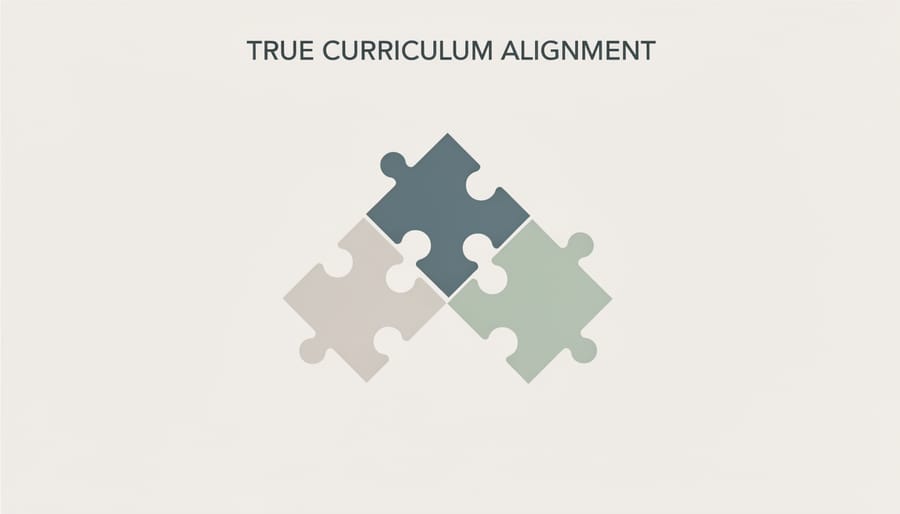
Think of alignment as a three-legged stool. Your standards are the blueprint, your instruction is the building process, and your assessments prove the house is solid. When one leg wobbles, everything topples. You might be teaching engaging lessons that students love, but if those lessons don’t match your standards or your tests measure something completely different, you’re setting everyone up for disappointment.
The good news? Fixing alignment issues doesn’t require overhauling your entire curriculum overnight. Start by checking one simple thing: Can your students actually demonstrate the exact skills your standards require during your regular classroom activities? If your standard asks students to “analyze author’s purpose” but your lessons focus on summarizing plot points, there’s your gap.
This disconnect frustrates teachers everywhere. You work hard, your students seem engaged, yet test scores don’t reflect the effort. Understanding alignment gives you a clear roadmap to bridge these gaps and finally see your instruction translate into measurable student success. Let’s explore practical ways to spot misalignment in your classroom and fix it without adding hours to your already packed schedule.
What Does True Alignment Really Mean?
Think of alignment as a three-legged stool. When all three legs work together, everything stays balanced and steady. In education, those three legs are your curriculum standards, your daily instruction, and how you assess student learning.
Here’s what true alignment looks like in action: Imagine your fourth-grade standard says students should “analyze how characters respond to challenges in a story.” When you have alignment, your instruction focuses specifically on teaching character analysis skills through close reading and discussion. Then, your assessment asks students to demonstrate that exact skill, perhaps by writing about how a character overcame an obstacle in the story you studied together.
Sounds straightforward, right? But misalignment happens more often than you’d think, and it’s frustrating for everyone involved.
Picture this common scenario: Your standard requires students to solve multi-step word problems, but you spend most of your math time drilling basic computation facts. Then test day arrives, and students face complex word problems they’ve barely practiced. That’s misalignment, and it leaves your students confused and unprepared.
Or consider this: You teach an amazing unit on ecosystems with hands-on experiments and collaborative projects, but your test only asks students to memorize vocabulary definitions. Your instruction was engaging, but it didn’t match what you measured.
When curriculum, instruction, and assessment work together seamlessly, students know exactly what’s expected. They can show what they’ve learned because you’ve taught precisely what matters. You’ll feel more confident, and your students will experience greater success. Implementing effective standards alignment strategies helps ensure all three pieces connect naturally, creating that sturdy three-legged stool your classroom needs.
Warning Signs Your Curriculum Isn’t Aligned
Something feels off, but you can’t quite put your finger on it. Maybe your students are excited during lessons but freeze up during tests. Or perhaps you’re teaching content that seems important but never actually shows up on assessments. These are classic warning signs that your curriculum, instruction, and assessment aren’t working together like they should.
Here’s what to watch for in your classroom. If students consistently bomb assessments even though they seemed engaged during lessons, there’s likely a disconnect between what you’re teaching and how you’re testing. You might be focusing on interesting activities that don’t actually address the learning standards.
Another red flag? You’re spending lots of time on topics that don’t appear on your assessments at all. This often happens when we teach what we love rather than what students actually need to master. The reverse is equally problematic: testing students on material you barely covered in class.
Pay attention to curriculum continuity issues too. If your sixth graders struggle with concepts they supposedly learned in fifth grade, alignment problems may extend beyond your classroom.
You might also notice that your assessments focus heavily on memorization while your lessons emphasize critical thinking, or vice versa. When there’s a mismatch between the cognitive demands of instruction and assessment, students understandably feel confused and frustrated. Recognizing these warning signs is your first step toward creating a more cohesive learning experience.
Gap Analysis: Your Detective Work Made Easy
What Is a Curriculum Gap Analysis?
Think of a curriculum gap analysis as your teaching GPS! It’s a straightforward process that helps you spot the distance between where your students should be and where they actually are. Essentially, you’re comparing three key things: the standards you’re required to teach, what you’re actually covering in your lessons, and how you’re testing student understanding.
Here’s the exciting part: this doesn’t have to be complicated or time-consuming. A gap analysis is simply a reality check that helps you answer questions like “Am I teaching everything my students need to know?” and “Do my tests actually measure what the standards require?”
When you conduct this comparison, you might discover that you’re spending three weeks on a topic that deserves one week, or maybe you’ve completely skipped a standard without realizing it. You might also find that your assessments focus heavily on recall when the standards call for critical thinking.
The good news? Once you identify these gaps, you can take action to fix them, making your teaching more effective and your students more successful. It’s about working smarter, not harder!

Simple Tools to Spot the Gaps
Good news! You don’t need fancy software or hours of training to check if your curriculum, instruction, and assessments are working together. Think of these tools as your alignment detective kit—simple, practical, and ready to use right away.
Start with an alignment matrix. This is just a simple chart where you list your standards down one side and your lessons, activities, and assessments across the top. Put checkmarks where they connect. Gaps jump out immediately when you see standards with no checkmarks or assessments that don’t match any standard you’ve taught. You can create this in a basic spreadsheet or even sketch it on paper during your planning time.
Curriculum mapping templates are another lifesaver. These help you visualize what you’re teaching and when throughout the year. Layout your units chronologically and tag which standards each one addresses. This bird’s-eye view quickly reveals if you’re spending three weeks on one standard while barely touching another that’s equally important.
Quick self-assessment checklists are perfect for busy teachers. Create a simple yes-or-no checklist with questions like: Does this lesson directly teach a specific standard? Can students demonstrate this standard through my assessment? Are my standards-aligned materials actually being used in instruction? Run through these questions weekly, and you’ll catch misalignments before they become bigger problems.
The beauty of these tools is their flexibility. Customize them for your grade level, subject area, and teaching style. Start with one tool that feels most manageable, use it consistently, and watch how quickly you gain clarity about what’s working and what needs adjustment.
Making Gap Analysis Work in Your Busy Schedule
You don’t need to carve out entire days for gap analysis! Start small by dedicating just 15 minutes during your weekly planning time. Focus on one standard or unit at a time rather than tackling everything at once.
Team up with grade-level colleagues to divide and conquer. When teachers collaborate, you can split the work by subject areas or standards, then share your findings. This approach cuts your workload while giving you fresh perspectives on alignment issues.
Digital tools are game-changers for busy educators. Use simple spreadsheets or free online templates to track standards, lessons, and assessments side by side. Many teachers find success with color-coding systems that quickly reveal gaps at a glance.
Build gap analysis into activities you’re already doing. During student review sessions or classroom games, jot down quick notes about which standards students struggle with most. These informal observations become valuable data points without requiring extra work.
Remember, gap analysis doesn’t have to be perfect. Even identifying one or two misalignments per quarter helps you improve student outcomes. The key is consistency over perfection. Start with what feels manageable, and you’ll develop a rhythm that fits naturally into your teaching routine.
Fixing the Gaps: Practical Action Steps
Once you’ve spotted the gaps, it’s time to roll up your sleeves and fix them! The good news? You don’t need to overhaul everything at once. Small, targeted adjustments can make a huge difference.
Start with your lesson plans. Look at where students struggled and ask yourself: Did my instruction actually address what the standard requires? If a standard asks students to “analyze” but your lesson only had them “identify,” that’s your gap. Revise those lessons to include activities that match the cognitive demand. Use unit planning templates to help you map out exactly which standards you’re teaching and when, ensuring nothing falls through the cracks.
Next, take a hard look at your assessments. Do your test questions mirror the language and format of what students will encounter on standardized tests? If your standard requires students to compare and contrast multiple sources, but your quiz only asks multiple-choice recall questions, you’ve found another gap. Modify your assessments to better reflect the complexity and skills outlined in the standards.
Here’s where it gets fun: use review games as both a teaching tool and an alignment check! Games give you instant feedback on what students actually understand. Create review activities that directly target the standards you’ve identified as weak spots. When students struggle with certain question types during game play, you know exactly where to revisit in your instruction.
The key is to make this cycle ongoing. After each assessment, gather student work samples and analyze them against your standards. What patterns do you see? Where are students consistently missing the mark? Use that data to adjust your teaching, update your materials, and create targeted practice opportunities. Remember, alignment isn’t a one-time task—it’s a continuous process of refinement that helps your students succeed!
Turn Alignment Check-Ins Into Classroom Fun
Who says alignment checks have to be boring? Turn those assessment moments into student favorites with interactive review games! These aren’t just fun time-fillers—they’re powerful tools that show you exactly how well your instruction matches what students are actually absorbing.
Here’s the magic: when you create a review game based on your learning standards, student responses reveal alignment gaps instantly. If everyone struggles with a particular question type, you’ve found a mismatch between how you taught the concept and how the standard expects students to demonstrate it. If students breeze through certain questions but bomb the actual assessment later, you know there’s a disconnect worth investigating.
The beauty of game-based check-ins is they give students a low-stakes environment to show what they know while you gather real-time data about your curriculum alignment. Plus, students are way more likely to give their genuine best effort when they’re competing in teams or racing against the clock than when they’re filling out another worksheet.
Start simple by creating quick games that mirror your assessment format. Use the same question styles, vocabulary, and thinking skills your standards require. Pay attention to patterns in student responses—these patterns tell you whether your daily lessons truly prepare students for what they’ll face on assessments. The best part? You’re fixing alignment issues before high-stakes testing, not after. Students have fun, you get actionable insights, and everyone wins.

Here’s the truth: alignment isn’t about achieving perfection overnight. It’s an ongoing journey, and that’s completely okay! Every time you pause to check whether your lesson connects to your standards, every moment you adjust a quiz question to better match what you actually taught, you’re making progress. These small, consistent efforts add up in powerful ways.
When your curriculum, instruction, and assessment work together, something wonderful happens. Students feel less confused about expectations, their performance improves, and you spend less time wondering why a lesson didn’t land. The frustration that comes from teaching one thing and testing another simply fades away.
Start small today. Pick one upcoming lesson and ask yourself: Does this clearly connect to my standard? Does my assessment measure what I taught? If you spot a gap, adjust it. Celebrate that win, then tackle the next one. Remember, you’re not overhauling everything at once. You’re building better alignment one thoughtful choice at a time, and your students will absolutely benefit from your efforts.