

Transform Your Engineering Classroom With Games That Actually Teach
Transform your mechanical engineering classroom into an active learning lab by embedding interactive challenges that mirror real-world problem-solving. Replace traditional lecture-heavy sessions with hands-on design tasks where students calculate load distributions, analyze stress points, or optimize simple machine systems through trial and error. This approach turns abstract concepts like torque, friction, and thermodynamics into tangible experiences students can manipulate and explore.
Integrate game-based activities that reward iterative thinking and precision. Create point systems for accurate calculations, timed challenges for mechanism design, or team competitions where students race to solve engineering puzzles. These mechanics naturally encourage the repetition and practice mechanical engineering demands while keeping motivation high.
Customize learning pathways based on student progress and interests. Some learners grasp kinematics quickly but struggle with material properties, while others excel at CAD modeling but need support with mathematical foundations. Offer choice boards where students select projects aligned with their curiosity, whether designing a bridge, creating a gear system, or analyzing thermal efficiency.
Build immediate feedback loops into every activity. Students need to see why their calculations missed the mark or how their design improvements changed outcomes. Quick assessment checks, peer reviews, and digital simulations provide this real-time guidance, turning mistakes into powerful learning moments rather than roadblocks.
Why Mechanical Engineering Needs a Learning Makeover
Let’s be honest: teaching mechanical engineering can feel like trying to explain invisible forces at work. Your students need to grasp abstract concepts like torque and thermodynamics, wrestle with complex mathematical relationships, and develop spatial reasoning skills to visualize how machines move and interact. That’s a tall order for any classroom!
Traditional teaching methods—think textbook diagrams and lecture-heavy lessons—often struggle to reach every learner. Visual learners might get lost in equations, while hands-on learners zone out during theoretical explanations. Students who need extra time to process spatial relationships may feel left behind when the class moves quickly through 3D concepts.
Here’s the real challenge: mechanical engineering isn’t just about memorizing formulas. It requires students to think like problem-solvers, understanding cause and effect in physical systems. When we rely solely on static images and one-size-fits-all instruction, we miss opportunities to engage diverse learning styles.
The good news? Your students don’t all learn the same way, and your teaching approach doesn’t have to be limited to traditional methods either. By recognizing these challenges, you’re already taking the first step toward finding solutions that work for your unique classroom. The key is creating experiences where students can interact with concepts, experiment safely, and build understanding at their own pace—something that rigid, conventional approaches simply can’t deliver effectively.
What Learning Engineering Actually Means for Your Classroom
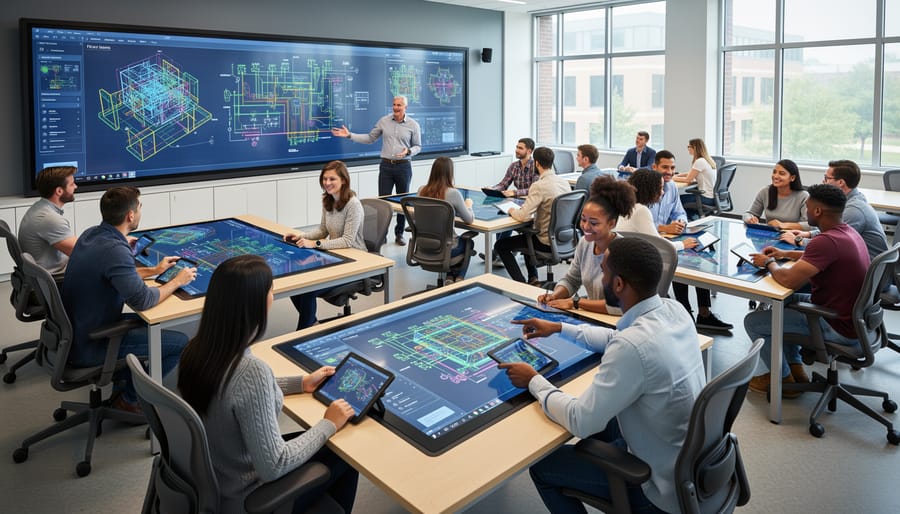
Think of learning engineering as your teaching toolkit getting a serious upgrade! At its heart, learning engineering combines what we know works from educational research with smart technology to create learning experiences that actually stick with students—especially in challenging STEM subjects like mechanical engineering.
Here’s the simple breakdown: instead of guessing what might help your students understand complex concepts like force, motion, or structural design, learning engineering uses data and proven teaching methods to build experiences tailored to how students actually learn. It’s like having a GPS for education rather than just a paper map.
For STEM teachers, this means tapping into technology-enhanced learning that makes abstract mechanical engineering principles visible and interactive. Imagine your students designing virtual bridges that can actually collapse if their calculations are off, or building digital machines where they see the immediate consequences of their design choices. That’s learning engineering in action!
The beauty of this approach is customization. Every student learns differently, and learning engineering helps you meet them where they are. Some students grasp gear ratios through visual simulations, while others need hands-on problem-solving scenarios. The technology tracks what’s working and adapts accordingly.
You don’t need to be a tech wizard to benefit from learning engineering. The key is understanding that it’s really about designing smarter learning experiences using tools that give you feedback on what’s clicking with your students. When you combine educational research with interactive technology, you create those lightbulb moments where mechanical engineering concepts finally make sense—and that’s what makes teaching so rewarding!
Game-Based Learning: Your Secret Weapon for Complex Concepts
Building Blocks: Turning Statics and Dynamics Into Play
Games transform abstract mechanical engineering concepts into hands-on learning experiences that stick. When students tackle force diagrams through quiz-style challenges, they’re actively applying Newton’s laws rather than passively memorizing them. Try creating review games where students identify forces acting on objects in different scenarios—a book on a table, a car accelerating, or a bridge supporting weight.
Motion principles come alive when you gamify velocity and acceleration problems. Students can compete in teams to solve kinematic equations, earning points for correct calculations. The competitive element keeps energy high while reinforcing fundamental concepts. For equilibrium challenges, design games where students must balance forces and torques, perhaps determining whether structures will topple or stay stable.
The beauty of game-based learning is the immediate feedback students receive. They instantly know if their force vector diagram is correct or if they’ve miscalculated an acceleration value. This rapid response helps correct misconceptions before they become ingrained.
Customize your review games to match your current unit—whether you’re covering static equilibrium, projectile motion, or rotational dynamics. Mix question types: multiple choice for quick concept checks, short answer for calculations, and diagram labeling for visual learners. This variety keeps all students engaged while addressing different learning styles.
Making Materials Science Stick
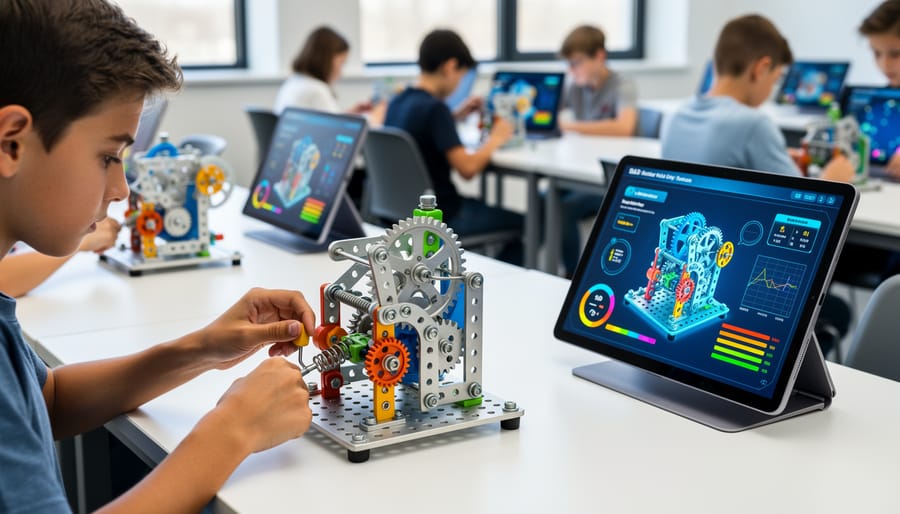
Materials science doesn’t have to feel like memorizing endless charts and formulas! Game-based learning transforms abstract concepts like stress-strain relationships into hands-on adventures your students will actually remember.
Start with simple bridge-building challenges where students test different materials under load. They’ll quickly grasp why engineers choose steel over wood for certain applications when they watch their designs succeed or fail in real-time. Digital simulations let learners adjust material properties and instantly see how structures respond to tension, compression, and shear forces.
Try creating material property scavenger hunts where students match everyday objects to their mechanical characteristics. A rubber band demonstrates elasticity, while a ceramic tile shows brittleness. These tangible connections make textbook definitions come alive.
The beauty of game-based approaches is their flexibility. Customize difficulty levels based on your students’ grade level, from basic property identification for younger learners to complex failure analysis for advanced classes. Add competitive elements like timed challenges or team competitions to boost engagement.
When students experiment with virtual materials, test structural designs, and solve real-world engineering problems through play, they’re not just learning content. They’re developing critical thinking skills and genuine enthusiasm for mechanical engineering concepts that will stick long after class ends.
Customizing Games for Different Engineering Topics
The beauty of game-based learning is that you can adapt almost any template to fit your mechanical engineering curriculum, regardless of whether you’re teaching basic concepts or advanced principles. Think of game templates as your blank canvas—ready to be filled with the exact content your students need to master.
Start with the fundamentals. For younger learners exploring simple machines, create matching games that pair everyday objects with their mechanical principles. A bottle opener becomes a lever, scissors become double levers, and a wheelchair ramp represents an inclined plane. Quiz games work wonderfully for reinforcing vocabulary like force, motion, friction, and energy.
When teaching thermodynamics, transform temperature conversion problems into timed challenges or racing games where students compete to solve heat transfer equations. The competitive element keeps energy high while building computational fluency. You can adjust difficulty by changing the complexity of problems or adding multi-step calculations.
For advanced topics like stress analysis or fluid dynamics, consider adapting puzzle games where students must identify forces acting on structures or predict flow patterns. These visual representations help bridge the gap between abstract equations and real-world applications.
Here’s your flexibility advantage: most game templates allow you to control question difficulty, time limits, and point values. Teaching mixed-ability classes? Create different versions of the same game with scaffolded content. Struggling students might identify basic mechanical components while advanced learners design virtual systems with multiple interacting parts.
Don’t forget about project-based applications. Use simulation-style games where students make design decisions and see immediate consequences. Will their bridge hold? Does their gear system work efficiently? These scenarios develop critical thinking alongside technical knowledge.
The key is starting simple, testing with your students, and refining based on their engagement and learning outcomes.
Quick Wins: Getting Started Without the Tech Headache
Ready to dip your toes into tech-enhanced learning without feeling overwhelmed? Great news: you don’t need to be a tech wizard to get started. Begin with what you already have. That PowerPoint presentation you’ve been using? It’s already halfway to becoming an interactive learning experience.
Start small with a simple addition to your next lesson. Take one concept from your mechanical engineering unit, like simple machines or forces, and transform a few slides into a quick quiz game. Use PowerPoint’s built-in hyperlink feature to create clickable answer choices that jump to feedback slides. This takes about 15 minutes to set up and instantly makes your lesson more engaging.
Here’s your three-step quick start: First, identify one lesson where students typically zone out. Second, pick three key concepts from that lesson that you can turn into questions. Third, create a simple game structure where correct answers earn points or unlock the next challenge.
The beauty of starting this way is that you’re not abandoning your existing materials. You’re enhancing them. Plus, PowerPoint templates designed for classroom games make customization even easier. Just swap in your mechanical engineering content, adjust difficulty levels to match your students, and you’re ready to go.
Remember, technology-enhanced learning isn’t about perfection on day one. It’s about taking manageable steps that make learning stickier for your students. Start with one game this week, see how students respond, then build from there.

Measuring Success: What Actually Works
You don’t need fancy spreadsheets or complicated assessment tools to see if your game-based mechanical engineering lessons are working. Start with simple observations: Are students asking more questions? Are they staying engaged longer than usual? These everyday classroom moments tell you plenty.
Watch for collaboration patterns during game activities. When students naturally start explaining pulley systems or gear ratios to each other, you’re winning. Take quick notes on a clipboard about which concepts sparked the most discussion or where students got stuck.
Use the games themselves as informal assessments. Many platforms let you track student engagement and see which questions challenged learners most. Pay attention to repeated mistakes, they show where you need to circle back with different explanations.
Try quick exit tickets after game sessions: “Draw one thing you learned about simple machines today” or “Name a real-world example of the concept we explored.” These take minutes to review but reveal genuine understanding.
Remember, success isn’t just about correct answers. If students are excited to return to mechanical engineering topics tomorrow, you’re building the foundation for deeper learning that lasts.
Ready to bring game-based learning into your mechanical engineering lessons? The best part is you don’t need to overhaul your entire curriculum overnight. Start small and watch the impact unfold. Try introducing just one interactive review game during your next unit on forces, motion, or simple machines. You’ll likely notice an immediate shift in classroom energy and student participation.
Even a single engaging activity can help students solidify complex concepts they might otherwise struggle to retain. The beauty of game-based learning is its flexibility. You can customize questions to match exactly what your students need to practice, whether that’s Newton’s laws, gear ratios, or thermodynamics principles.
Don’t let perfection hold you back from getting started. Your first game doesn’t need fancy graphics or complicated rules. A simple question-and-answer format with a competitive twist can work wonders for engagement and comprehension. As you grow more comfortable, you’ll discover endless opportunities to weave interactive elements throughout your lessons. Remember, every expert teacher started with a single step. Take yours today and see how game-based learning can transform understanding in your classroom.