How Multilingual AAC Tools Transform Inclusive Play in Your Classroom
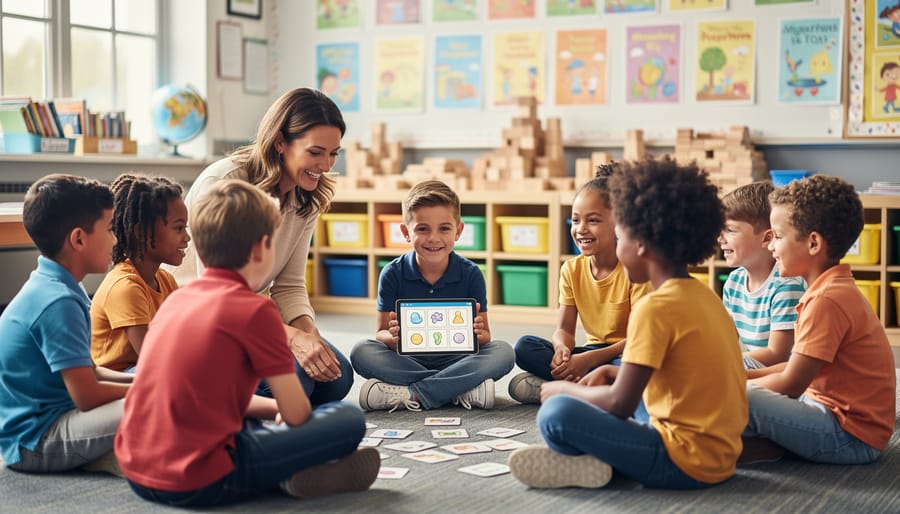
Picture this: A student who speaks Spanish at home tries to join a classroom game but struggles to communicate their ideas. Another child uses an AAC device but gets left behind when the game moves too quickly. These moments happen every day in diverse classrooms, and they’re precisely why research from journals like the Journal of Multilingual and Multicultural Development matters so much for your teaching practice.
The good news? You don’t need a PhD to bring this research into your games and activities. When you weave multilingual support together with AAC tools during play, something magical happens. Students who’ve been quiet suddenly participate. Kids who felt isolated find their voice. Learning becomes genuinely inclusive, not just well-intentioned.
This approach isn’t about adding more work to your already-full plate. It’s about making small, strategic shifts that open doors for every learner. Think of it as customizing your favorite games to fit all players, not just some. Whether you’re teaching kindergarten or middle school, these evidence-based strategies transform ordinary classroom games into powerful learning experiences where language differences become strengths and communication tools become bridges.
Ready to discover how simple tweaks to your existing activities can create breakthrough moments for multilingual learners and AAC users? Let’s explore practical strategies that work in real classrooms with real students, starting tomorrow.
Why Multilingual Matters in AAC-Supported Play
Supporting Home Languages While Building English Skills
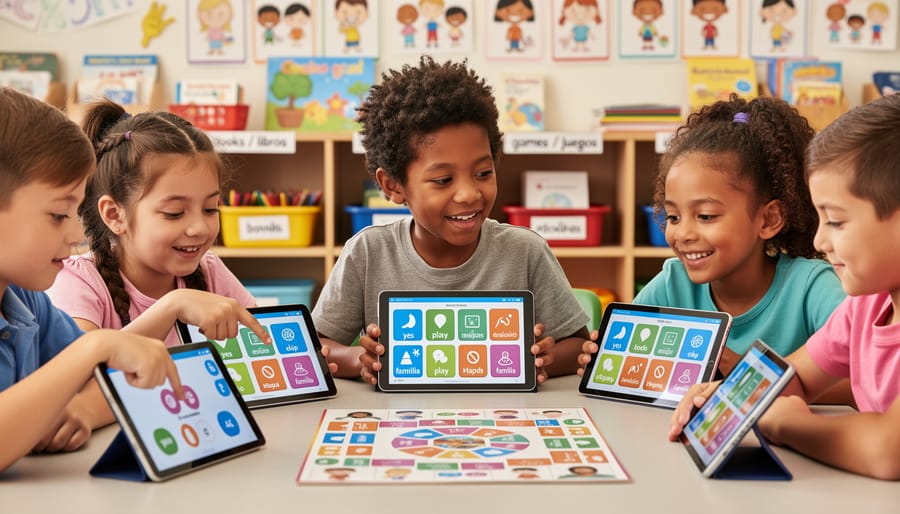
Multilingual AAC tools create beautiful bridges between home and school, letting students bring their whole selves into classroom games. When kids can express themselves in their home language during a vocabulary scavenger hunt or math relay race, they maintain strong connections to their cultural identity while building English skills naturally.
Think of it like code-switching superpowers! Students might use their home language to explain game strategies to a partner, then practice English vocabulary during the activity itself. This approach honors their linguistic background rather than asking them to leave part of themselves at the classroom door.
These tools work especially well with culturally responsive practices during team-based games. You can customize AAC boards with bilingual labels, familiar cultural references, and images that reflect students’ backgrounds. A simple modification like adding home language options to a digital board game transforms participation from stressful to celebratory.
The best part? Research shows that maintaining home language skills actually accelerates English acquisition. When students feel confident and valued, they take more risks, participate more actively, and learn more effectively during play-based activities.
What Research Says About Multilingual AAC
Research from the Journal of Multilingual and Multicultural Development shows us something exciting: students using AAC devices in multiple languages don’t get confused. In fact, they thrive! Studies reveal that incorporating home languages alongside classroom languages actually strengthens communication skills overall.
Here’s what makes this research so practical for your classroom. When children see their native language represented in AAC tools during games and activities, they engage more confidently. They’re not choosing between languages, they’re building bridges between them. Research consistently demonstrates that this dual-language approach supports cognitive development and cultural identity.
The best part? You don’t need to be fluent in every student’s home language to make this work. Simple visual supports, partnering with families to learn key phrases, and using AAC devices with multilingual options create inclusive play experiences. Studies emphasize that even basic incorporation of multiple languages validates students’ backgrounds and boosts participation.
Think of multilingual AAC as opening more doors for connection, not adding complications. The evidence is clear: when students play games using communication tools that honor their whole linguistic identity, everyone wins.
Simple Ways to Add Multilingual AAC to Your Classroom Games
Visual Supports That Work Across Languages
Visual supports are game-changers for multilingual classrooms! When you incorporate icons, pictures, and symbols into your game templates, you create an instant bridge between languages. Think of visuals as the universal language that connects all your students, regardless of their home language.
Start by adding picture cues to game cards and boards. A die icon means “roll,” a raised hand means “take a turn,” and a trophy signals “winner.” These simple symbols eliminate confusion and let everyone jump right in. You’re essentially building Universal Design for Learning principles directly into your game design.
Color-coding is another powerful tool. Use green for “go,” red for “stop,” and yellow for “wait” across all your games. Students quickly learn these visual patterns and apply them independently.
Don’t forget emoji-style symbols for emotions and actions. A smiley face for correct answers, arrows for directions, and check marks for completed tasks work beautifully. The best part? You can customize these visuals to match your specific games and student needs. Keep symbols consistent across different games so students build visual literacy over time, making every new game easier to learn than the last.
Customizing Game Templates for Language Learners
Ready to make your PowerPoint games work for all your language learners? The beauty of templates is how easily you can customize them to support multilingual students. Start by adding vocabulary in multiple languages directly on your slides. Place English labels alongside home language translations, giving students visual connections between words they know and new terms they’re learning.
Audio supports are game-changers for language development. Record pronunciations for key vocabulary words and embed them as clickable sound buttons within your game slides. Students can hear correct pronunciation as many times as needed during gameplay. This auditory input reinforces learning without slowing down the fun.
Don’t forget visual cues! Icons, images, and color-coding help students understand game instructions and content without relying solely on text. Use consistent symbols throughout your game for actions like “your turn,” “correct answer,” or “try again.” Picture supports paired with words create a scaffold that benefits English learners at all proficiency levels.
Keep your customizations simple and student-friendly. Too much text or too many elements can overwhelm rather than support. Focus on clarity and accessibility, ensuring every modification helps students participate more fully in the learning experience.
Low-Tech AAC Options for Game Time
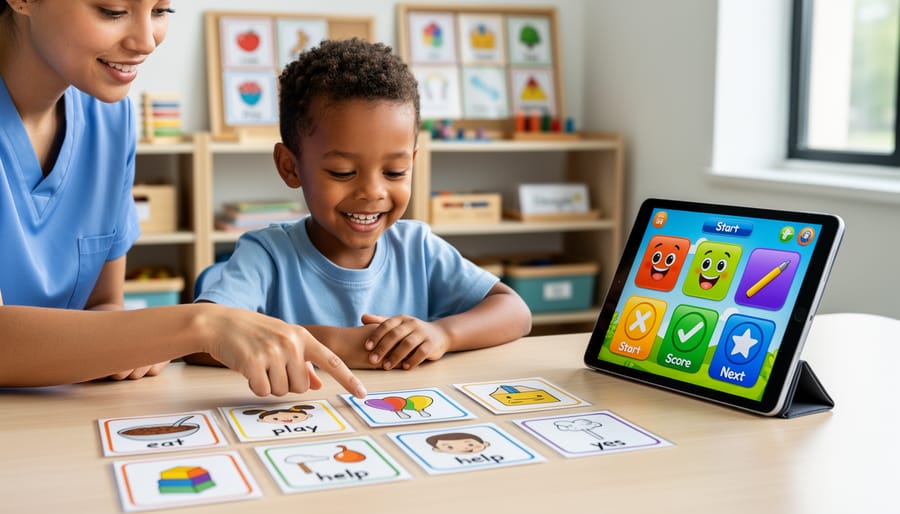
You don’t need fancy technology to create inclusive game experiences! Low-tech AAC options are perfect budget-friendly solutions that work beautifully alongside your classroom games.
Start with simple communication boards featuring key game vocabulary in multiple languages. Create laminated cards showing common game phrases like “my turn,” “help please,” or “good job” with corresponding images and text in your students’ home languages. These boards give everyone a voice during gameplay, regardless of their verbal abilities.
Picture cards are game-changers for explaining rules and choices. Use clear visuals to show different game actions, allowing students to point and participate confidently. You can easily customize these cards to match specific games you’re playing.
Gesture supports add another layer of accessibility. Teach universal hand signals for common game interactions like “wait,” “go,” or “stop.” Post visual reminders of these gestures around your game area so students can reference them anytime.
The beauty of low-tech options? They’re customizable, portable, and always ready to use without batteries or wifi. Mix and match these tools based on your students’ needs, creating an inclusive environment where every learner can join the fun and express themselves during game time.
Creating Truly Inclusive Play Experiences
Team Roles That Welcome AAC Users
Creating inclusive game teams starts with identifying roles that play to each student’s strengths. For AAC users, consider positions like scorekeeper, rule checker, timer manager, or materials organizer. These roles offer clear responsibilities without requiring rapid verbal responses.
Think about accessible game design from the start. Visual roles work beautifully for many students. Assign AAC users as the team’s strategist who points to game board options, or make them the decision validator who uses their device to confirm team choices.
Rotate roles regularly so every student experiences different responsibilities. This prevents any single role from feeling less important. When students using AAC devices serve as team captains or spokespersons, they lead discussions using their communication tools while teammates support wait time.
Customize roles based on individual interests and abilities. One student might excel at pattern recognition for puzzle games, while another could manage team resources in strategy activities. The key is ensuring each role genuinely contributes to team success, creating authentic participation rather than token involvement. When everyone has a meaningful job, the whole team wins together.
Wait Time and Turn-Taking Tips
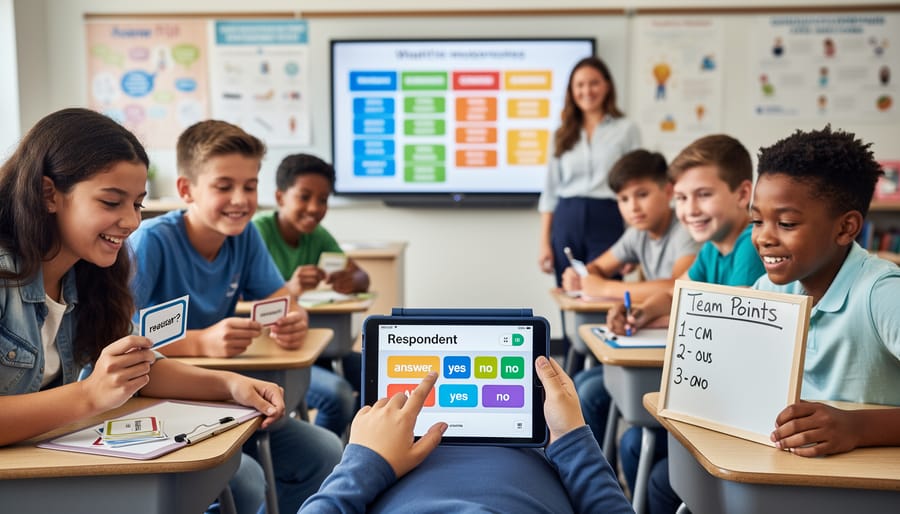
Creating space for every student to participate fully means rethinking how quickly games move forward. When you’re working with AAC device users and multilingual learners, building in extra processing time isn’t just helpful—it’s essential for true inclusion.
Start by doubling your typical wait time after asking questions during games. Count silently to ten instead of five. This gives students using communication devices time to navigate screens and select responses, while multilingual learners can mentally translate and formulate answers. You’ll notice more students joining in once they know they won’t be rushed.
Consider implementing a visual timer that everyone can see. This removes pressure while clearly showing how much time remains for each turn. When students know exactly how long they have, they can pace themselves more effectively.
Try these game modifications to support thoughtful participation. Use a talking stick or token system where only the person holding the object can respond. This eliminates the anxiety of being called on unexpectedly. For team games, allow students to pre-select their answers or moves before their turn arrives, giving them advance preparation time.
Partner quiet think time with sensory-friendly game experiences to create truly accessible activities. Encourage students to use gesture signals when they’re ready to respond rather than requiring immediate verbal answers.
Remember that slower-paced games often lead to richer participation from all students. When you remove time pressure, you create space for deeper thinking and more meaningful engagement across your diverse classroom.
Real Classroom Wins: What Inclusive Play Looks Like
Picture this: Ms. Rodriguez’s third-grade class is playing a competitive math relay race. Jayden, who uses AAC and speaks both English and Spanish at home, lights up when he sees the game board includes visual symbols alongside words in both languages. As teams race to solve problems, Jayden taps his device to encourage teammates with “¡Vamos!” and “Great job!” The whole class starts picking up these phrases, creating an energizing bilingual cheer squad.
What makes this scenario special? Everyone benefits. English-speaking students naturally absorb Spanish vocabulary through play. Jayden participates fully without feeling singled out. The visual supports help students who struggle with reading, regardless of language background. That’s the magic of multilingual AAC in action.
Here’s another win from Mr. Patel’s kindergarten. During a sorting game with picture cards, each item features the word in English, Mandarin, and Arabic with corresponding symbols. When playing “categorize the animals,” students using AAC devices can select images that speak the words aloud in their home language. But here’s the bonus: curious classmates start requesting to hear words in different languages, transforming game time into a spontaneous cultural exchange.
These aren’t rare unicorn moments. Teachers report that once multilingual visual supports become standard in classroom games, something beautiful happens. Students stop seeing AAC tools as “special equipment” and start viewing them as cool tech everyone wants to try. Language differences become celebrated assets rather than barriers.
The key is customization. Simple tweaks like adding familiar language options to bingo cards, incorporating culturally relevant images in matching games, or programming AAC devices with game-specific vocabulary in multiple languages create immediate inclusion. Students feel seen, valued, and ready to jump into the fun. When play is truly accessible, learning accelerates for everyone in the room.
Quick Start Checklist for Teachers
Ready to transform your classroom games into multilingual celebrations? Here’s your go-to checklist for making it happen today:
Start by auditing your current games. Choose one favorite classroom activity and identify language-heavy moments where students might struggle. Look for opportunities to add visual supports like picture cards or gesture cues that complement verbal instructions.
Next, create a simple visual vocabulary board. Select 5-10 key game words and display them with images, home language translations, and simple symbols. Keep it visible during gameplay so everyone can reference it easily.
Build in choice moments throughout your games. Let students point, gesture, use their device, or speak to participate. Multiple response options mean everyone gets a turn to shine.
Partner strategically by pairing students who speak different languages together. Encourage peer modeling and collaborative problem-solving that naturally supports language development.
Keep a quick reference sheet nearby with common game phrases in your students’ home languages. Even basic greetings and encouragement words make a huge difference in building confidence.
Finally, observe and adjust. Notice which supports help most and customize as you go. Your game modifications will naturally evolve as you learn what works best for your unique classroom community.
Here’s the truth that research keeps showing us: when we design games and activities with multilingual learners and students using AAC in mind, everyone benefits. The visual supports, simplified instructions, and multiple ways to participate don’t just help students with communication needs—they make learning more accessible and enjoyable for your entire class.
You don’t need to overhaul your whole teaching approach tomorrow. Start small. Pick one game you already love and add just one accessible modification—maybe some visual choice boards or partner supports. Notice what happens. You’ll likely see quieter students finding their voice, multilingual learners jumping in with confidence, and the whole group engaging more deeply.
Play is one of the most powerful equalizers we have in diverse classrooms. It creates natural opportunities for communication, removes pressure, and lets every student shine in their own way. When we combine game-based learning with thoughtful multilingual and AAC supports, we’re not just teaching content—we’re building a classroom where every voice matters and every student belongs.