Your Complete Answer Key for the Zombie Teacher Escape Room Game
Download the complete answer key before class to familiarize yourself with all puzzle solutions and ensure smooth gameplay. Review each challenge’s logic so you can offer strategic hints without giving away answers—this keeps students engaged while preventing frustration. Test-run the puzzles yourself or with a colleague to identify potential stumbling blocks and prepare targeted support for struggling groups.
Preview the difficulty level against your students’ abilities and customize puzzles by adjusting time limits, providing starter clues, or modifying questions to match your curriculum. The Zombie Teacher escape room works brilliantly for reviewing content across subjects, from math problems to reading comprehension, making it adaptable for grades 3-8.
Access answers strategically during gameplay—keep the key nearby but resist solving puzzles for students. Instead, use it to verify their work quickly and keep momentum going. If multiple groups finish at different times, having solutions ready lets you efficiently move everyone forward while maintaining the excitement. The beauty of this escape room lies in its flexibility: you control the challenge level, the content focus, and the pacing to match your classroom’s unique needs.
What Is the Zombie Teacher Escape Room?
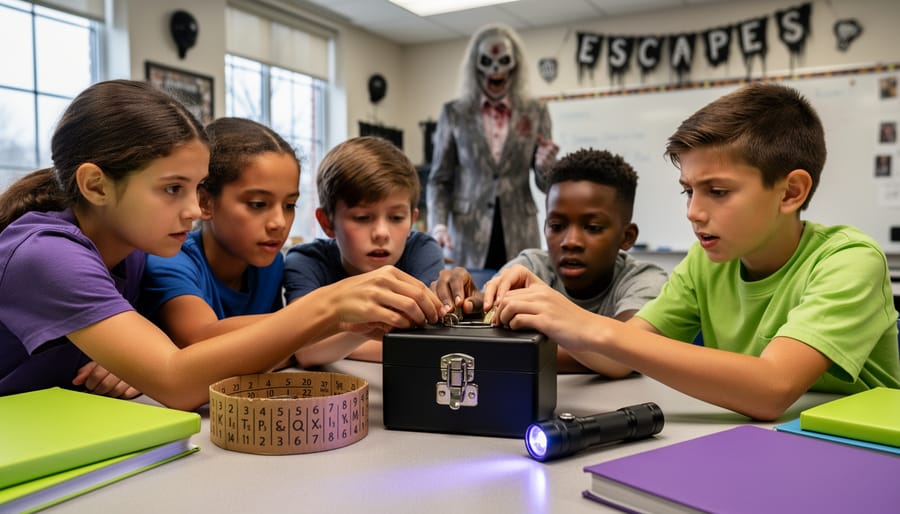
The Zombie Teacher escape room is an exciting, interactive learning experience that transforms your classroom into an adventure zone where students must solve puzzles to “escape” before the zombie teacher catches them. This engaging activity is part of the Classroom Game Toolkit framework, designed specifically to make review sessions memorable and fun.
Here’s the basic premise: students work together in teams to crack codes, solve riddles, and uncover clues hidden throughout the room. Each puzzle they solve brings them closer to freedom while reinforcing key concepts from your curriculum. The zombie theme adds just enough playful suspense to keep everyone motivated without being scary.
What makes this game so versatile is its flexibility across grade levels and subjects. While it works wonderfully for middle and high school students, you can easily adapt it for upper elementary classes too. Whether you’re teaching math, science, language arts, or social studies, the puzzles can be customized to match your content perfectly.
These escape room kits come with everything you need to get started, but the real magic happens when you make it your own. You can adjust difficulty levels, swap in your own questions, and modify the storyline to fit your classroom’s unique needs. The framework provides structure while giving you creative freedom to personalize the experience for your students, making test prep and review sessions something they’ll actually look forward to.
Understanding the Game Flow Before You Start
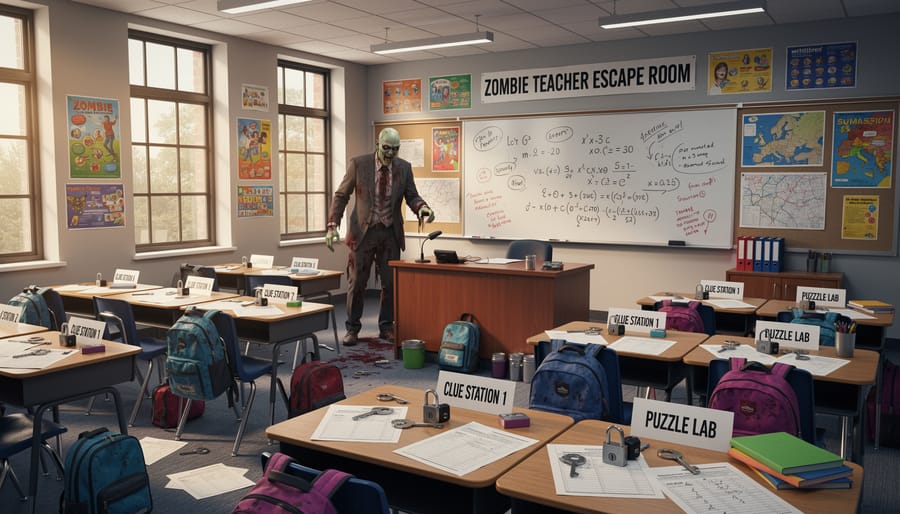
Before you dive into the specific answers, let’s talk about how this exciting game actually works! The Zombie Teacher escape room follows a clear progression that keeps your students engaged from start to finish.
Think of it as a linear adventure where each puzzle unlocks the next challenge. Your students will typically begin with an introductory scenario that sets the stage – maybe a teacher has been turned into a zombie and they need to find the antidote or escape the classroom before time runs out! The story creates urgency and motivation.
The game flow usually includes 4-6 interconnected puzzles that build upon each other. Students might start by cracking a code that reveals a hidden message, which then leads them to a locked box requiring a combination. Each solved puzzle provides clues or keys needed for the subsequent challenge. This sequential design prevents students from jumping ahead while ensuring everyone stays on track together.
Your role as the facilitator is to monitor progress and provide hints when groups get stuck. Understanding the complete puzzle sequence helps you determine whether students are struggling with the actual content or just need a gentle nudge in the right direction.
Most versions take 30-45 minutes to complete, making them perfect for a single class period. The ultimate goal is always the same: work collaboratively, solve all the puzzles, and achieve that thrilling escape before the timer runs out! Knowing this framework helps you see how individual answers fit into the bigger picture.
Complete Puzzle Solutions and Answers
Puzzle 1: The Classroom Code
The first puzzle typically involves cracking a numerical or letter code to unlock the classroom door. The answer usually requires students to solve a series of math problems or decode a cipher where each number corresponds to a letter.
Here’s the solution: Students need to identify clues hidden around your classroom (posters, books, or sticky notes you’ve placed) that reveal the code sequence. Most versions use a 4-digit combination like 2-7-3-9 or a word like “BRAIN” when decoded.
If your students are struggling, try these helpful hints without giving away the answer completely. First, remind them to look carefully at everything in the room, especially items that seem out of place. Ask guiding questions like “What do these numbers have in common?” or “Have you checked behind the poster?” You can also suggest they work together and divide up the searching tasks.
For younger students, consider simplifying the code to three digits instead of four, or provide a decoder key sheet. The goal is to challenge them while keeping the momentum fun and exciting. Remember, you can always customize the difficulty level to match your class’s abilities, making this puzzle perfect for any grade level.
Puzzle 2: The Science Lab Mystery
Ready to crack the Science Lab Mystery? This puzzle gets students thinking like real scientists! Here’s your step-by-step solution guide.
The core challenge involves matching chemical formulas to their common names. Students need to identify substances like H2O (water), NaCl (salt), and CO2 (carbon dioxide). The correct sequence reveals a three-digit code that unlocks the next stage.
Start by distributing the formula cards face-up on desks. Have students work in teams to match each formula with everyday items around your classroom. For example, point them toward a water bottle for H2O or the salt shaker if you have one handy. Once matched correctly, the numbers on the back of each card spell out 742.
Quick tip for customization: Adjust the difficulty by using simpler compounds for younger grades or adding more complex molecules for advanced students. You can even swap in formulas that connect to your current science unit!
If students get stuck, encourage them to use reference sheets or textbooks. This puzzle works beautifully as a review activity while keeping the excitement high. The zombie theme adds just enough urgency to keep everyone motivated and engaged throughout the challenge!
Puzzle 3: The Teacher’s Secret Message
This cipher puzzle is where the fun really heats up! The Teacher’s Secret Message typically uses a substitution cipher where each letter shifts by a specific number. The answer key usually reveals a phrase like “BRAINS ARE FOR THINKING NOT EATING” or “THE CURE IS IN THE LAB.”
To solve it, students need to identify the cipher type first. Most versions use a Caesar cipher with a shift of 3 or 5 positions. For example, if the shift is 3, A becomes D, B becomes E, and so on. The decoded message will point students toward their next clue location.
Having trouble? Here are quick troubleshooting tips: Make sure students are shifting in the correct direction (forward or backward in the alphabet). Double-check that they’re applying the shift consistently to every letter. If your class is struggling, offer a hint by revealing the first word or providing a cipher wheel as a visual aid.
Feel free to customize this puzzle by creating your own message that connects to your current lesson topic. You can adjust the difficulty by changing the shift number or mixing in additional cipher elements. The beauty of this puzzle is how easily you can adapt it to match your students’ skill levels while keeping the zombie theme exciting!
Puzzle 4: The Final Lock Combination
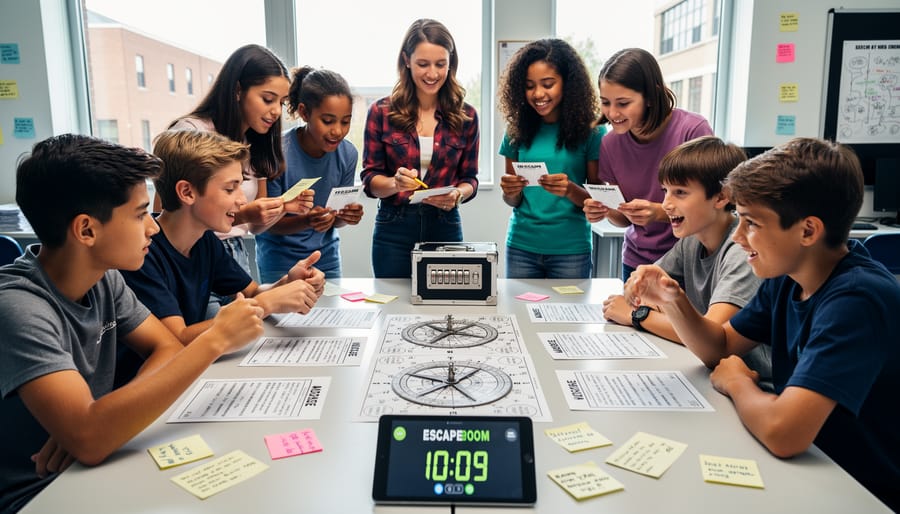
Here’s where everything comes together! The final lock combination is revealed by collecting clues from all three previous puzzles. Each puzzle provides one number, creating a three-digit code to unlock the escape door.
The typical sequence works like this: the periodic table puzzle reveals the first digit, the cipher provides the second, and the math word problems give you the third. Your students will need to reference their completed work from each station to piece together the combination.
For example, if your answer key shows 7 from the periodic table, 4 from the cipher, and 9 from the math problems, your final combination is 7-4-9. Once students enter this correctly, they’ve officially escaped the zombie apocalypse and saved the day!
This culminating moment is perfect for celebrating teamwork and problem-solving skills. Consider having a victory announcement ready or a small reward waiting outside the door. You can easily customize the final combination by adjusting any of the previous puzzle answers, making each classroom experience unique. Remember to write your specific combination clearly in your answer key so you can quickly help groups who get stuck at this exciting final step!
Bonus Challenges and Extensions
Want to really challenge your sharpest students? These bonus puzzles add an extra layer of excitement! For the Advanced Code Breaker challenge, the answer is “ANTIDOTE” using the Caesar cipher shifted by 3. The Hidden Message puzzle reveals “CHECK THE SUPPLY CLOSET” when students decode the invisible ink clues using their UV flashlights.
The Math Master extension requires solving three equations simultaneously, with the final combination being 7-4-9. For the Zombie Biology trivia round, answers include: the cerebellum controls movement, infection spreads through bodily fluids, and the incubation period is 24 hours.
These extensions work beautifully for differentiated instruction! You can assign them to early finishers or create a competitive element where teams race to complete bonus tasks for extra points. Feel free to swap in your own subject-specific questions to align with current curriculum topics. The beauty of these challenges is their flexibility—adjust difficulty levels to match your students’ abilities and watch engagement soar!
How to Use These Answers Effectively
Having the answers at your fingertips is great, but using them strategically makes all the difference in creating an amazing learning experience for your students. Think of the answer key as your secret teaching superpower rather than just a cheat sheet.
Before game day, review the answers thoroughly to understand the puzzle flow and spot any tricky spots where students might need guidance. This prep time lets you customize challenges to match your class’s skill level and gather any additional materials you might need. You’ll feel confident and ready to facilitate without constantly checking the key during gameplay.
During the activity, resist the urge to jump in with answers right away. Instead, use a tiered hint system. Start with gentle nudges like “Look carefully at the symbols” before revealing more specific clues. This approach keeps students engaged and maintains that satisfying aha moment when they solve puzzles themselves. Consider using Halloween classroom timers to add excitement while giving yourself natural checkpoints to assess which groups need support.
The answer key also works wonderfully for differentiation. Advanced groups can tackle puzzles independently while you provide scaffolded support to others. After the escape room, use the answers to facilitate meaningful discussions about problem-solving strategies and teamwork.
Remember, the goal is enhancing learning, not racing to finish. Your students will remember the journey of discovery far more than simply getting the right answers.

Customizing the Zombie Teacher Escape Room
One of the best features of the Zombie Teacher Escape Room is how easily you can adapt it to fit your unique classroom needs! Whether you’re teaching math, science, language arts, or social studies, you can swap out puzzle content while keeping the engaging zombie theme that students love.
Start by identifying which puzzles align best with your curriculum. The cipher puzzles work wonderfully for vocabulary or spelling practice—simply replace the original words with your current unit terms. Math teachers can adjust the number sequences to match concepts you’re currently covering, from basic operations to algebraic equations. The beauty of print your own classroom games is that modifications are simple and budget-friendly.
Adjust difficulty levels by changing the complexity of clues rather than the overall structure. For younger students, provide more direct hints or reduce the number of steps needed to reach answers. Challenge advanced learners by adding red herrings or requiring multi-step reasoning. This flexibility in making games work for all learners ensures everyone stays engaged.
The toolkit includes customizable answer sheets, so you can preview exactly what students will encounter and plan your facilitation accordingly. Keep a master answer key handy with your modifications noted clearly. This preparation lets you confidently guide students without breaking the immersive experience. Remember, the goal is engagement paired with learning—customize freely to achieve both!
Troubleshooting Common Student Mistakes
Even the most engaging escape rooms can leave students scratching their heads! Here’s where learners typically hit roadblocks and how you can help them push forward.
The most common stumbling block? Students often overthink the puzzles. They’ll breeze past simple solutions in search of something more complex. If you notice groups stuck for more than five minutes, ask guiding questions like “What information haven’t you used yet?” or “Are you looking at everything in the room?”
Watch for students who skip reading instructions carefully. Many wrong answers stem from misreading clues rather than misunderstanding concepts. Encourage them to read everything twice before attempting solutions.
Pattern recognition puzzles frequently trip up visual learners who focus on colors instead of shapes, or vice versa. Gently redirect their attention by asking “What else do you notice about these items?”
For combination locks, students often input correct numbers in the wrong order. Remind them that sequence matters without revealing the actual answer.
Remember, the goal is building problem-solving skills, not racing to finish. Celebrate their thinking process, even when they’re temporarily stuck. Sometimes the best hint is simply “You’re closer than you think—keep going!”
Now that you have the complete answer key at your fingertips, you’re ready to bring the Zombie Teacher escape room to life in your classroom! With these solutions, you can confidently guide students through challenges, offer helpful hints when they’re stuck, and ensure everyone has a successful and engaging experience. Remember, this activity isn’t just about solving puzzles—it’s building critical thinking skills, encouraging teamwork, and creating those memorable learning moments that students will talk about long after the bell rings.
Don’t stop here! Our toolkit collection features dozens of other escape room kits designed for different subjects, holidays, and themes. Each one offers the same customizable format that lets you tailor the experience to your students’ needs and your classroom goals. Whether you’re teaching math concepts, reinforcing reading skills, or celebrating seasonal events, there’s an escape room adventure waiting to energize your lessons and captivate your learners.