

Why Your K-6 Math Curriculum Isn’t Preparing Students for Middle School (And How to Fix It)
Bridge the gap between elementary foundations and middle school success by auditing your current K-6 curriculum against grade 7-8 standards. Identify the five most essential prerequisite skills students need—typically fractions, decimals, proportional reasoning, integers, and basic algebraic thinking—then build targeted intervention cycles into your existing instruction.
Create consistent vocabulary and problem-solving frameworks across all elementary grades so students enter middle school with unified mathematical language. When a third grader learns “numerator” and “denominator,” those same terms should carry through fifth grade and beyond, eliminating confusion during transitions.
Implement spiral review systems that revisit foundational concepts weekly rather than teaching units in isolation. Students forget up to 70% of content without regular reinforcement, making consistent practice more valuable than extended single-topic units. Use quick, engaging activities that take 10-15 minutes daily to maintain skill sharpness.
Collaborate vertically with middle school teachers to understand exactly where students struggle most. These conversations reveal hidden curriculum gaps—like insufficient experience with word problems or weak mental math—that traditional scope-and-sequence documents miss. Adjust your elementary instruction based on this real-world feedback to set students up for genuine middle school readiness rather than just checking off standards.
The Critical Gap Between Elementary and Middle School Math

What K-6 Students Should Master (But Often Don’t)
Just like foundational skills in early grades, certain math concepts form the building blocks for middle school success. When students move into grades 6-8 without mastering these essentials, they often struggle to keep up with more complex topics.
Here are the key skills your K-6 students need to truly own before middle school:
Number sense and place value understanding go beyond memorizing facts. Students should confidently compare numbers, estimate answers, and understand how digits relate to each other in different positions.
Fractions deserve special attention since they’re consistently challenging. Students need hands-on experience understanding what fractions represent, comparing them visually and numerically, and performing operations with confidence.
Decimals connect directly to fractions and money concepts. Make sure students can convert between forms, compare decimal values, and apply them to real-world situations.
Basic algebraic thinking starts early with patterns and relationships. Students should recognize number patterns, understand the equal sign as balance, and solve simple equations using reasoning.
Problem-solving strategies matter just as much as computation. Teach students to break down word problems, identify relevant information, choose appropriate operations, and check their answers for reasonableness.
The good news? These skills can be reinforced through engaging practice and customized review activities that meet students exactly where they are. Game-based learning makes repetition feel fresh and keeps motivation high as students build confidence with each concept.
Where Traditional K-6 Curricula Fall Short
Many elementary math programs create unintentional roadblocks for students heading into middle school. One major issue? Surface-level coverage that touches on concepts without building true understanding. Students might memorize multiplication facts but struggle to apply them in multi-step word problems or real-world situations.
Another common gap involves problem-solving depth. Traditional curricula often focus on procedural skills—following steps to get an answer—without encouraging students to think critically about why those steps work. This leaves middle schoolers unprepared for the analytical thinking required in higher math.
Fraction fluency is frequently underdeveloped too. While students learn basic fraction operations, they don’t always grasp the conceptual foundation needed for algebra and pre-algebra. Similarly, measurement, geometry, and data analysis often receive minimal attention compared to computation skills.
The good news? Recognizing these gaps is the first step toward bridging them! By understanding where students need extra support, you can customize your approach and incorporate engaging review activities that build confidence. When students have opportunities to practice concepts in fun, low-pressure ways, those tricky topics become much more manageable and prepare them beautifully for what’s ahead.
Building Bridges: Strengthening K-6 Math for Middle School Success
Focus on Conceptual Understanding Over Memorization
Here’s the truth: when students genuinely understand why math works, they can tackle new problems confidently instead of panicking when they forget a memorized rule. Think of it this way – memorizing that multiplication is repeated addition is helpful, but understanding that 4 x 6 means “four groups of six” gives students a mental picture they can apply anywhere.
In upper elementary grades, try having students explain their thinking out loud. When teaching fractions, instead of just drilling procedures, ask students to draw models showing why 1/2 equals 2/4. Have them use manipulatives to demonstrate equivalent fractions physically. This hands-on exploration builds real understanding.
For multi-digit multiplication, encourage students to break problems apart using area models or the distributive property. When they see that 23 x 5 can become (20 x 5) + (3 x 5), they’re not just following steps – they’re understanding the structure of numbers.
Make it fun by turning conceptual exploration into games where students compete to explain concepts in the most creative ways. The beauty of deep understanding is that it sticks. Students who truly grasp concepts can reconstruct forgotten procedures and adapt their knowledge to new situations, setting them up for middle school success.
Introduce Pre-Algebra Thinking Early
Great news—you don’t need to wait until middle school to introduce algebraic thinking! When you weave these concepts into your K-6 lessons naturally, students build powerful reasoning skills without even realizing it.
Start simple by using boxes or question marks in place of numbers in early grades. Instead of just “3 + 4 = 7,” try “3 + ? = 7.” This helps young learners think flexibly about numbers and operations. As students progress, encourage them to find patterns in number sequences and explain what comes next and why.
Make it interactive by having students create their own “guess my rule” games where they identify patterns in input-output tables. This is algebraic thinking in action, and kids love the detective work involved!
Balance scales are another fantastic tool for introducing equation-solving concepts. Students can physically see how keeping things equal works, which builds intuition for solving equations later.
The key is keeping it playful and concrete. Use real objects, drawings, and relatable situations. When students see algebra as an extension of the math they already know rather than something completely new and scary, they’ll approach middle school math with confidence and curiosity.
Master Fractions and Ratios Thoroughly
Here’s the truth: fractions and ratios are absolute game-changers for middle school success. When students arrive in grade 6 without solid fraction foundations, they struggle with everything from pre-algebra to problem-solving. These concepts aren’t just isolated skills—they’re the building blocks for equations, proportions, and advanced math thinking.
So how do you ensure mastery before middle school? Start early and keep it visual! Use manipulatives like fraction bars and pie models in grades 3-4, then gradually move toward abstract thinking. Focus on equivalence first—students who truly understand why 1/2 equals 2/4 will grasp more complex operations later.
The key is regular practice with immediate feedback. Students need multiple opportunities to work with fractions in different contexts: comparing, adding, multiplying, and converting to decimals. Make it engaging through games and interactive activities that let them see their progress. When students can confidently explain why their answer makes sense, not just recite procedures, you know they’ve achieved real mastery. This deep understanding transforms fractions from a feared topic into a confidence-builder that propels them through middle school math with ease.
Making Review Fun: Game-Based Learning for Math Mastery
Why Games Work for Math Review
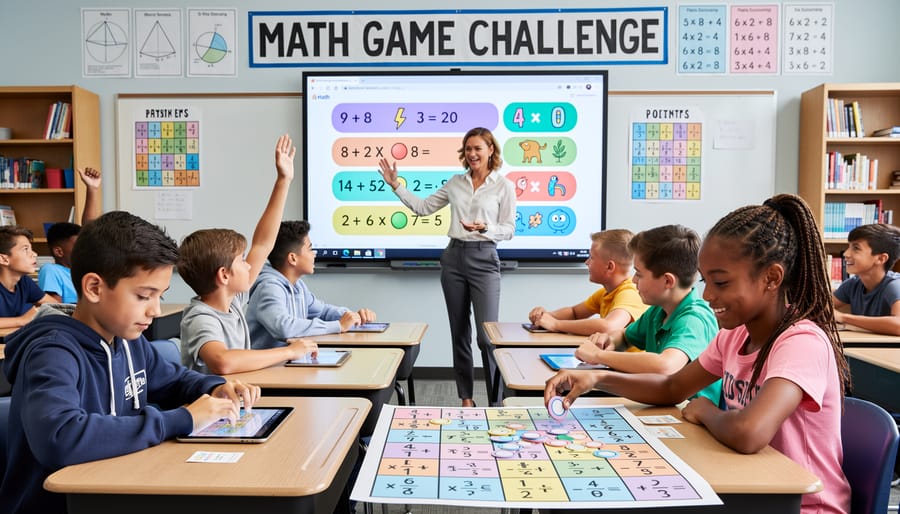
Games aren’t just fun—they’re powerful learning tools that help students truly master K-6 math concepts. When kids play math games, they practice skills in a low-pressure environment where mistakes become learning opportunities rather than failures. This repetition builds both competency and confidence, two essential ingredients for middle school success.
What makes game-based learning especially valuable is its ability to reveal exactly where students are struggling. As you watch your class play, you’ll quickly spot who needs extra support with fractions, multiplication facts, or word problems. This real-time feedback helps you address gaps before they widen in later grades.
Games also give students immediate feedback on their understanding, helping them self-correct and improve without the anxiety that sometimes accompanies traditional assessments. Plus, when you turn curriculum standards into games, you’re meeting students where they are—engaged, motivated, and ready to learn. The best part? You can customize games to target specific skills your students need most, making review time both productive and enjoyable for everyone involved.
Best Topics to Gamify for Middle School Prep
Ready to transform review time into your students’ favorite part of the day? Some math concepts practically beg to be gamified, especially in grades 4-6 when students need solid mastery before middle school.
Multiplication and division facts top the list. By fourth grade, automaticity with these operations becomes essential for tackling more complex problems. Games create low-pressure repetition that builds fluency without the worksheet fatigue. You can customize difficulty levels to meet individual needs while keeping the whole class engaged.
Fraction operations deserve serious game time too. Adding, subtracting, multiplying, and dividing fractions trips up countless students entering middle school. Game-based review strategies help students practice these tricky concepts repeatedly until they click. The visual feedback and immediate reinforcement games provide work wonders for fraction confidence.
Don’t overlook decimal operations and place value either. These foundational skills support everything from money math to scientific notation in later grades. Games make comparing, rounding, and computing with decimals feel less intimidating.
Problem-solving strategies benefit hugely from gamification too. Multi-step word problems, logic puzzles, and measurement challenges become adventures rather than obstacles. The motivation factor alone makes games worth it, but add in the customization options where you can target exactly what your students need to practice, and you’ve got a winning combination for middle school readiness.
Assessment Strategies That Reveal True Readiness
Quick Diagnostic Activities
Catching gaps early makes all the difference! Try these quick, no-prep diagnostic activities that take just 10-15 minutes but reveal so much about where your students really stand.
Start with a Number Talk routine a few times per week. Present a problem like 25 x 4 and ask students to solve it mentally, then share their strategies. You’ll immediately see who understands place value, multiplication relationships, and flexible thinking versus who’s still relying on memorization alone.
Use Exit Tickets with purposefully designed problems. Instead of asking students to simply solve 3/4 + 1/2, ask them to draw a model showing why their answer makes sense. This reveals conceptual understanding rather than just procedural knowledge.
Try Error Analysis activities where students identify and explain mistakes in sample work. Can they spot why someone got the wrong answer when dividing fractions? This shows deeper comprehension.
Create a simple Skill Inventory Checklist covering essential concepts like fraction operations, decimal place value, and multi-digit multiplication. Have students self-assess with green, yellow, or red dots, giving you an instant visual of who needs support. These quick checks help you customize your instruction and identify students who’ll benefit from extra practice before middle school challenges begin.
Red Flags to Watch For
Keep an eye out for these telltale signs that a student might need extra support before moving to middle school math. If you notice a child still counting on fingers for basic addition or subtraction beyond grade 3, that’s a signal to step in. Watch for students who struggle to explain their thinking or can only solve problems one way. Difficulty with word problems, especially determining which operation to use, is another common warning sign. Students who rely heavily on calculators for simple computations or can’t estimate reasonable answers may lack number sense. You might also spot kids who panic when faced with fractions or can’t identify basic shapes and their properties. The good news? Catching these gaps early makes all the difference! Just like early intervention strategies work wonders for reading, timely math support helps students build confidence and competence before middle school challenges arrive.

Collaborating Across Grade Levels for Smoother Transitions
One of the most powerful ways to smooth the transition from elementary to middle school math is creating opportunities for teachers across grade levels to talk and plan together. When you connect with colleagues teaching the grades before and after yours, everyone wins—especially your students!
Start by organizing informal meetups or quick collaboration sessions where elementary and middle school teachers can share what’s working and what challenges they’re seeing. Fifth-grade teachers can give sixth-grade teachers a heads-up about concepts students struggled with, while middle school teachers can share which skills they wish incoming students had mastered better. These conversations help identify exactly where the gaps are forming.
Consider creating a shared document or checklist that outlines essential skills students should have by the end of each grade level. This living resource keeps everyone on the same page and makes it easy to spot where curriculum adjustments might help. You might discover that certain topics need more practice time in fifth grade or that some concepts could be introduced earlier than expected.
Team up to share teaching strategies and resources that work well for transitional concepts. Maybe the sixth-grade teacher has a fantastic way to explain fractions that would benefit fifth graders, or perhaps the elementary team uses engaging games that could reinforce skills for struggling middle schoolers.
Remember, collaboration doesn’t have to be time-consuming or formal. Even brief check-ins during planning periods or quick emails sharing observations can make a meaningful difference in supporting student success across grade levels.
You have the power to transform your students’ math journey! Every lesson you teach in elementary school creates building blocks for middle school success. By intentionally targeting foundational skills like fractions, decimals, and number sense, you’re setting students up to thrive in algebra and beyond.
The good news? Small, consistent efforts make a huge difference. When you weave review opportunities into your daily routine and focus on conceptual understanding alongside procedures, you’re bridging those common gaps that frustrate middle school teachers.
Here’s your challenge: Start tomorrow by incorporating more engaging review methods into your classroom. Try game-based activities that let students practice essential skills in fun, low-pressure ways. Customize your approach to meet your unique students where they are. Remember, you’re not just teaching math concepts—you’re building confident, capable problem-solvers ready to tackle whatever comes next. Your intentional instruction today creates middle school success stories tomorrow!